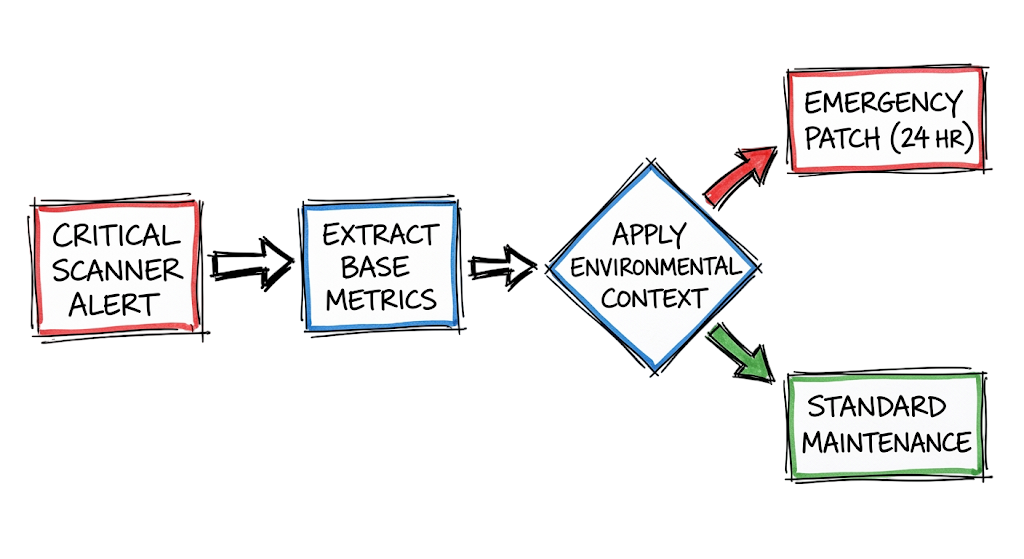
It is Friday afternoon and your vulnerability scanner just dumped five hundred critical alerts into your queue. You have three hours to decide which ones require an emergency weekend patch and which ones can wait until standard maintenance hours. This situation plays out in security operations centers every week.
In this CVSS Scores Explained with Real Vulnerability Examples (2026 Guide), you will learn how security teams use CVSS severity ratings and CVSS base metrics to translate vulnerability scores into practical patching decisions. Understanding the scoring framework helps analysts focus on the issues that create the highest risk.
Many organizations waste valuable engineering time chasing low-risk findings because they do not fully understand vulnerability severity ratings. A critical remote code execution vulnerability may deserve immediate attention, while lower-risk findings can often wait for a scheduled update cycle.
This guide explains how to interpret scores, evaluate real-world risk, and use modern vulnerability management platforms to prioritize remediation efforts more effectively.
What Is CVSS Scores Explained with Real Vulnerability Examples?
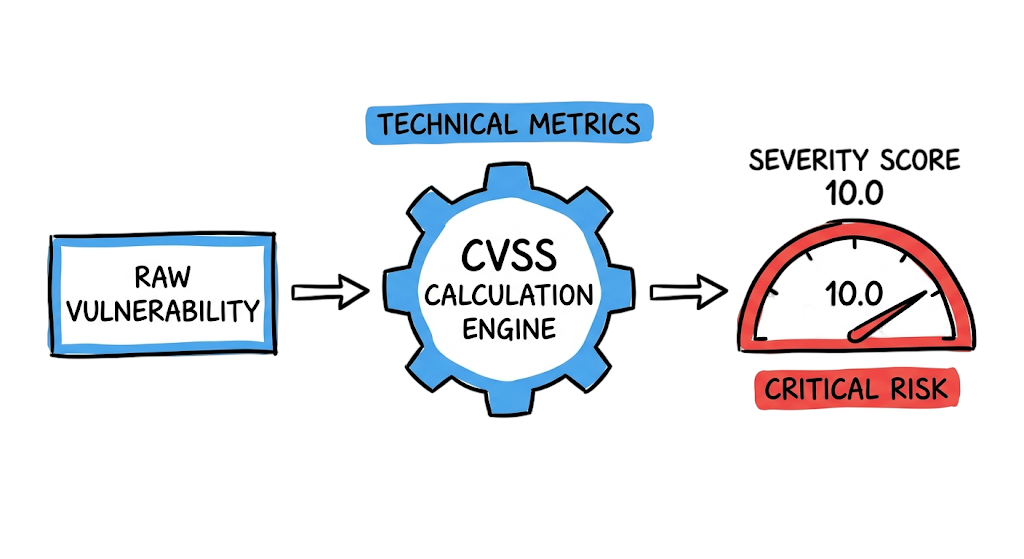
The Common Vulnerability Scoring System provides a mathematical framework for measuring the severity of security flaws in software and hardware. It translates the technical characteristics of a vulnerability into a standardized numerical score between zero and ten using defined CVSS base metrics.
Organizations use CVSS severity ratings to understand the immediate danger a flaw presents to their infrastructure. Higher scores indicate vulnerabilities that are easier to exploit and capable of causing greater damage. For example, a remote code execution vulnerability often receives a high or critical score because attackers can take control of affected systems.
The Forum of Incident Response and Security Teams maintains this open framework to ensure security professionals worldwide evaluate threats using the same criteria. Before CVSS existed, vendors relied on their own definitions of critical, high, medium, and low severity.
This lack of consistency made it difficult for engineers to prioritize vulnerabilities across different operating systems, applications, and security products. Today, CVSS serves as a foundation for vulnerability management platforms, helping organizations assess risk, prioritize patching, and communicate security findings more effectively.
How CVSS Severity Ratings Work
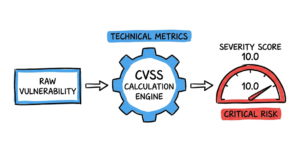
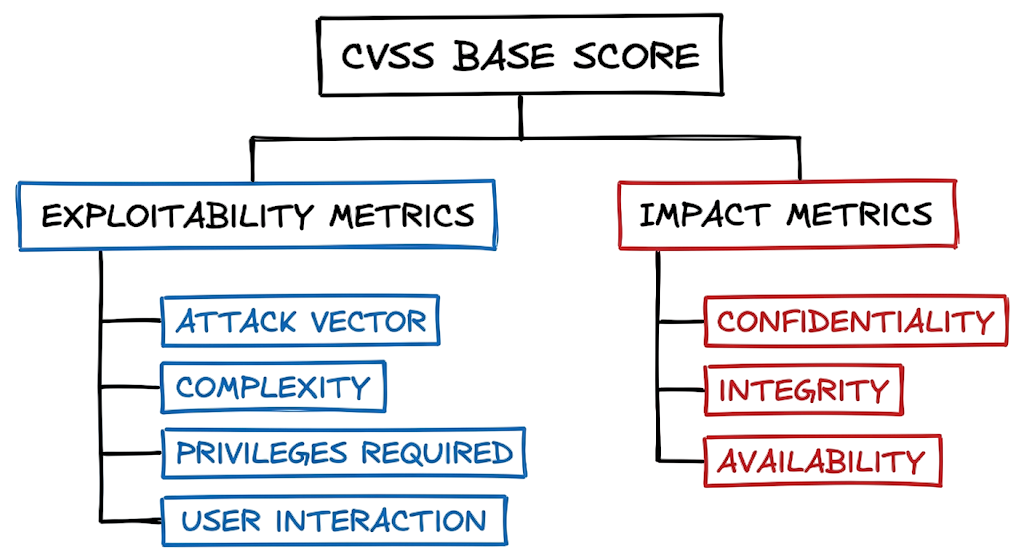
The scoring engine calculates severity by evaluating multiple technical metrics at the same time. These CVSS base metrics help security teams measure both exploitability and potential business impact.
The formula first examines the attack vector. It determines whether an attacker can exploit the vulnerability remotely over a network or if local or physical access is required. Vulnerabilities that can be exploited remotely generally receive higher CVSS severity ratings because they are easier for attackers to target.
Next, the system evaluates attack complexity. If exploitation requires rare conditions, specialized knowledge, or unusual configurations, the overall score decreases. Simpler attacks typically receive higher scores because they are easier to execute.
The framework also measures the privileges required to exploit the flaw. If an attacker needs administrative credentials, the score is reduced. However, vulnerabilities that allow unauthenticated access or remote code execution often receive critical severity ratings.
User interaction is another important factor. Vulnerabilities that require a victim to click a malicious link or open a file usually receive lower scores than attacks that can be executed automatically.
The impact assessment focuses on confidentiality, integrity, and availability. A vulnerability receives a higher score when attackers can steal sensitive information, modify data, or disrupt business operations.
The system also considers scope. Scope changes occur when a vulnerability in one component allows an attacker to compromise another security boundary. For example, escaping from a virtual machine and gaining control of the underlying host significantly increases the severity score.
The final result is a standardized score between 0.0 and 10.0. Security teams and vulnerability management platforms use this score to prioritize remediation and focus on the most dangerous threats first.
CVSS Scores Explained with Real Vulnerability Examples
When I was working on a major incident response engagement during the Log4Shell outbreak, my team stared down thousands of identical scanner alerts across three different data centers. We needed to understand exactly why the scanner demanded immediate action.
JSON
{
  "vulnerability": "CVE-2021-44228",
  "severity": "CRITICAL",
  "cvss_v3_score": 10.0,
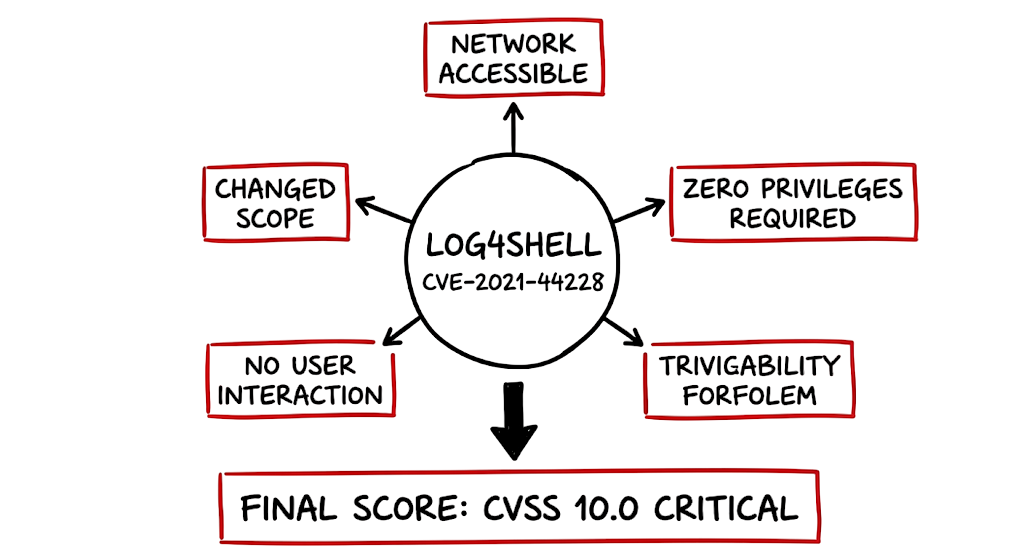
  "vector": "CVSS:3.1/AV:N/AC:L/PR:N/UI:N/S:C/C:H/I:H/A:H",
  "description": "Apache Log4j2 JNDI features do not protect against attacker controlled LDAP and other JNDI related endpoints.",
  "remediation": "Upgrade to Log4j 2.15.0 or higher immediately."
}
This output shows a perfect ten out of ten base score. The vector string explains exactly why this vulnerability reached the maximum severity level possible. The network attack vector component means anyone on the internet can send a malicious payload to your application. The zero privileges and zero user interaction components confirm the attacker needs no credentials and no help from a victim to execute their malicious code. The changed scope metric proves the attacker can use the logging library to compromise the underlying host operating system completely.
Common CVSS Base Metrics and Scoring Techniques
Attackers exploit vulnerabilities using several techniques that directly influence CVSS severity ratings. Understanding these attack methods helps security teams prioritize vulnerabilities based on real-world risk rather than relying solely on numerical scores.
One of the most dangerous techniques is remote code execution. When attackers discover a vulnerability with a network attack vector and low attack complexity, they can send specially crafted requests to execute malicious commands on a target system. Because these attacks often require no authentication, they frequently receive critical CVSS scores.
Another common technique involves memory corruption vulnerabilities such as buffer overflows. Attackers manipulate application memory to alter program execution and run malicious code. Successful exploitation can lead to data theft, system compromise, or service outages.
Local privilege escalation is another frequently observed attack method. In this scenario, attackers begin with limited user access and exploit a vulnerability to gain administrative privileges. Once elevated permissions are obtained, they can disable security controls, install malware, and access sensitive resources.
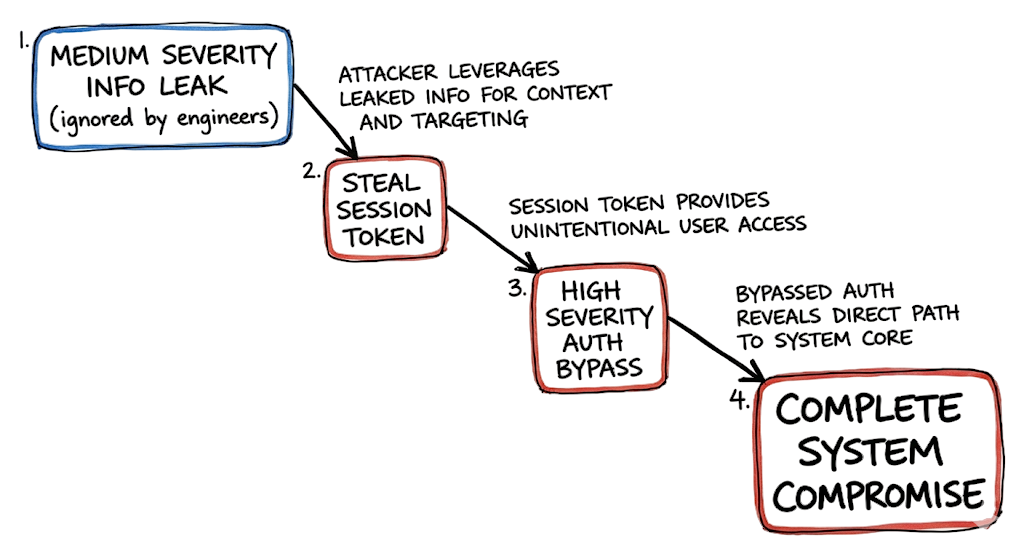
Attackers rarely rely on a single vulnerability. Instead, they often chain multiple weaknesses together. A medium-severity information disclosure flaw may expose a valid session token, while a second vulnerability allows authentication bypass or unauthorized access.
This is why security teams should not ignore medium-risk findings. Modern vulnerability management platforms frequently analyze attack paths because multiple lower-rated vulnerabilities can create a much larger security risk when combined. Understanding these relationships helps organizations prioritize remediation more effectively and reduce overall exposure.
Detection Methods for High-Risk CVSS Vulnerabilities
Detecting exploitation attempts requires correlating vulnerability findings with network logs, endpoint telemetry, and security monitoring data. While CVSS severity ratings help identify risky vulnerabilities, organizations must also determine whether attackers are actively attempting to exploit them.
Security analysts should monitor logging platforms for unusual child processes, suspicious command execution, and unexpected application behavior. Vulnerabilities associated with remote code execution often leave traces in process creation logs, endpoint alerts, and network traffic records.
If a vulnerability has a high availability impact, teams should configure alerts for abnormal CPU utilization, memory consumption, service interruptions, and unexpected application crashes. These indicators can reveal active exploitation attempts or failed attack activity.
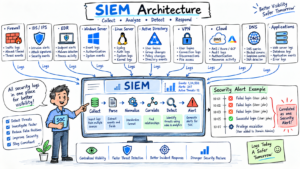
Many organizations misunderstand the role of vulnerability scanners. A scanner identifies weaknesses and calculates risk using CVSS base metrics, but it does not confirm whether an attack is occurring. Security teams need Endpoint Detection and Response solutions, SIEM platforms, and web application firewalls to detect real-world exploitation activity.
Analysts should also map vulnerability impacts to specific log sources. For example, if a vulnerability enables unauthorized file access, file auditing logs should be reviewed for unusual access patterns. This approach allows vulnerability management platforms and security monitoring tools to work together, providing better visibility into both exposure and active threats.

Business Impact of Critical CVSS Scores
Consider a practical scenario in the Indian banking sector. A public-facing customer transaction portal contains a critical vulnerability with a high confidentiality impact. According to its CVSS severity rating, the flaw requires immediate remediation because attackers can exploit it remotely with minimal effort.
If a threat actor successfully exploits this remote code execution vulnerability, they could gain unauthorized access to backend databases containing millions of customer financial records. The exposure may include account balances, payment information, customer details, and other sensitive banking data.
The business consequences extend far beyond the technical compromise. Financial institutions in India must follow strict cybersecurity and vulnerability management requirements. A successful breach can trigger regulatory investigations, mandatory incident reporting, and significant financial penalties.
Security teams may also need to notify affected customers, conduct forensic investigations, and perform large-scale remediation activities. During this period, development projects and operational initiatives are often delayed while resources focus on incident response and recovery.
This example demonstrates why organizations should not rely solely on technical metrics. While CVSS base metrics measure the severity of a vulnerability, the actual business impact can include financial losses, compliance violations, legal challenges, and long-term reputational damage.
For executives and security leaders, understanding the relationship between vulnerability severity and business risk is essential. A critical vulnerability is not just a technical issue. It can become a major operational, financial, and regulatory event that affects the entire organization.
CVSS Vulnerability Prevention Best Practices
Effective patch management requires more than simply sorting vulnerabilities by their CVSS severity ratings. Security teams should evaluate the environmental context of each finding before scheduling emergency maintenance or downtime.
A high-severity vulnerability on an isolated test server may present less risk than a medium-severity vulnerability affecting a public-facing payment portal. This is why organizations should combine CVSS base metrics with asset criticality, business impact, and internet exposure when prioritizing remediation efforts.
You should also determine whether a working exploit exists for the vulnerability. If security researchers or threat actors have released public exploit code, the risk increases significantly. In many cases, active exploitation can justify accelerated patching even when the raw CVSS score is not critical.
Network segmentation is another important defense strategy. Placing sensitive systems on restricted internal networks reduces exposure and limits attack opportunities. Proper segmentation, firewall controls, and access restrictions can reduce the likelihood of successful remote code execution attacks while giving engineering teams additional time to deploy vendor fixes.
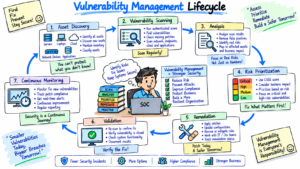
After applying patches, always verify the remediation results. Many vulnerability management platforms support authenticated scanning to confirm that vulnerabilities have been fully resolved. A successful deployment status does not always guarantee effective remediation.
Some fixes require service restarts, configuration changes, registry modifications, or additional hardening steps. Security teams should validate the patch directly on the affected asset and perform follow-up scans to ensure the vulnerability no longer exists. Verification is a critical step in any mature vulnerability management program.
Security Tools That Use CVSS Scores for Vulnerability Management
Several vulnerability management platforms help organizations operationalize CVSS severity ratings and prioritize remediation activities. These tools combine vulnerability detection, asset visibility, and risk analysis to improve patch management decisions.
Tenable Nessus is widely used for infrastructure vulnerability scanning across enterprise networks. It identifies missing patches, configuration weaknesses, and known vulnerabilities while providing risk assessments based on CVSS base metrics. It performs well in traditional on-premises environments but may require additional integrations for dynamic cloud and container workloads.
Qualys VMDR offers continuous asset discovery and vulnerability assessment across hybrid environments. Its agent-based approach provides ongoing visibility into endpoints, servers, and cloud resources. The platform excels in large-scale deployments, although advanced reporting and query functions can require additional training.
Rapid7 InsightVM focuses on risk-based prioritization by combining vulnerability data with exploitability information and asset context. This approach helps security teams identify vulnerabilities that are most likely to be targeted by attackers. Proper tuning is often necessary to reduce noise and improve alert quality.
Microsoft Defender Vulnerability Management integrates directly with Microsoft security products and endpoint sensors. It enables organizations to identify software weaknesses, monitor exposure levels, and track remediation progress without relying entirely on scheduled network scans.
Organizations should remember that different tools may assign slightly different risk priorities to the same vulnerability. Factors such as threat intelligence, exploit availability, and proprietary detection methods can influence the results. For this reason, security teams should establish a single source of truth for reporting and remediation tracking.
The goal is not simply to collect vulnerability data. Effective programs use CVSS severity ratings, business context, and threat intelligence together to make consistent remediation decisions and reduce overall risk.
FAQ About CVSS Scores Explained with Real Vulnerability Examples
Q: What is a good CVSS score?
A: Lower scores pose significantly less risk to your environment. Vulnerabilities scoring below 4.0 typically require standard maintenance patching over a thirty day window. Scores above 9.0 demand emergency remediation and immediate incident response review.
Q: Is a score of 7.5 considered critical?
A: No. A score of 7.5 falls firmly into the High severity category based on the official framework guidelines. Critical vulnerabilities strictly begin at 9.0 and go up to the absolute maximum of 10.0.
Q: Who actually assigns these severity numbers?
A: Security researchers and software vendors calculate the initial base scores during the disclosure process. The National Vulnerability Database reviews these calculations and publishes the official finalized metrics for public reference.
Q: Does a score of 10.0 mean attackers are currently exploiting my network?
A: A perfect ten indicates the absolute maximum potential technical danger of the software flaw. It does not mean active exploitation is currently happening on your specific servers or applications.
Q: Why do base scores and environmental scores differ?
A: The base score represents the raw technical danger of the vulnerability in a vacuum without any external factors. The environmental score adjusts that number down based on your specific network segmentation and compensating security controls.
Conclusion: Using CVSS Scores to Prioritize Vulnerabilities
The scoring framework gives your security team a standardized method for evaluating technical risk through CVSS severity ratings and CVSS base metrics. As explained throughout this CVSS Scores Explained with Real Vulnerability Examples (2026 Guide), the score should be used as a starting point rather than the final decision factor.
Organizations should combine CVSS data with threat intelligence, asset criticality, business impact, and exploit availability to build an effective vulnerability management strategy. Open your vulnerability management console today and filter critical vulnerabilities by internet exposure, active exploitation, and remote code execution risk. This approach helps your team focus on the vulnerabilities that require immediate attention and reduce overall organizational risk more efficiently.
For additional cybersecurity learning, explore these related guides:
- What Is Cybersecurity and Why It Is Important Today
https://technaga.com/what-is-cybersecurity-and-why-it-is-important-today/ - Complete Network Security Basics Guide for Beginners 2026
https://technaga.com/what-is-networks-and-network-security-basics-2026/ - What is Firewall in Cybersecurity? Types, Examples and How it Works in 2026
https://technaga.com/firewall-in-cybersecurity-types-examples-explained/ - Essential Endpoint Security Guide 2026 for Every Organization
https://technaga.com/endpoint-security-2026-guide/ - Network Segmentation Explained with Real-World Example
https://technaga.com/network-segmentation-guide-ransomware-prevention/ - Security Information and Event Management: Complete SIEM Guide 2026
https://technaga.com/security-information-and-event-management-2026/ - Best SOC Analyst Roadmap 2026: Complete Guide to L1, L2, L3 Roles, Skills, and Tools
https://technaga.com/complete-soc-analyst-roadmap-2026/ - Top 10 Cybersecurity Best Practices for 2026
https://technaga.com/top-10-cybersecurity-best-practices-2026/ - Cloud Security Basics 2026: Complete Beginner Guide
https://technaga.com/cloud-security-basics-2026/ - Zero Trust Security in 2026: Architecture, Real Examples, and Implementation Guide
https://technaga.com/zero-trust-security-2026-guide/ - Critical API Security Risks in the Cloud and Best Practices for 2026
https://technaga.com/api-security-cloud-risks-best-practices-2026/ - Cloud Misconfiguration: 10 Critical Errors Leading to Data Breaches in 2026
https://technaga.com/cloud-misconfiguration-data-breaches-2026/ - Identity and Access Management in 2026: A Practical Guide for Cloud Security Professionals
https://technaga.com/identity-and-access-management-cloud-security-2026/ - Multi-Factor Authentication (MFA): Critical Guide to Secure Your Systems (2026)
https://technaga.com/multi-factor-authentication-mfa-guide-2026/ - How to Identify Phishing Attacks in 2026 (Complete Guide)
https://technaga.com/how-to-identify-phishing-attacks-in-2026/
Additional Resources
For further reading on CVSS, vulnerability management, CVE tracking, and risk assessment, explore these authoritative resources:
- FIRST CVSS Documentation
https://www.first.org/cvss/ - National Vulnerability Database (NVD)
https://nvd.nist.gov/ - MITRE CVE Program
https://www.cve.org/ - CISA Known Exploited Vulnerabilities Catalog
https://www.cisa.gov/known-exploited-vulnerabilities-catalog - NIST National Vulnerability Database Severity Metrics
https://nvd.nist.gov/vuln-metrics/cvss - OWASP Vulnerability Management Guide
https://owasp.org/www-community/Vulnerability_Management - NIST Cybersecurity Framework (CSF)
https://www.nist.gov/cyberframework - Microsoft Defender Vulnerability Management Documentation
https://learn.microsoft.com/en-us/defender-vulnerability-management/ - Tenable Vulnerability Management Resources
https://www.tenable.com/cyber-exposure - Qualys VMDR Documentation
https://www.qualys.com/vmdr/ - Rapid7 InsightVM Documentation
https://docs.rapid7.com/insightvm/ - CISA Vulnerability Response Playbooks
https://www.cisa.gov/resources-tools/resources/cisa-cybersecurity-incident-vulnerability-response-playbooks - NIST Vulnerability Management Guidelines
https://csrc.nist.gov/projects/risk-management - OWASP Top 10 Web Application Security Risks
https://owasp.org/www-project-top-ten/ - CERT Coordination Center Vulnerability Notes Database
https://www.kb.cert.org/vuls/