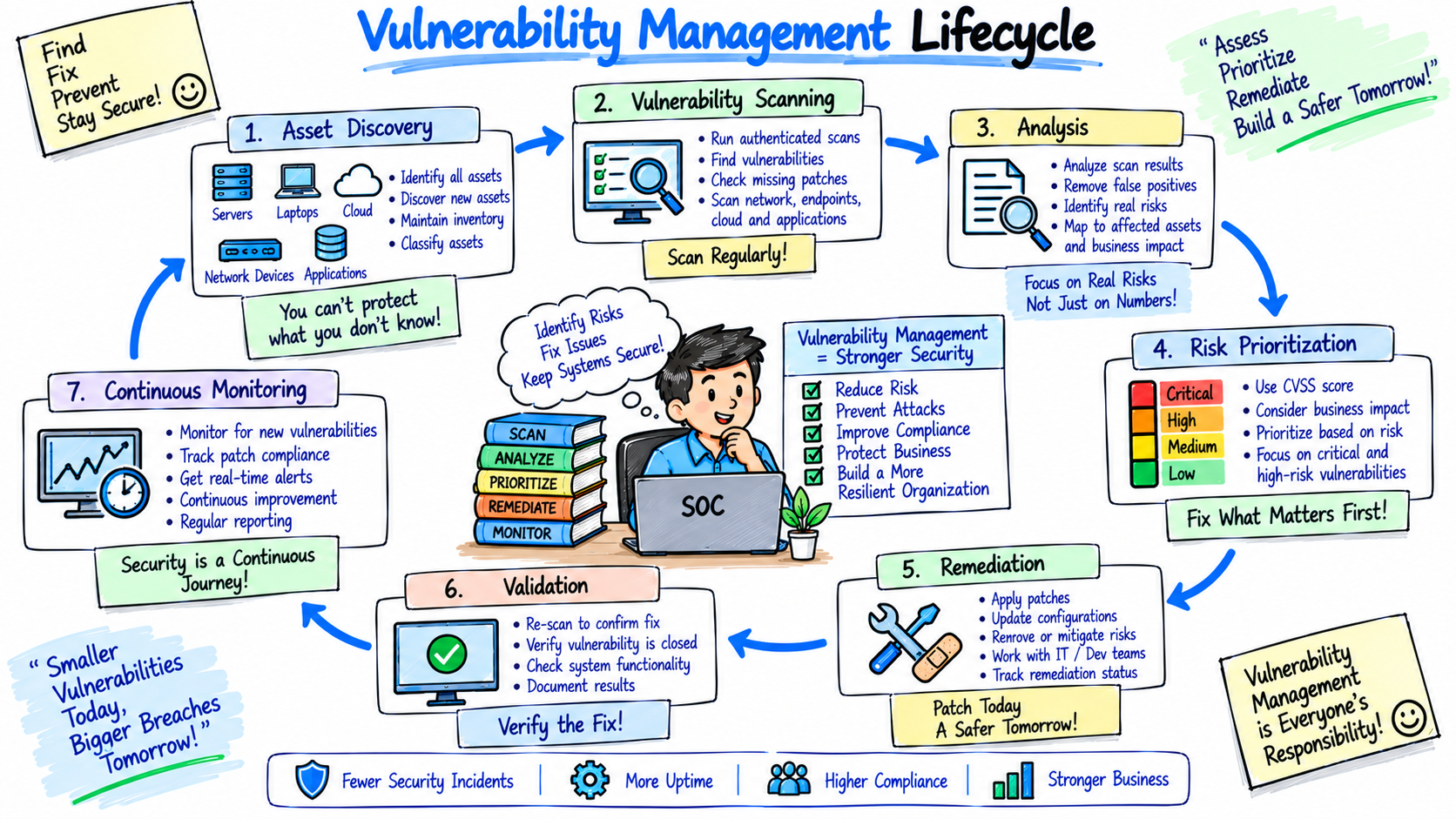
Vulnerability management is a core cybersecurity process used to identify, assess, prioritize, remediate, and continuously monitor security weaknesses across systems, applications, networks, cloud environments, and endpoints.
If you are preparing for a Vulnerability Management Analyst, SOC Analyst, Cybersecurity Analyst, Security Engineer, Security Operations, or Vulnerability Management interview, you should understand the complete vulnerability management lifecycle and how security teams handle vulnerabilities in real-world environments.
This guide covers 50 Vulnerability Management Interview Questions and Answers 2026, including vulnerability scanning, CVE, CVSS, asset discovery, risk prioritization, remediation, patch management, false positives, vulnerability validation, threat intelligence, application security, cloud vulnerabilities, and practical interview scenarios.
1. What is Vulnerability Management?
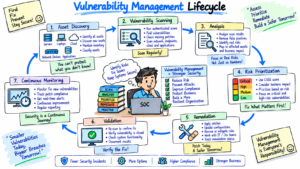
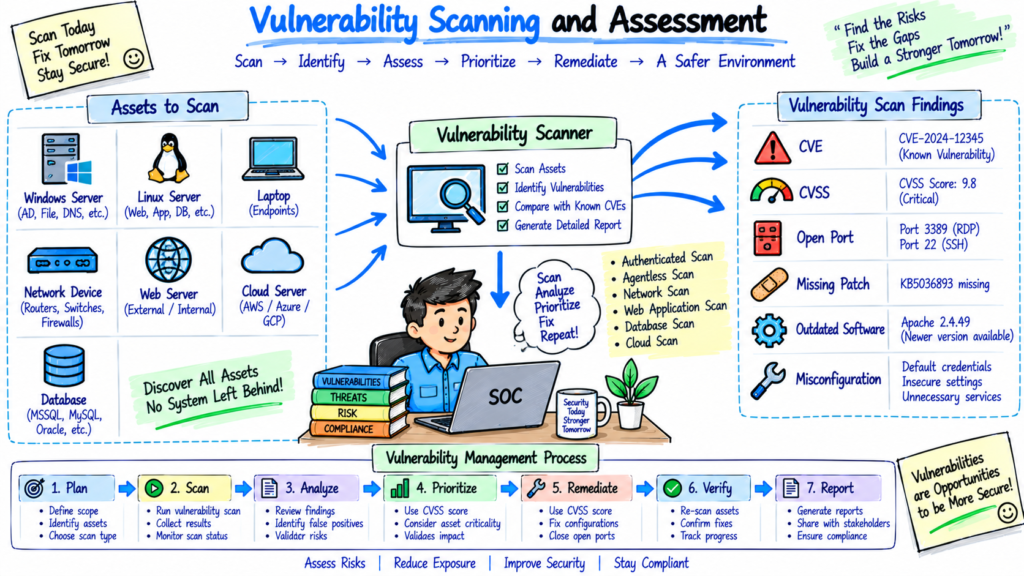
Vulnerability management is the continuous process of identifying, evaluating, prioritizing, remediating, and monitoring security vulnerabilities in an organization’s environment.
A typical vulnerability management lifecycle is:
Asset Discovery → Vulnerability Scanning → Analysis → Risk Prioritization → Remediation → Validation → Continuous Monitoring
Vulnerability management helps organizations reduce their exposure to security threats.
Vulnerability Management Interview Questions and Answers 2026
2. What is a vulnerability?
A vulnerability is a weakness or flaw in a system, application, network, configuration, or process that could potentially be exploited by an attacker.
Examples include:
- Unpatched software
- Weak passwords
- Misconfigured services
- Outdated operating systems
- Insecure application code
- Excessive permissions
- Exposed network services
- Cloud misconfigurations
For example, an outdated web server containing a known exploitable vulnerability represents a security risk.
3. What is the difference between a vulnerability, threat, and risk?
These terms describe different concepts.
Vulnerability
A weakness that can potentially be exploited.
Threat
A person, group, event, or condition capable of exploiting a vulnerability.
Risk
The potential impact and likelihood associated with a threat exploiting a vulnerability.
A simple example:
Vulnerability: Unpatched web server
Threat: Attacker
Risk: Unauthorized access to the application
Vulnerability Management Interview Questions and Answers 2026
4. What is the vulnerability management lifecycle?
A vulnerability management lifecycle commonly includes:
- Asset discovery
- Asset classification
- Vulnerability assessment
- Vulnerability analysis
- Risk prioritization
- Remediation
- Validation
- Reporting
- Continuous monitoring
The process is continuous because new vulnerabilities and assets appear regularly.
5. What is vulnerability scanning?
Vulnerability scanning is the automated process of checking systems, applications, devices, or networks for known security weaknesses.
A scanner may identify:
- Missing patches
- Vulnerable software versions
- Weak configurations
- Open services
- Unsupported software
- Known CVEs
- TLS/SSL issues
Examples of vulnerability scanners include:
- Tenable Nessus
- Qualys VM
- Rapid7 InsightVM
- OpenVAS/Greenbone
Vulnerability Management Interview Questions and Answers 2026
6. What is the difference between vulnerability scanning and penetration testing?
Vulnerability Scanning
Primarily identifies potential vulnerabilities using automated tools and checks.
Penetration Testing
Uses controlled exploitation techniques to determine whether vulnerabilities can actually be exploited and what impact they may have.
For example:
A vulnerability scanner may identify a vulnerable web application component.
A penetration tester may safely validate whether the vulnerability can be exploited.
Both activities serve different purposes and can complement each other.
7. What is authenticated vulnerability scanning?
Authenticated scanning allows the vulnerability scanner to log into a target system using authorized credentials.
This provides deeper visibility into:
- Installed software
- Patch levels
- Configuration
- Local security settings
- Operating system details
- User privileges
Authenticated scanning generally provides more detailed information than a purely network-based unauthenticated scan.
Vulnerability Management Interview Questions and Answers 2026
8. What is unauthenticated vulnerability scanning?
Unauthenticated scanning evaluates a target without logging into the system.
The scanner behaves more like an external observer and can identify issues such as:
- Open ports
- Exposed services
- Service versions
- Network vulnerabilities
- Some configuration weaknesses
It provides useful external visibility but may not identify vulnerabilities that require local system information.
9. What is CVE?
CVE stands for Common Vulnerabilities and Exposures.
A CVE provides a standardized identifier for a publicly known cybersecurity vulnerability.
A typical identifier looks like:
CVE-2026-XXXXX
Security teams can use CVE identifiers to:
- Search vulnerability information
- Identify affected software
- Research remediation options
- Correlate vulnerability scanner findings
- Track remediation
A CVE identifier itself does not represent the complete risk of a vulnerability.
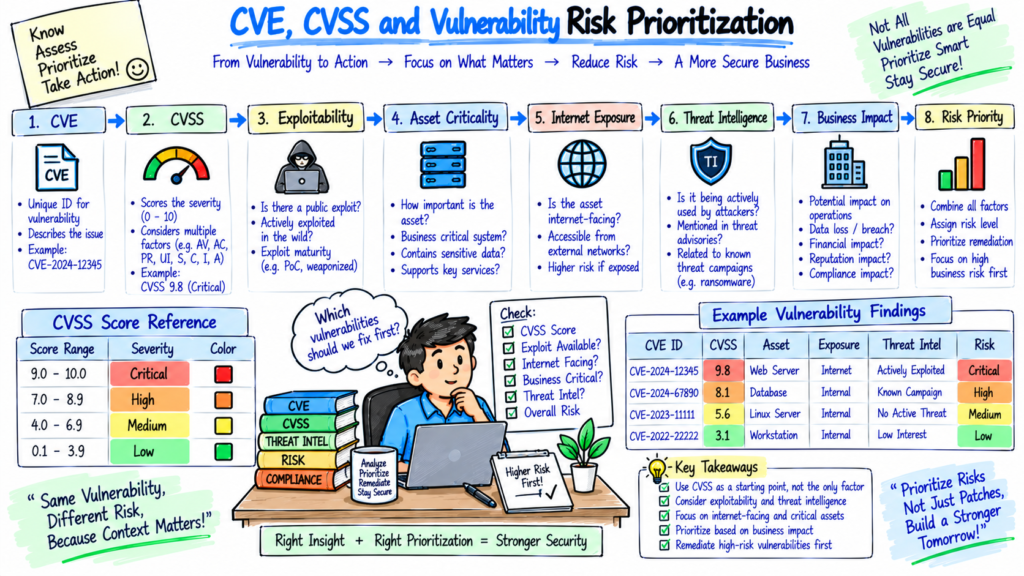
10. What is CVSS?
CVSS stands for Common Vulnerability Scoring System.
CVSS provides a standardized way to describe the severity of a vulnerability.
The score ranges from:
0.0 to 10.0
A commonly used severity classification is:
- None: 0.0
- Low: 0.1–3.9
- Medium: 4.0–6.9
- High: 7.0–8.9
- Critical: 9.0–10.0
However, organizations should not rely only on the CVSS score when deciding remediation priority.
11. What is the difference between CVE and CVSS?
CVE identifies a vulnerability.
CVSS provides a standardized severity score for a vulnerability.
Example:
CVE identifies the vulnerability as
CVE-2026-XXXXX.
CVSS provides a score indicating its severity.
Organizations may combine CVSS with asset criticality, exploit availability, business impact, and threat intelligence to determine remediation priority.
Vulnerability Management Interview Questions and Answers 2026
12. What is asset discovery?
Asset discovery identifies systems and devices that exist within an organization’s environment.
Assets can include:
- Servers
- Laptops
- Desktops
- Network devices
- Cloud resources
- Databases
- Applications
- Containers
- Virtual machines
- IoT devices
You cannot effectively manage vulnerabilities on assets that you do not know exist.
13. What is asset inventory?
An asset inventory is a maintained record of organizational assets.
It may contain:
- Hostname
- IP address
- MAC address
- Operating system
- Application
- Owner
- Business unit
- Location
- Criticality
- Environment
- Internet exposure
Accurate asset inventory improves vulnerability prioritization and remediation tracking.
14. What is an attack surface?
An attack surface is the collection of systems, applications, interfaces, services, and entry points that could potentially be targeted by attackers.
Examples include:
- Internet-facing servers
- VPN gateways
- Web applications
- APIs
- Cloud resources
- Remote access services
- Employee endpoints
Vulnerability management helps reduce exposure across the attack surface.
Vulnerability Management Interview Questions and Answers 2026
15. What is external attack surface management?
External Attack Surface Management, or EASM, focuses on discovering and monitoring assets that are exposed to the internet.
Examples include:
- Public IP addresses
- Internet-facing applications
- Public cloud services
- DNS records
- Exposed ports
- Public APIs
- Unknown or forgotten assets
EASM can help organizations discover externally exposed assets that may not be present in internal asset inventories.
16. What is vulnerability prioritization?
Vulnerability prioritization determines which vulnerabilities should be addressed first.
Factors can include:
- CVSS score
- Exploit availability
- Active exploitation
- Asset criticality
- Internet exposure
- Business impact
- Data sensitivity
- Vulnerability age
- Threat intelligence
- Availability of remediation
For example, a medium-severity vulnerability on an internet-facing critical server may deserve attention before a higher-scoring issue on an isolated test system.
Vulnerability Management Interview Questions and Answers 2026
17. What is risk-based vulnerability management?
Risk-based vulnerability management prioritizes vulnerabilities based on their actual organizational risk rather than severity score alone.
For example:
Vulnerability
      ↓
CVSS
      +
Exploit availability
      +
Asset criticality
      +
Internet exposure
      +
Threat intelligence
      +
Business impact
      ↓
Risk-based priority
This approach helps security teams focus remediation efforts on vulnerabilities that present greater organizational risk.
18. What is a vulnerability remediation?
Vulnerability remediation is the process of addressing a vulnerability so that the associated security risk is reduced or eliminated.
Remediation may involve:
- Installing a security patch
- Upgrading software
- Changing configuration
- Removing vulnerable software
- Disabling an unnecessary service
- Applying a security control
- Rebuilding a system
The appropriate remediation depends on the vulnerability and environment.
19. What is vulnerability mitigation?
Mitigation reduces the risk associated with a vulnerability without necessarily removing the underlying vulnerability.
Examples include:
- Firewall restrictions
- Network segmentation
- Disabling a vulnerable feature
- Access control
- Web application firewall rules
- Temporary configuration changes
Mitigation may be useful when an immediate patch is unavailable.
Vulnerability Management Interview Questions and Answers 2026
20. What is the difference between remediation and mitigation?
Remediation
Addresses or removes the vulnerability.
Example:
Install the vendor’s security update.
Mitigation
Reduces the likelihood or impact of exploitation without necessarily fixing the vulnerability.
Example:
Restrict access to the vulnerable service using firewall rules.
Mitigation can be temporary while a permanent remediation is planned.
21. What is a false positive in vulnerability management?
A false positive occurs when a vulnerability scanner reports a vulnerability that is not actually present.
For example:
A scanner reports an outdated software version, but investigation shows that the software has already been patched and the scanner is using outdated information.
The analyst should validate the finding before closing it.
22. What is a false negative?
A false negative occurs when a real vulnerability exists but the scanning process fails to identify it.
Possible reasons include:
- Incorrect scan configuration
- Missing credentials
- Unsupported technology
- Network restrictions
- Scanner limitations
- Incomplete asset coverage
False negatives can create significant visibility gaps.
Vulnerability Management Interview Questions and Answers 2026
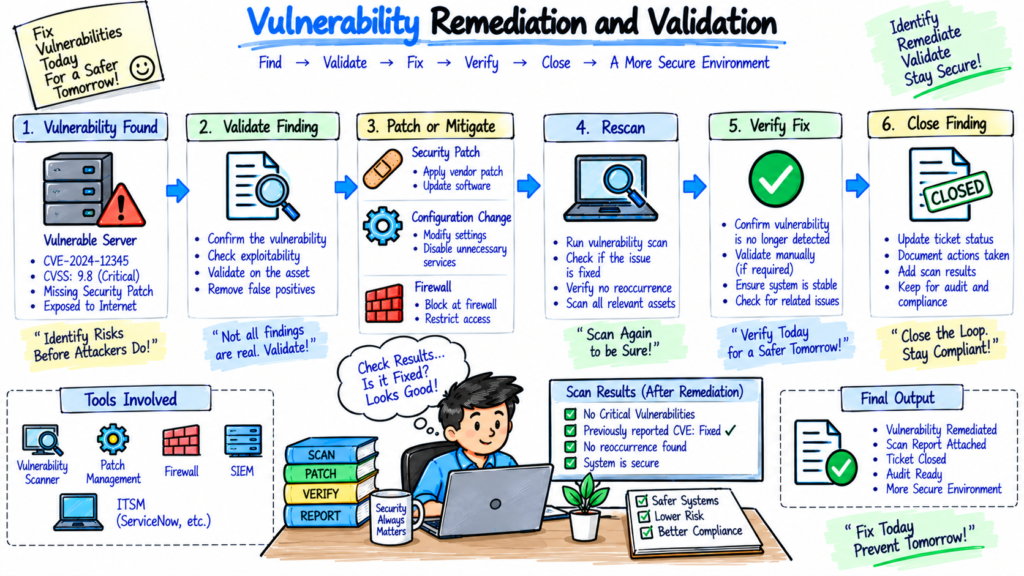
23. How do you validate a vulnerability?
I would validate a vulnerability using multiple sources.
For example:
- Review the scanner finding.
- Identify the affected host.
- Check installed software.
- Verify the software version.
- Check patch status.
- Review the vendor advisory.
- Check the CVE details.
- Determine whether the vulnerable component is actually used.
- Confirm whether compensating controls exist.
- Document the validation result.
The exact validation method depends on the technology.
24. What is vulnerability aging?
Vulnerability aging measures how long a vulnerability has remained unresolved.
For example:
Day 0       Vulnerability discovered
Day 7       Assigned to application owner
Day 15      Remediation planned
Day 30      Still open
Day 60      SLA exceeded
Organizations use vulnerability aging to monitor remediation performance and identify overdue vulnerabilities.
25. What is a remediation SLA?
A remediation SLA defines the expected timeframe for fixing vulnerabilities based on their severity or risk.
For example, an organization might define different remediation targets for:
- Critical vulnerabilities
- High-risk vulnerabilities
- Medium-risk vulnerabilities
- Low-risk vulnerabilities
The exact timelines vary by organization.
26. What is patch management?
Patch management is the process of identifying, testing, deploying, and validating software updates.
A typical process is:
Patch Identification → Testing → Approval → Deployment → Validation
Patch management is one of the major ways organizations remediate vulnerabilities.
27. What is the difference between vulnerability management and patch management?
Vulnerability management identifies and manages security weaknesses.
Patch management focuses specifically on deploying software updates and patches.
Not every vulnerability can be fixed through patching.
For example, a weak configuration may require a configuration change rather than a software patch.
28. What is a vulnerability exception?
A vulnerability exception is an approved decision to temporarily or permanently accept a vulnerability without immediate remediation.
An exception may be considered when:
- A patch breaks a critical application
- The vendor has not released a fix
- The system cannot be upgraded immediately
- Business constraints prevent immediate remediation
Exceptions should have:
- Business justification
- Risk assessment
- Approval
- Expiration date
- Compensating controls where appropriate
29. What is risk acceptance?
Risk acceptance occurs when an authorized party formally accepts the remaining risk associated with a vulnerability.
For example:
A legacy application cannot be patched immediately because the vendor does not support the required upgrade.
The organization may document and formally accept the risk while implementing additional controls.
Risk acceptance should be an authorized business decision, not an informal analyst decision.
30. What is vulnerability suppression?
Vulnerability suppression prevents a known finding from repeatedly generating unwanted results under defined conditions.
Suppression may be appropriate when:
- A finding is confirmed to be a false positive
- A compensating control is documented
- The finding is not applicable
- The organization has approved an exception
Suppression should be documented and periodically reviewed.
31. What is an authenticated scan failure?
An authenticated scan failure occurs when a vulnerability scanner cannot successfully authenticate to the target system.
Possible causes include:
- Incorrect credentials
- Expired password
- Insufficient permissions
- Firewall restrictions
- SSH configuration
- Windows authentication issues
- Credential policy changes
- Scanner configuration problems
I would troubleshoot the authentication method, permissions, connectivity, and scanner configuration.
32. What is a credentialed scan?
A credentialed scan uses authorized credentials to obtain information directly from the target system.
For example, a Windows credentialed scan may inspect:
- Installed applications
- Windows patches
- Registry settings
- Security configurations
Credentialed scanning generally provides greater visibility than a purely network-based scan.
33. What is vulnerability scanning frequency?
Scanning frequency depends on:
- Organization size
- Risk profile
- Asset type
- Regulatory requirements
- Internet exposure
- Change frequency
Organizations may perform:
- Continuous monitoring
- Daily scans
- Weekly scans
- Monthly scans
- Scan-on-demand after major changes
Internet-facing assets may require more frequent monitoring.
34. What is a vulnerability assessment report?
A vulnerability assessment report documents discovered vulnerabilities and related risk information.
It may include:
- Asset
- Vulnerability
- CVE
- CVSS
- Severity
- Evidence
- Description
- Affected software
- Remediation
- Due date
- Status
Reports help security and infrastructure teams track remediation.
35. What metrics are used in vulnerability management?
Common metrics include:
- Number of open vulnerabilities
- Critical vulnerabilities
- High-risk vulnerabilities
- Mean Time to Remediate
- SLA compliance
- Vulnerability aging
- Remediation rate
- Scan coverage
- Asset coverage
- Recurring vulnerabilities
- Exception count
These metrics help security teams measure the effectiveness of the vulnerability management program.
36. What is MTTR in vulnerability management?
MTTR generally means Mean Time to Remediate.
It measures the average time required to remediate vulnerabilities.
For example:
Vulnerability A → 5 days
Vulnerability B → 10 days
Vulnerability C → 15 days

MTTR = (5 + 10 + 15) / 3
     = 10 days
Organizations can track MTTR by severity, asset type, application, or business unit.
37. What is an exploitable vulnerability?
An exploitable vulnerability is a vulnerability for which an attacker can potentially execute an attack under specific conditions.
Factors that can increase concern include:
- Public exploit availability
- Active exploitation
- Remote accessibility
- Low attack complexity
- No authentication requirement
- High-impact consequences
Exploitability should be considered alongside asset and business context.
38. What is an exploit in vulnerability management?
An exploit is a technique, code, or method used to take advantage of a vulnerability.
An exploit can potentially allow an attacker to:
- Execute code
- Gain unauthorized access
- Escalate privileges
- Read sensitive data
- Modify information
- Cause service disruption
The existence of a vulnerability does not automatically mean successful exploitation is occurring.
39. What is a zero-day vulnerability?
A zero-day vulnerability is a previously unknown or insufficiently addressed vulnerability for which defenders may not yet have an available security fix or adequate mitigation.
Organizations may need to respond using:
- Vendor guidance
- Network controls
- Temporary configuration changes
- Detection rules
- Threat intelligence
- Increased monitoring
The exact response depends on the vulnerability and available controls.
40. How would you prioritize a critical vulnerability?
I would first determine whether the vulnerability actually affects the environment.
Then I would evaluate:
- Affected assets
- Internet exposure
- Asset criticality
- Exploit availability
- Active exploitation
- Authentication requirements
- Potential impact
- Available remediation
- Compensating controls
- Organizational SLA
A critical CVSS score is an important signal, but I would use additional context to determine the actual remediation priority.
41. How would you handle a vulnerability that cannot be patched?
I would first determine why it cannot be patched.
Then I would evaluate alternatives such as:
- Vendor-supported workaround
- Configuration change
- Firewall restriction
- Network segmentation
- Disabling vulnerable functionality
- Access restriction
- Additional monitoring
I would document the residual risk and follow the organization’s exception or risk acceptance process if the vulnerability remains unresolved.
42. How would you handle thousands of vulnerabilities?
I would avoid treating every vulnerability equally.
I would:
- Verify asset inventory.
- Remove duplicate findings.
- Validate false positives.
- Prioritize actively exploited vulnerabilities.
- Prioritize internet-facing assets.
- Consider business-critical systems.
- Group vulnerabilities by common remediation.
- Assign findings to responsible owners.
- Track remediation SLAs.
- Continuously monitor progress.
For example, if 500 servers have the same vulnerable package, upgrading the package across those systems may address hundreds of findings efficiently.
43. How would you investigate a vulnerability scanner finding?
I would review:
- Asset
- IP address
- Hostname
- Vulnerable software
- Installed version
- CVE
- CVSS
- Evidence
- Detection plugin
- Network exposure
Then I would independently validate the software version and configuration.
After validation, I would determine whether to:
- Remediate
- Mitigate
- Accept risk
- Suppress a false positive
- Request additional investigation
44. How would you reduce false positives in vulnerability scans?
I would:
- Use authenticated scanning where appropriate.
- Keep scanner plugins updated.
- Configure accurate asset information.
- Verify reported software versions.
- Review scanner evidence.
- Tune scan policies.
- Exclude known non-applicable systems carefully.
- Validate findings before suppression.
I would avoid broad exclusions because they can hide real vulnerabilities.
45. How would you handle an internet-facing critical vulnerability?
I would treat it as a high-priority finding according to the organization’s risk model.
I would:
- Confirm the affected asset.
- Verify the vulnerability.
- Check exploit availability and threat intelligence.
- Determine whether the asset is actively exposed.
- Identify business criticality.
- Apply the vendor patch if available.
- Apply temporary mitigation if required.
- Monitor for exploitation attempts.
- Validate remediation.
- Document the outcome.
46. How would you verify that a vulnerability has been remediated?
I would not close the vulnerability simply because the owner says the patch was installed.
I would validate using:
- A follow-up vulnerability scan
- Software version
- Patch status
- Configuration verification
- Vendor remediation guidance
- Manual validation where appropriate
For example:
Initial Scan
    ↓
CVE detected
    ↓
Patch installed
    ↓
Validation scan
    ↓
CVE no longer detected
    ↓
Finding closed
47. What would you do if a vulnerability reappears after remediation?
I would investigate why it returned.
Possible causes include:
- Patch failed
- Vulnerable software was reinstalled
- Asset was rebuilt from an old image
- Configuration management reverted the change
- Scanner inconsistency
- Multiple vulnerable versions exist
- Remediation was incomplete
I would identify the root cause and verify remediation again after correction.
48. How would you handle a vulnerability on a business-critical production server?
I would coordinate with the system owner and change management process before making disruptive changes.
I would evaluate:
- Business criticality
- Vulnerability risk
- Exploitability
- Maintenance window
- Backup availability
- Patch testing
- Compensating controls
If immediate patching is not possible, temporary mitigation may be implemented while a permanent fix is scheduled.
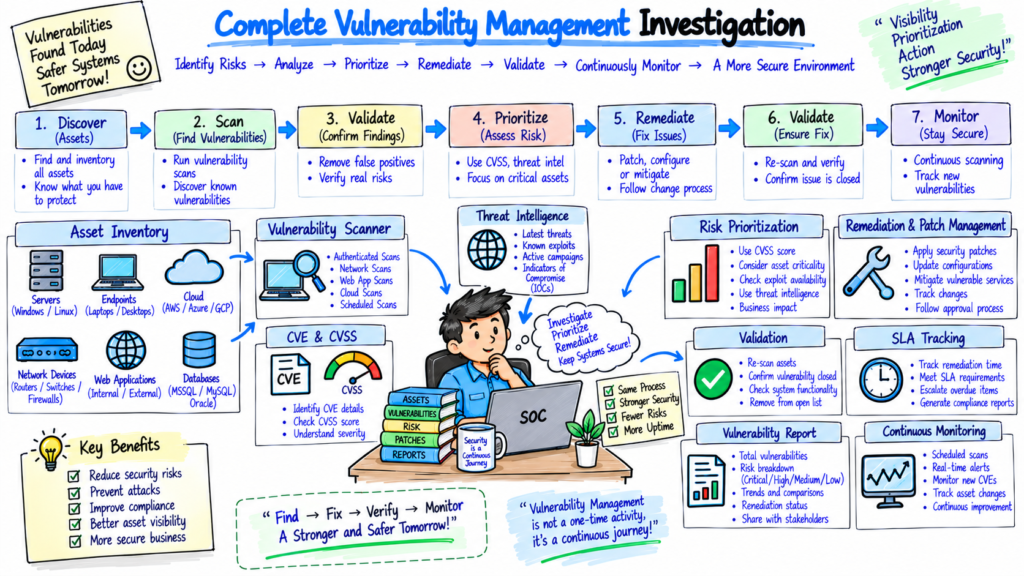
49. What is continuous vulnerability management?
Continuous vulnerability management means continuously maintaining visibility into assets, vulnerabilities, risk, remediation, and new threats.
It involves:
Discover
   ↓
Scan
   ↓
Analyze
   ↓
Prioritize
   ↓
Remediate
   ↓
Validate
   ↓
Monitor
   ↓
Discover again
The process continues because assets, software, vulnerabilities, and threats constantly change.
50. Explain a complete vulnerability management process with a real-world example.
Suppose a vulnerability scanner identifies a critical vulnerability on an internet-facing web server.
Step 1: Asset Identification
Identify:
- Server
- IP address
- Application
- Owner
- Business criticality
Step 2: Vulnerability Validation
Confirm:
- CVE
- Software version
- Scanner evidence
- Affected component
- Vendor advisory
Step 3: Risk Assessment
Evaluate:
- CVSS
- Exploit availability
- Internet exposure
- Asset criticality
- Threat intelligence
- Business impact
Step 4: Remediation
Install the vendor patch or upgrade the affected component.
Step 5: Temporary Mitigation
If patching cannot happen immediately, apply appropriate controls such as restricting access or disabling vulnerable functionality where feasible.
Step 6: Validation
Run a follow-up scan and verify the vulnerable version is no longer present.
Step 7: Closure
Document:
- Remediation date
- Evidence
- Validation results
- Remaining risk
Step 8: Continuous Monitoring
Continue monitoring the asset for newly discovered vulnerabilities.
The complete process is:
Discover → Assess → Prioritize → Remediate → Validate → Monitor
Related Cybersecurity Articles
If you are preparing for cybersecurity and vulnerability management interviews, these related TechNaga guides can help you expand your knowledge:
- Security Information and Event Management: Complete SIEM Guide 2026
- Incident Response Interview Questions and Answers 2026
- SOC Analyst Roadmap 2026
- Endpoint Security Guide 2026
- EDR vs XDR vs MDR Comparison 2026
- Cloud Security Basics 2026
- Network Security Basics Guide for Beginners 2026
- Firewall in Cybersecurity: Types, Examples and How It Works
External Resources
- NIST National Vulnerability Database (NVD)
https://nvd.nist.gov/ - NIST Cybersecurity Framework
https://www.nist.gov/cyberframework - CISA Known Exploited Vulnerabilities Catalog
https://www.cisa.gov/known-exploited-vulnerabilities-catalog - FIRST CVSS
https://www.first.org/cvss/ - MITRE CVE
https://www.cve.org/