One real incident I handled in the SOC clearly demonstrated why API Security is one of the most important areas of cybersecurity today. It was a quiet Tuesday afternoon when a critical alert appeared in Splunk:
Apr 11 14:30:05 cloud-waf-01
waf_event:
[ID 949110]
Severity: CRITICAL
Tag: OWASP_API_2023_T1
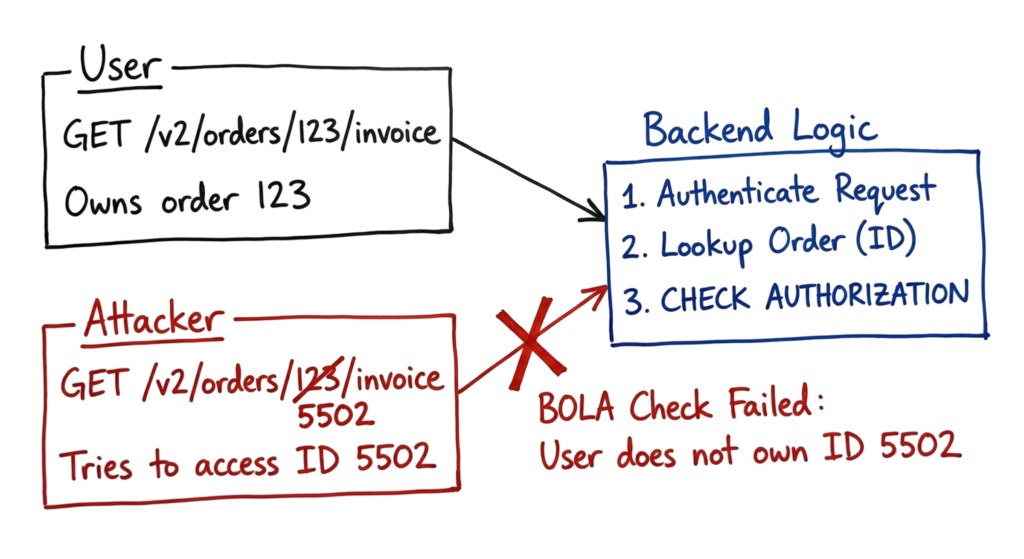
The alert pointed to a classic Broken Object Level Authorization (BOLA) attack, ranked as one of the highest risks in the OWASP API Security Top 10. The attacker simply modified the resource ID in the URL to access another customer’s invoice. There was no sophisticated exploit or malware involved. The attack succeeded because the application failed to verify whether the authenticated user was authorized to access the requested resource.
This incident clearly shows why API Security cannot rely solely on firewalls or network defenses. Every API request must be authenticated, authorized, validated, and monitored before sensitive data is returned.
Today, nearly 80% of web traffic flows through APIs. Mobile applications, cloud platforms, SaaS products, microservices, and AI applications all depend on APIs to exchange data. Every endpoint exposes business logic and sensitive information, making APIs one of the most attractive targets for attackers.
Following strong API Security Best Practices helps organizations prevent unauthorized access, data breaches, API abuse, and business logic attacks before they impact critical systems.
What is API Security?
API Security is the collection of technologies, policies, and controls used to protect Application Programming Interfaces (APIs) against unauthorized access, abuse, and cyberattacks. In modern cloud-native applications, APIs serve as the communication layer between users, applications, microservices, and third-party platforms. Because they expose critical business functions and sensitive data, securing APIs has become a top cybersecurity priority.
Modern API Security focuses on several key controls, including API Authentication, authorization, encryption, input validation, rate limiting, and continuous monitoring. Instead of depending only on traditional perimeter security, every API request is independently verified before access is granted.
By 2026, API Security extends far beyond traditional REST APIs. Organizations now protect AI model endpoints, serverless functions, GraphQL APIs, Kubernetes services, and machine-to-machine communications. Every request must be validated using strong identity verification, secure token handling, and granular access controls.
One of the most important API Security Best Practices is validating every request at the business logic level. Even if servers, networks, and cloud infrastructure are fully secured, weak authorization rules or improper input validation can still expose sensitive customer data. This is why OWASP API Security continues to emphasize risks such as Broken Object Level Authorization (BOLA), excessive data exposure, and broken authentication.
How API Security Works
The fundamental principle of API Security is straightforward: every API request must be inspected, authenticated, authorized, and validated before it reaches the backend application.
The process typically follows these stages:
1. Request Inspection
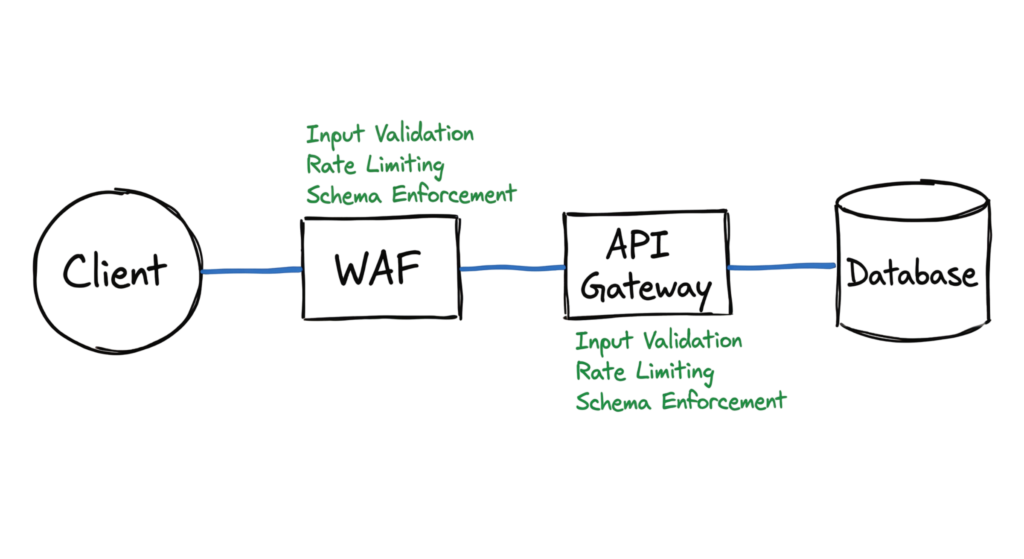
Every incoming request first passes through a Web Application Firewall (WAF) or an API Gateway. These security controls inspect headers, request payloads, query parameters, and request patterns for malicious behavior such as SQL injection, API abuse, malformed requests, or denial-of-service attempts.
Cloud services such as AWS WAF, Azure Front Door, and Google Cloud Armor commonly perform this initial inspection.
2. API Authentication
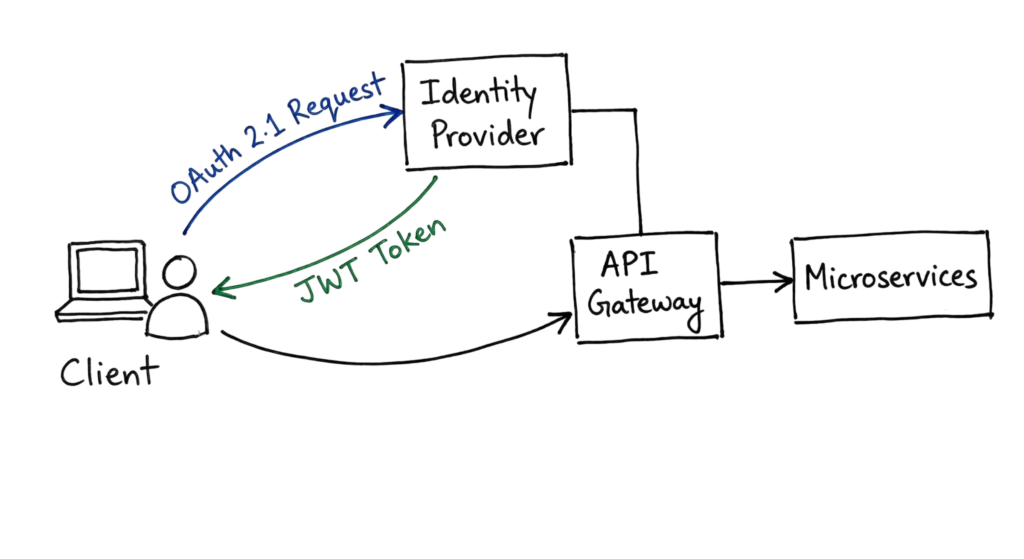
The next stage is API Authentication, where the platform verifies the identity of the requesting user, application, or service. Modern APIs commonly use OAuth 2.1, OpenID Connect (OIDC), Mutual TLS (mTLS), API Keys, or JSON Web Tokens (JWTs).
The system validates that the token is correctly signed, has not expired, belongs to the requesting client, and has not been revoked.
3. Authorization
Once authentication succeeds, authorization determines whether the authenticated identity is permitted to access the requested resource.
This step is critical because many attacks documented in OWASP API Security exploit authorization weaknesses rather than authentication failures. Even when users successfully log in, they should only access resources specifically assigned to them.
4. Policy Enforcement
The API Gateway evaluates security policies such as:
- Rate limiting
- IP restrictions
- Geographic restrictions
- Request size validation
- Schema validation
- Threat intelligence rules
These controls form part of modern API Security Best Practices and help prevent abuse, credential stuffing, brute-force attacks, and automated bot activity.
5. Logging and Monitoring
Finally, every request, response, authentication event, and authorization decision is logged and forwarded to monitoring platforms such as SIEM solutions. Continuous monitoring enables security teams to detect anomalies, investigate incidents, and identify attacks before they become large-scale breaches.
API Security Technical Flow and Architecture
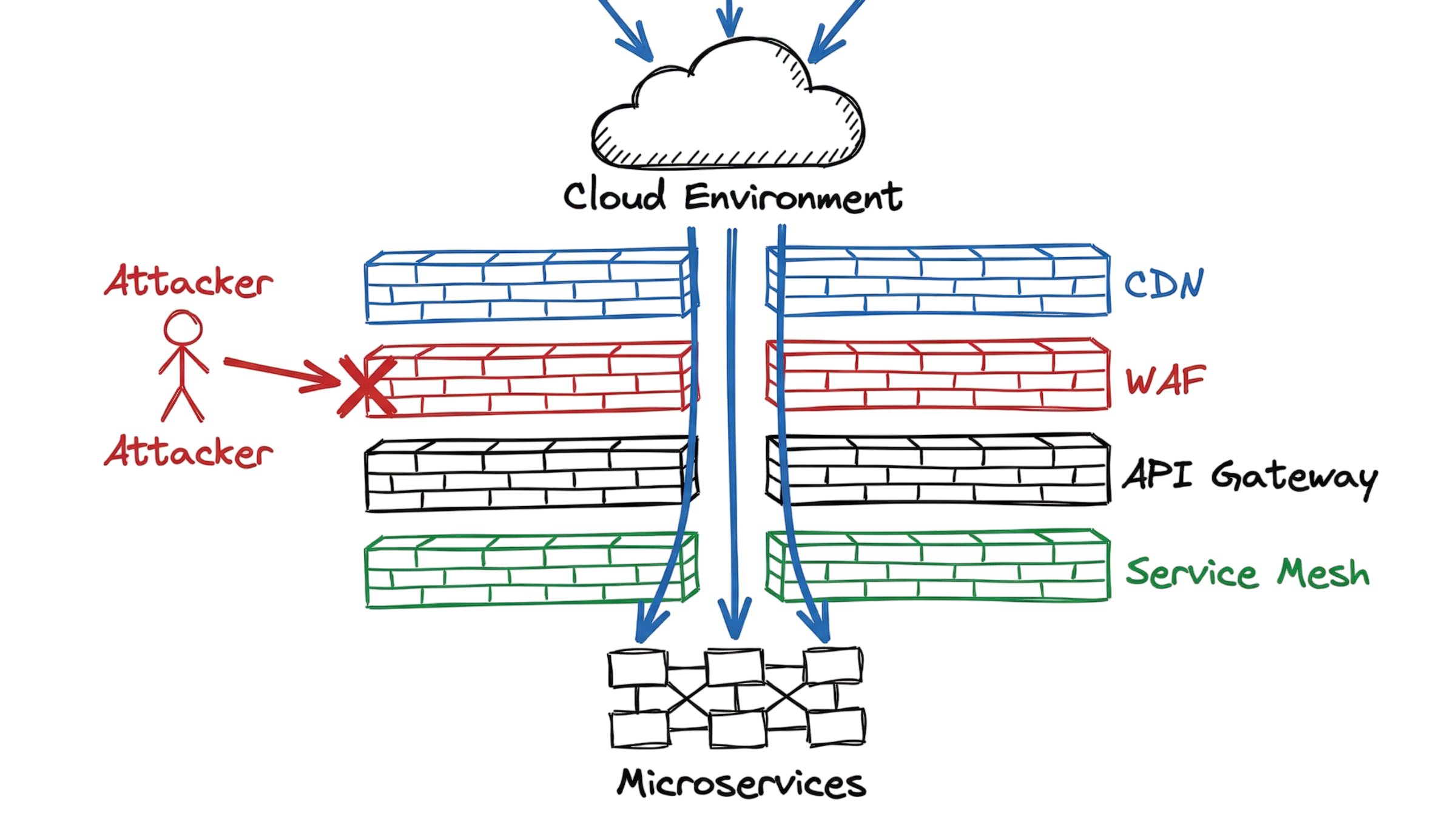
Modern API Security follows a layered architecture where every request passes through multiple security controls before reaching the backend application. This defense-in-depth approach reduces the risk of unauthorized access, API abuse, and data breaches.
The process begins when a client sends a request over the public internet. The traffic first reaches a Content Delivery Network (CDN), which helps absorb Distributed Denial-of-Service (DDoS) attacks, improves application performance, and filters malicious traffic before it reaches the application.
Next, the request is forwarded to the API Gateway, one of the most important components of modern API Security. The gateway performs SSL/TLS termination, validates API keys or access tokens, enforces rate limits, applies routing policies, and blocks requests that violate security policies. Implementing these controls is one of the most effective API Security Best Practices for protecting public-facing APIs.
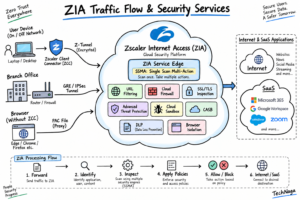
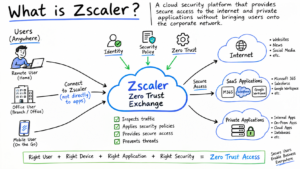
In enterprise environments, the architecture is often more complex than standard diagrams suggest. I have worked in environments where organizations used Palo Alto Networks Next-Generation Firewalls, Zscaler Internet Access (ZIA), and cloud API gateways simultaneously. During one troubleshooting exercise, an incorrect split-tunnel VPN configuration caused DNS requests to bypass the intended inspection path before reaching the API Gateway. Misconfigurations like these can create unexpected security gaps, making continuous monitoring and validation essential.
After passing through the gateway, requests are routed to internal microservices through a Service Mesh such as Istio or Linkerd. The service mesh secures service-to-service communication using Mutual TLS (mTLS), ensuring that every workload verifies the identity of other services before exchanging data. This additional layer strengthens API Authentication between internal services and helps prevent attackers from moving laterally if one service becomes compromised.
Finally, backend services communicate with databases and storage systems. These systems should implement strict network segmentation, IP allowlists, database authentication, encryption, and least-privilege access policies. Every layer independently verifies requests, creating multiple security barriers before sensitive information is accessed. These layered defenses represent core API Security Best Practices recommended for modern cloud-native applications.
Key Components of API Security
Building a secure API ecosystem requires several essential security components working together.
Identity Provider (IdP)
The Identity Provider manages user identities and issues secure authentication tokens. Solutions such as Microsoft Entra ID, Okta, and Ping Identity authenticate users and applications before granting access. Strong API Authentication begins with a trusted identity provider that supports OAuth 2.1, OpenID Connect (OIDC), Multi-Factor Authentication (MFA), and Conditional Access policies.
API Gateway
The API Gateway acts as the primary enforcement point for API traffic. Platforms such as Kong, Google Apigee, Amazon API Gateway, and Azure API Management provide centralized policy enforcement, request validation, authentication, authorization, rate limiting, and traffic management. Deploying an API Gateway is considered one of the fundamental API Security Best Practices for securing modern APIs.
Web Application Firewall (WAF)
A Web Application Firewall (WAF) inspects API requests for malicious payloads, injection attacks, bot activity, and known attack signatures. Solutions such as Prisma SASE, FortiWeb, and AWS WAF help defend against many risks identified in the OWASP API Security Top 10 by filtering malicious requests before they reach backend services.
Security Monitoring and Observability
Visibility is a critical component of API Security. Platforms such as Splunk, Microsoft Sentinel, Datadog, and Elastic Security collect logs from gateways, applications, identity providers, and cloud infrastructure. These logs enable security teams to detect anomalies, investigate incidents, and perform digital forensics after an attack. Without comprehensive logging, even the strongest security controls become difficult to validate.
Real-World API Security Example
One real incident involved a large fintech company that suffered a privilege escalation attack caused by a Mass Assignment vulnerability, a common business logic flaw highlighted in OWASP API Security guidance.
The vulnerable endpoint accepted requests such as:
PATCH /api/users/profileThe application allowed users to update profile information such as their email address. However, the backend automatically stored every field received in the JSON request without validating whether users were authorized to modify those properties.
An attacker submitted the following additional field:
{
  "is_admin": true
}
Because the backend failed to enforce proper authorization, the application updated the user’s account and granted administrative privileges. The attacker then accessed thousands of customer records that should never have been exposed.
Fortunately, one of our security engineers identified the attack while reviewing SIEM alerts. The investigation revealed an unusually high number of administrative actions originating from a standard user account.
The alert appeared as:
SECURITY_EVENT:
USER_PRIVILEGE_ESCALATION
Source IP: 203.0.113.45
Account ID: 88291
Action: update_permission
This incident reinforced several important API Security Best Practices. Every API request should validate user permissions, use strict schema validation, reject unexpected fields, and apply the principle of least privilege. Even strong API Authentication cannot prevent privilege escalation if backend authorization logic is poorly implemented. Proper input validation, secure coding practices, and continuous monitoring remain essential for protecting modern APIs against real-world attacks.
Practical Implementation
Getting an API secure takes a real system. You can’t just flip a switch on a firewall and call it a day. You have to set up every layer to handle the risks we see on the OWASP Top 10 list.
Follow these steps to secure a new cloud endpoint:
- Define an explicit OpenAPI schema where you specify all available methods, URLs, and supported data types.
- Use an API Gateway as the sole access point to all outside requests.
- Authenticate using OAuth 2.1 and require all tokens to be signed using a secure hashing algorithm, e.g., RS256.
- Install a Web Application Firewall with configurations to defend against injection attacks and invalid JSONs.
- Add a rate-limiting mechanism at the gateway layer to stop brute-force attacks and resource exhaustion.
- Collect all incoming/outgoing requests’ metadata in a SIEM via centralized logging.
- Manually audit business logic for authorization issues that automated tools could have missed.
Advantages and Limitations
The main plus of having a solid strategy is that your data stays protected. By putting security in the gateway, you apply the same rules to every service. This means your developers don’t have to write security code for every single thing they build. It also gives you a clear audit trail for things like GDPR or PCI-DSS. Most cloud tools can now spot threats and block them automatically.
But there are trade-offs. Extra security can slow things down, which users will notice. If your gateway is set up wrong, it can fail and take the whole app offline. Also, encryption like TLS 1.3 keeps data safe while it is moving, but it doesn’t do anything once the data is being used in memory. You also have to watch the bill. Fast WAFs and SIEM storage get expensive very quickly as you get more users. You are always balancing protection against speed and cost.
Common Mistakes
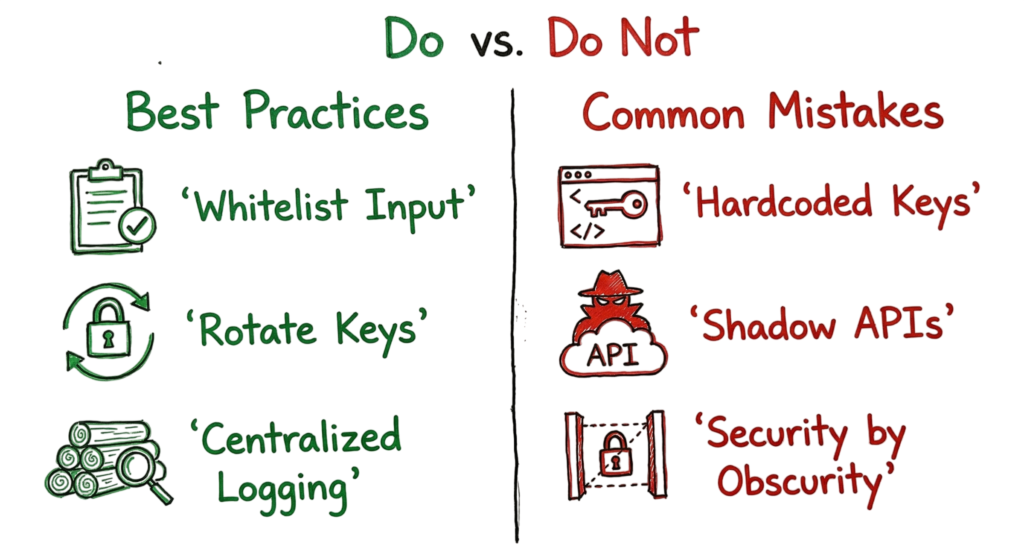
One big mistake is thinking you’re safe just because no one knows your URL. This is “security through obscurity,” and it’s a total myth. Hackers use bots to find every open door in minutes. Another issue is leaving API keys right in the frontend code of a web page or mobile app. Anyone can just pull those keys out and use them.
I’ve learned the hard way that a developer’s definition of “temporary” usually means “forever,” which is how those zombie endpoints stay active for years. These old versions often don’t have modern security and are still tied to your data. Finally, don’t let your error messages say too much. If an API sends back a full database error, you are giving the attacker a map of your internal system.
Best Practices for API Resilience
To keep your defenses high, you need to stick to frameworks like the NIST Cybersecurity Framework. These Best Practices for API protection help you stay ahead of new threats.
- Use HTTPS with TLS 1.3 to guarantee privacy and data integrity.
- Whitelist all input values rather than attempt blacklisting of certain input values.
- Perform fine-grained access control with a policy similar to ABAC (Attribute Based Access Control).
- Change all secrets and API keys after every 90 days to avoid the consequences of any leak.
- Regularly test for security vulnerabilities, especially those involving logic bugs which automated scanners miss.
Troubleshooting Scenario
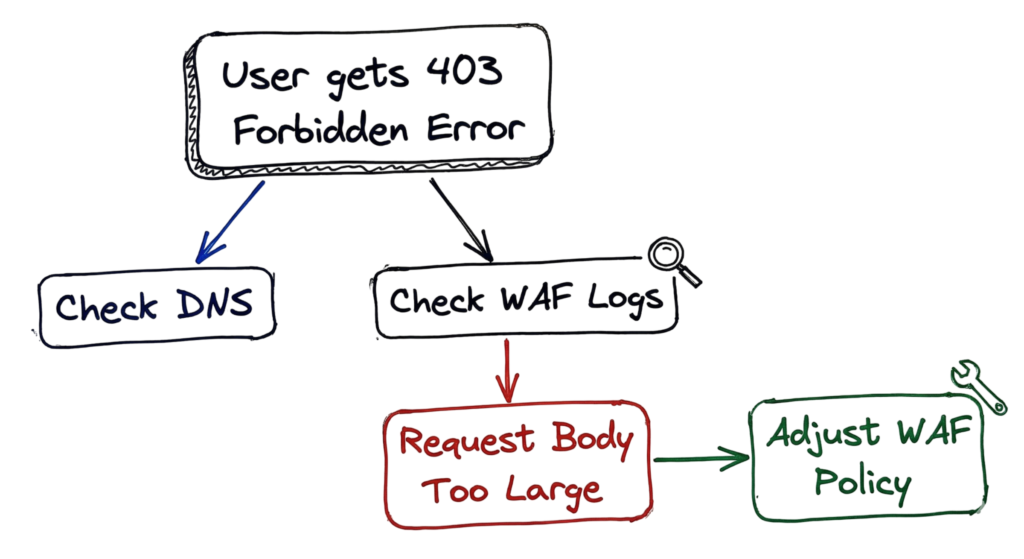
Let’s say you’re the engineer on call and people are getting 403 Forbidden errors. The first thing I check is DNS to make sure they are hitting the right gateway IP. Then I dig into the WAF logs. You might find something like this: BLOCK_REASON: “Request_Body_Too_Large” source_ip: 198.51.100.12 limit: 10240 actual: 15000.
This isn’t an attack. It’s just a config issue. The WAF is blocking anything over 10KB, but a new app update is sending bigger files. You have to update the policy for that one endpoint to allow the larger size while keeping the rest of the site tight. This keeps the users happy without leaving the server open to buffer overflow attacks.
Interview Questions
How do you prevent BOLA attacks in a microservices environment? You have to check authorization at the code level for every single request. The app must verify that the person asking for the data actually owns it. You can’t just trust the gateway because it doesn’t have the database context to know who owns what.
What is the difference between an API Key and an OAuth token? An API key is just a static string. It usually lasts a long time and gives too much access. An OAuth token like a JWT is short-lived and has specific permissions built-in. You can revoke tokens, which makes them much safer.
Why is rate limiting essential for API Security? It stops attacks like brute-forcing and keeps your services from crashing. It prevents a hacker from guessing passwords thousands of times a second and protects you if a client has a bug that starts spamming your server.
How do you handle security for third-party API integrations? Don’t put credentials in your code. Use a vault like HashiCorp Vault or AWS Secrets Manager. You should also use an egress proxy to make sure your traffic is only going to the external sites you’ve approved.
What role does a Service Mesh play in API protection? It takes care of the “East-West” traffic inside your network. It handles the encryption between services using mTLS and gives you a central spot to manage internal permissions. This stops a breach in one service from spreading to the whole network.
Future Trends 2026 and Beyond
Now here’s where it gets interesting. By 2026, AI is everywhere in security. Our tools are using machine learning to figure out what “normal” looks like. If a user suddenly starts pulling data from a new country at 3 AM, the system can stop them and ask for more proof of identity. This beats relying on static rules that never change.
We are also seeing “Agentic Security” take off. As AI agents start calling APIs for us, we need ways to prove they are authorized to do so. This means tokens will likely get even shorter and verification will get tougher. We are also moving toward “Security as Code.” This is where we write our security rules in scripts and test them in the pipeline before they ever go live.
FAQ
Does a WAF protect against all API threats? No, it doesn’t. A WAF is great for blocking common attacks, but it doesn’t understand your specific app logic. It won’t stop a user from accessing someone else’s data if your code doesn’t check permissions correctly.
Should I use JWT for all my APIs? JWT is great for distributed systems, but they are hard to kill once they are issued. If you need to be able to revoke access instantly, you might want to look at opaque tokens stored in Redis instead.
What is a shadow API? This is an endpoint that is live and touching production data but the security team doesn’t know it exists. They usually show up when developers move too fast and forget to document their work.
How often should I rotate my API keys? Every 90 days is the standard. If you’re in a high-risk spot, you might use keys that only last a few hours. You definitely need automation to handle this or you will lose your mind.
Can I secure an API without a gateway? You could, but I wouldn’t recommend it. You’d have to write security logic for every single service, and you’ll inevitably miss something. A gateway keeps everything consistent.
Is GraphQL more secure than REST? Not really. It just has different problems. You have to watch out for things like “Query Depth” attacks where someone sends a massive, nested request just to crash your server.
Conclusion
To keep your cloud environment secure, you need a clear focus on API Security. Attackers are constantly probing for weak endpoints, and even a single exposed API can lead to a serious breach. A multi-layered architecture combined with strong API security best practices reduces that risk significantly.
But setup alone is not enough. You need continuous monitoring, regular tuning of policies, and visibility into every request flowing through your APIs. Without this, gaps will appear over time.
In 2026, control over your traffic is what keeps you out of breach reports. Use the full capability of your cloud platform, stay updated on new vulnerabilities, and track every active endpoint. Unknown or forgotten APIs are one of the most common entry points for attackers.
Strong API Security comes down to one rule: verify every request, enforce strict access control, and never assume trust at any layer.
Related Articles
- What Is Cybersecurity and Why It Is Important Today
https://technaga.com/what-is-cybersecurity-and-why-it-is-important-today/ - Identity and Access Management (IAM): Complete Guide 2026
https://technaga.com/identity-and-access-management-cloud-security-2026/ - Multi-Factor Authentication (MFA): Complete Guide 2026
https://technaga.com/multi-factor-authentication-mfa-guide-2026/ - Cloud Security Basics 2026: Complete Beginner Guide
https://technaga.com/cloud-security-basics-2026/ - Zero Trust Security: Complete Implementation Guide 2026
https://technaga.com/zero-trust-security-2026-guide/ - Security Information and Event Management (SIEM): Complete Guide 2026
https://technaga.com/security-information-and-event-management-siem-guide-2026/ - Essential Endpoint Security Guide 2026 for Every Organization
https://technaga.com/endpoint-security-2026-guide/ - Initial Access in Cybersecurity: Top Attack Vectors You Must Know
https://technaga.com/initial-access-cybersecurity-attack-vectors-2026/ - Network Segmentation: Best Practices to Stop Lateral Movement
https://technaga.com/network-segmentation-best-practices-2026/ - Top 10 Cybersecurity Best Practices for 2026
https://technaga.com/top-10-cybersecurity-best-practices-2026/
External References
- OWASP API Security Top 10
https://owasp.org/www-project-api-security/ - OWASP API Security Cheat Sheet
https://cheatsheetseries.owasp.org/cheatsheets/REST_Security_Cheat_Sheet.html - OAuth 2.0 Framework (RFC 6749)
https://datatracker.ietf.org/doc/html/rfc6749 - OAuth 2.1 Draft Specification
https://datatracker.ietf.org/doc/html/draft-ietf-oauth-v2-1 - OpenID Connect (OIDC)
https://openid.net/connect/ - FIDO Alliance
https://fidoalliance.org/ - NIST Cybersecurity Framework (CSF 2.0)
https://www.nist.gov/cyberframework - MITRE ATT&CK Framework
https://attack.mitre.org/ - AWS API Gateway Documentation
https://docs.aws.amazon.com/apigateway/ - Microsoft Azure API Management Documentation
https://learn.microsoft.com/azure/api-management/ - Google Cloud Apigee Documentation
https://cloud.google.com/apigee - Kong API Gateway Documentation
https://docs.konghq.com/ - Cloudflare API Shield
https://developers.cloudflare.com/api-shield/ - Postman API Security Testing
https://learning.postman.com/
1 thought on “Critical API Security Risks in the Cloud and Best Practices for 2026”