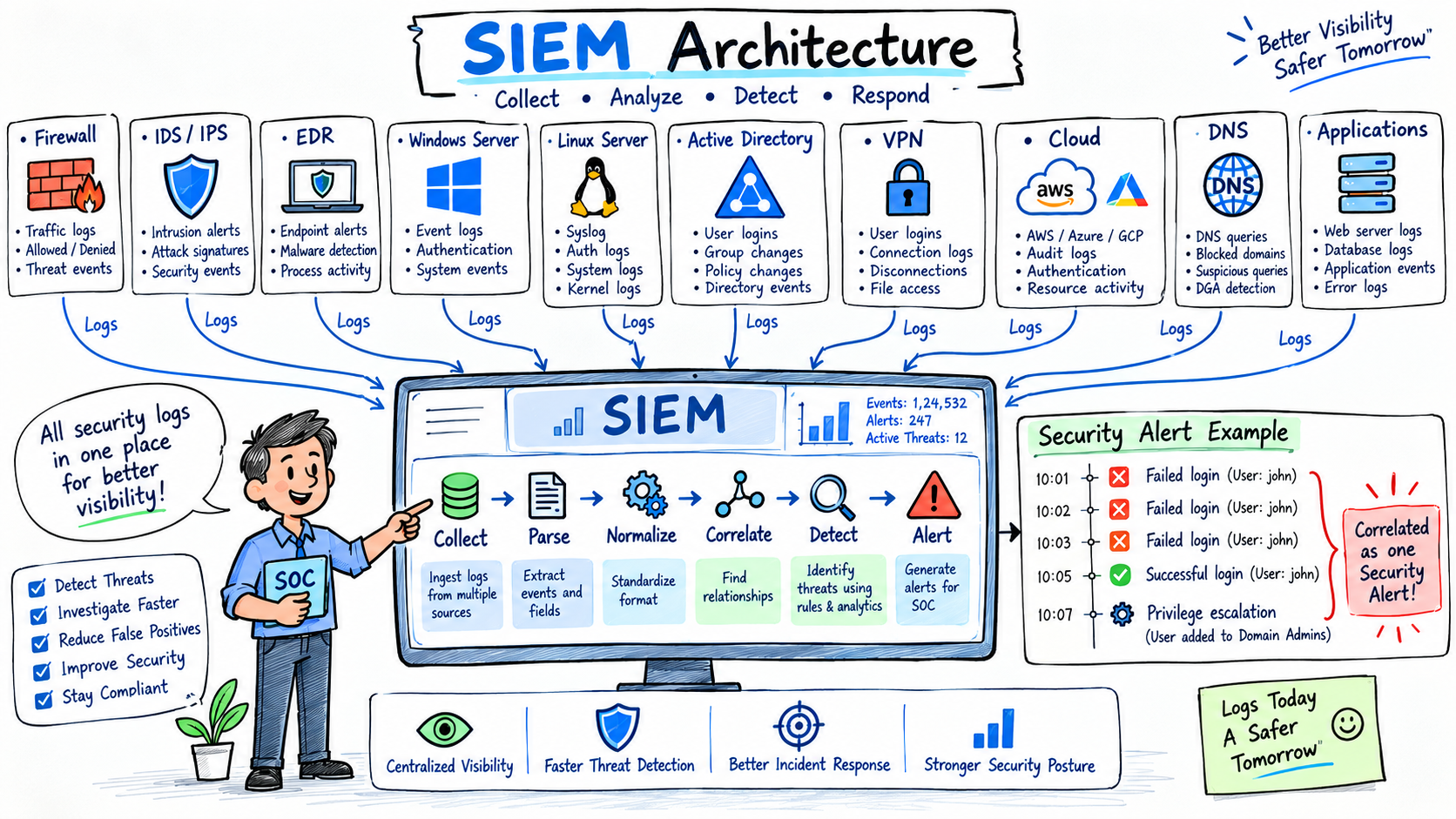
Security Information and Event Management (SIEM) is a core technology used by Security Operations Centers (SOCs) to collect, analyze, correlate, and investigate security events from different sources. SIEM platforms help security teams detect suspicious activity, investigate incidents, monitor users and systems, and respond to security threats.
If you are preparing for a SOC Analyst, Cybersecurity Analyst, Security Engineer, or SIEM Analyst interview, understanding SIEM concepts is essential. This SIEM Interview Questions and Answers 2026 guide covers the key concepts you need to understand for technical and scenario-based interviews.
This SIEM Interview Questions and Answers 2026 guide covers 50 questions ranging from basic SIEM concepts to advanced detection, correlation, threat hunting, incident investigation, and real-world security scenarios. Whether you are a beginner or an experienced cybersecurity professional, these questions can help you prepare for SIEM and SOC-related interviews.
1. What is SIEM?
SIEM stands for Security Information and Event Management.
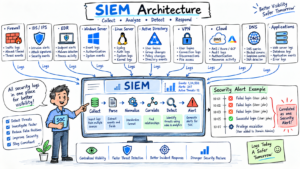
A SIEM platform collects security logs and events from multiple sources such as firewalls, servers, endpoints, applications, identity systems, cloud platforms, and network devices. It analyzes and correlates this data to identify suspicious activity.
A SIEM typically provides:
- Log collection
- Log aggregation
- Event normalization
- Event correlation
- Threat detection
- Alert generation
- Security monitoring
- Investigation
- Dashboards and reporting
- Compliance reporting
Examples of SIEM platforms include Splunk Enterprise Security, Microsoft Sentinel, IBM QRadar, Google Security Operations, and Elastic Security.
SIEM Interview Questions and Answers 2026
2. Why is SIEM important in cybersecurity?
SIEM provides security teams with a centralized location to monitor security events from different systems.
For example, consider a user account that:
- Logs in from India.
- Logs in again from another country shortly afterward.
- Performs multiple failed authentication attempts.
- Successfully authenticates.
- Accesses sensitive applications.
A SIEM can correlate these events and generate an alert for investigation.
SIEM helps organizations with:
- Threat detection
- Incident investigation
- Security monitoring
- Compliance
- Threat hunting
- User activity monitoring
- Centralized log management
3. What are the main components of a SIEM?
A typical SIEM architecture contains several components:
Log Sources
Examples include:
- Firewalls
- Routers
- Switches
- Servers
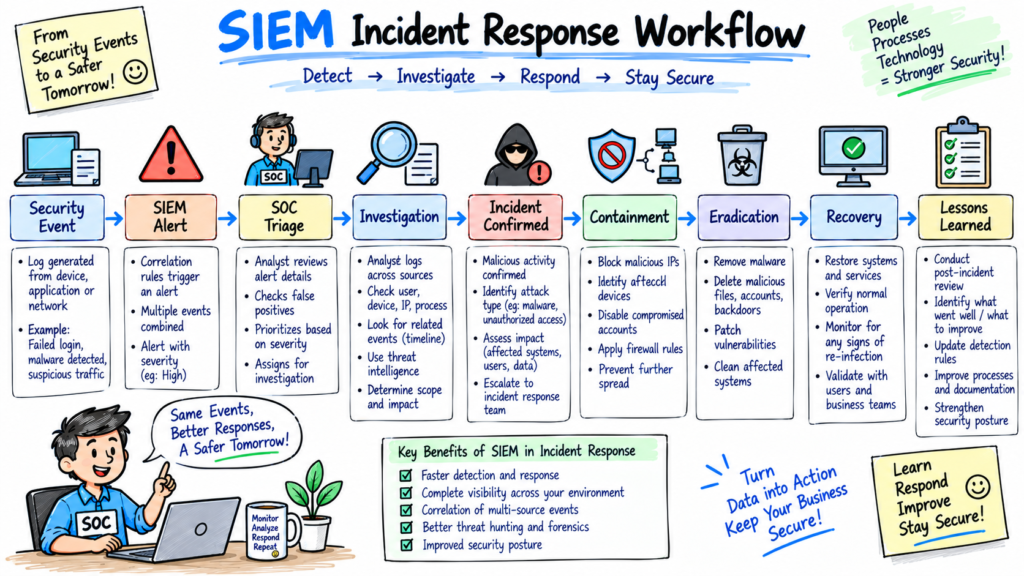
- Endpoints
- EDR platforms
- Active Directory
- Identity providers
- VPN
- Proxy servers
- Cloud services
- Applications
Data Collection
Collects logs from different sources.
Log Processing
Parses, normalizes, and enriches raw events.
Correlation Engine
Connects related events to identify suspicious activity.
Detection Engine
Evaluates events against detection rules and analytics.
Storage
Stores security events for investigation and compliance.
Alerting
Generates alerts when suspicious activity is detected.
Dashboard and Reporting
Provides analysts with visibility into security events.
SIEM Interview Questions and Answers 2026
4. What is a security event?
A security event is an activity recorded by a system that may be relevant to security monitoring.
Examples include:
- Successful login
- Failed login
- Firewall connection
- Malware detection
- File modification
- Privilege change
- Account creation
- VPN connection
- Application access
Not every security event is malicious.
For example:
User successfully logged into Microsoft 365.
This is an event.
If the same account suddenly logs in from multiple unusual locations, the combined activity may become suspicious.
5. What is the difference between an event and an alert?
An event is an individual activity recorded by a system.
An alert is generated when an event or combination of events matches a detection condition.
Example:
Events:
- 20 failed logins
- 1 successful login
- Login from an unusual location
Alert:
Possible brute-force attack followed by successful authentication.
Therefore:
Event = Recorded activity
Alert = Security condition requiring investigation
SIEM Interview Questions and Answers 2026
6. What is log management in SIEM?
Log management involves collecting, processing, storing, searching, and analyzing logs.
A typical process is:
Log Source → Collection → Parsing → Normalization → Enrichment → Storage → Correlation → Detection → Alert
Effective log management helps security teams investigate incidents and maintain historical records.
7. What types of logs are commonly collected by SIEM?
Common SIEM log sources include:
Network Logs
- Firewall
- IDS/IPS
- Router
- Proxy
- VPN
- DNS
Endpoint Logs
- Windows
- Linux
- macOS
- EDR
- Antivirus
Identity Logs
- Active Directory
- Azure AD / Microsoft Entra ID
- Okta
- SSO
- MFA
Application Logs
- Web servers
- Databases
- Business applications
- APIs
Cloud Logs
- AWS CloudTrail
- Azure Activity Logs
- Google Cloud logs
SIEM Interview Questions and Answers 2026
8. What is log normalization?
Log normalization converts logs from different sources into a consistent structure.
Different products may use different field names.
For example:
One firewall may use:
src_ip
Another may use:
source_address
A SIEM can normalize both into:
source.ip
This makes correlation and searching easier across multiple data sources.
9. What is log parsing?
Log parsing extracts useful fields from raw log data.
For example, a raw log might contain:
Failed login user=admin src=10.10.10.25 destination=server01
A SIEM parser can extract:
- Username: admin
- Source IP: 10.10.10.25
- Destination: server01
- Event type: Failed Login
These fields can then be used in searches and detection rules.
SIEM Interview Questions and Answers 2026
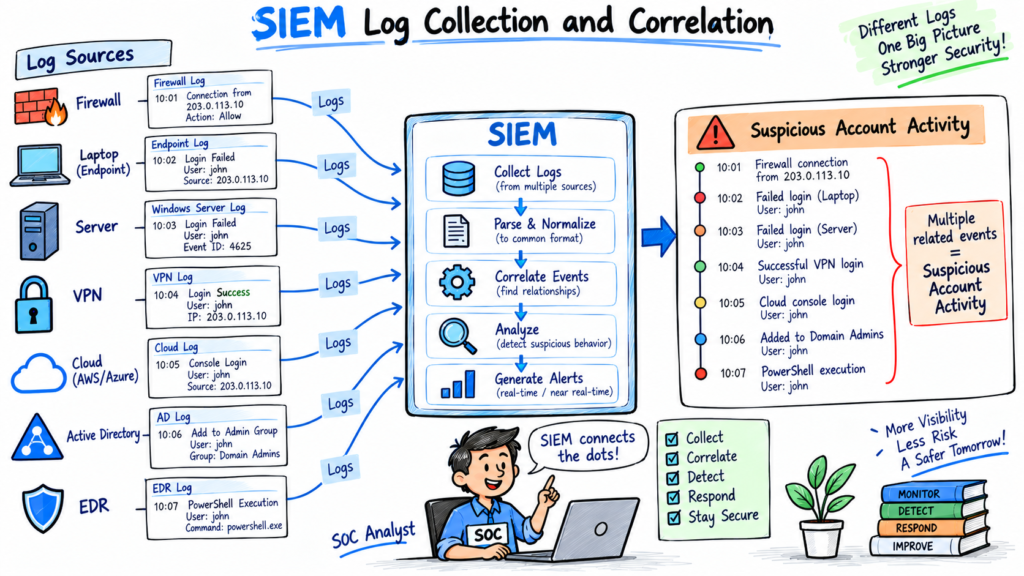
10. What is event correlation in SIEM?
Event correlation means connecting multiple events to identify a potentially meaningful security incident.
Example:
Multiple failed logins
        ↓
Successful login
        ↓
Privilege escalation
        ↓
Sensitive file access
Individually, these events may not be highly suspicious.
Together, they may indicate account compromise.
11. What is a correlation rule?
A correlation rule defines conditions under which multiple events should be considered suspicious.
Example:
IF
5 failed login attempts
within 5 minutes
FROM the same source IP
FOLLOWED BY
a successful login
THEN
generate a high-severity alert
Correlation rules help reduce the number of individual events analysts need to review.
SIEM Interview Questions and Answers 2026
12. What is a SIEM use case?
A SIEM use case describes a specific security detection or monitoring requirement.
Examples include:
- Brute-force detection
- Impossible travel
- Privilege escalation
- Malware detection
- Data exfiltration
- Suspicious PowerShell
- Account compromise
- Insider threat monitoring
- VPN anomalies
A use case generally defines:
- Data sources
- Detection logic
- Conditions
- Thresholds
- Severity
- Alert
- Investigation steps
- Response actions
13. What is a false positive in SIEM?
A false positive occurs when a SIEM generates an alert for activity that appears suspicious but is actually legitimate.
Example:
A vulnerability scanner performs hundreds of connections to servers.
The SIEM detects the activity as possible port scanning.
After investigation, the analyst confirms that the source IP belongs to the organization’s approved vulnerability scanner.
The alert is therefore a false positive.
SIEM Interview Questions and Answers 2026
14. What is a false negative?
A false negative occurs when malicious activity happens but the SIEM fails to detect it.
For example:
An attacker performs credential theft, but the required authentication and endpoint logs are not being collected.
The SIEM has insufficient visibility and does not generate an alert.
False negatives can be more difficult to identify because the detection failed completely.
15. What is alert triage?
Alert triage is the process of reviewing an alert and determining its priority and validity.
A SOC analyst may evaluate:
- Source IP
- Destination IP
- Username
- Hostname
- Timestamp
- Process
- Command line
- Authentication history
- Geolocation
- Threat intelligence
- Previous alerts
- User behavior
The analyst then determines whether the alert is:
- False positive
- Benign activity
- Suspicious activity
- Confirmed incident
SIEM Interview Questions and Answers 2026
16. What is SIEM alert severity?
Severity indicates the potential importance of an alert.
Organizations commonly use levels such as:
- Informational
- Low
- Medium
- High
- Critical
For example:
Low:
Single failed login.
Medium:
Multiple failed logins from an unusual source.
High:
Successful login after brute-force activity.
Critical:
Confirmed privileged account compromise with suspicious administrative activity.
The exact severity model depends on the organization’s security policy.
17. What is threat intelligence in SIEM?
Threat intelligence provides information about known or suspected malicious indicators.
Examples include:
- Malicious IP addresses
- Malicious domains
- URLs
- File hashes
- Malware families
- Threat actor infrastructure
A SIEM can compare observed events against threat intelligence.
For example:
Firewall Event
Source IP: 185.x.x.x
        ↓
Threat Intelligence Lookup
        ↓
Known malicious IP
        ↓
High-risk alert
18. What is IOC?
IOC stands for Indicator of Compromise.
An IOC is evidence that may indicate malicious activity.
Common IOCs include:
- IP addresses
- Domain names
- URLs
- File hashes
- Email addresses
- Malicious filenames
- Registry entries
For example:
A workstation connects to a domain known to distribute malware. The domain can be treated as an IOC.
SIEM Interview Questions and Answers 2026
19. What is IOA?
IOA stands for Indicator of Attack.
An IOA focuses more on attacker behavior than a specific artifact.
Examples include:
- Credential dumping
- Suspicious PowerShell execution
- Unusual privilege escalation
- Lateral movement
- Abnormal administrative activity
IOA-based detection can help identify attack behavior even when the exact malware or IOC is unknown.
20. What is UEBA?
UEBA stands for User and Entity Behavior Analytics.
UEBA analyzes normal behavior and identifies unusual activity.
For example:
A user normally logs in between 8 AM and 6 PM from India.
Suddenly:
- Login occurs at 3 AM.
- Login originates from another country.
- Large amounts of data are accessed.
UEBA can identify this as anomalous behavior.
SIEM Interview Questions and Answers 2026
21. What is the difference between SIEM and SOAR?
SIEM primarily focuses on:
- Log collection
- Security monitoring
- Detection
- Correlation
- Investigation
SOAR focuses more on:
- Automation
- Orchestration
- Incident response
- Playbooks
- Automated actions
Example:
SIEM:
Detects a malicious IP connection.
SOAR:
Automatically:
- Extracts the IP.
- Checks threat intelligence.
- Blocks the IP on the firewall.
- Creates a ticket.
- Notifies the SOC team.
SIEM and SOAR are often used together.
22. What is the difference between SIEM and EDR?
SIEM collects and analyzes security data from many sources across an organization.
EDR focuses primarily on endpoint activity.
EDR can monitor:
- Processes
- Files
- Registry activity
- Network connections
- Command lines
- Endpoint behavior
SIEM can ingest EDR alerts and correlate them with firewall, identity, cloud, and other security data.
Example:
EDR detects PowerShell activity
          +
AD detects unusual login
          +
Firewall detects suspicious connection
          ↓
        SIEM
          ↓
 Correlated security alert
23. What is a SIEM dashboard?
A SIEM dashboard provides a visual representation of security data.
Common dashboard metrics include:
- Number of alerts
- Critical alerts
- Failed logins
- Malware detections
- Top source IPs
- Top destination IPs
- Authentication activity
- Incident trends
- High-risk users
- Security events by geography
SOC teams use dashboards for monitoring and reporting.
SIEM Interview Questions and Answers 2026
24. What is log retention?
Log retention defines how long security logs are stored.
For example:
An organization may retain:
- 30 days of searchable logs
- 90 days of archived logs
- 1 year of compliance records
The actual retention period depends on organizational requirements, regulatory obligations, storage capacity, and investigation needs.
25. What is the difference between hot, warm, and cold data in SIEM?
These terms describe different levels of data accessibility.
Hot Data
Frequently accessed and quickly searchable.
Warm Data
Less frequently accessed and may have slower search performance.
Cold Data
Archived data retained primarily for long-term investigation or compliance.
Organizations use these storage tiers to balance performance and cost.
SIEM Interview Questions and Answers 2026
26. What is a brute-force attack, and how can SIEM detect it?
A brute-force attack involves repeated attempts to guess credentials.
A SIEM can detect patterns such as:
Source IP: 10.10.10.10

Failed login
Failed login
Failed login
Failed login
Failed login
Successful login
A detection rule could be:
Alert when more than 10 failed authentication attempts occur for the same account within 5 minutes.
The SIEM can also correlate the successful login that follows the failed attempts.
SIEM Interview Questions and Answers 2026
27. How can SIEM detect a password spraying attack?
Password spraying uses a small number of common passwords against many accounts.
Example:
user1 → Password123
user2 → Password123
user3 → Password123
user4 → Password123
Instead of looking for many failures against one account, the SIEM can look for:
- One source IP
- Many usernames
- Similar authentication failures
- Short time window
This distinguishes password spraying from traditional brute-force attacks.
28. What is impossible travel detection?
Impossible travel detection identifies authentication activity that appears geographically impossible within a short period.
Example:
10:00 AM → Login from India
10:20 AM → Login from United States
If the distance and time make normal travel impossible, the SIEM or UEBA system may generate an alert.
However, analysts should investigate VPNs, proxies, cloud gateways, corporate egress points, and other factors before treating the alert as a confirmed compromise.
SIEM Interview Questions and Answers 2026
29. How can SIEM detect privilege escalation?
SIEM can monitor events such as:
- User added to administrator group
- Privileged account creation
- Permission changes
- sudo activity
- Windows privilege assignment
- IAM role changes
Example:
Normal user
     ↓
Added to Domain Admins
     ↓
Sensitive server accessed
     ↓
SIEM alert
The analyst should verify whether the privilege change was authorized.
30. How can SIEM detect lateral movement?
Lateral movement occurs when an attacker moves from one compromised system to other systems within an environment.
SIEM can monitor:
- RDP
- SMB
- SSH
- WinRM
- Remote services
- Administrative logins
- Authentication patterns
Example:
Workstation A
     ↓
Compromised account
     ↓
RDP to Server B
     ↓
SMB connection to Server C
Correlation of these events can help identify suspicious lateral movement.
SIEM Interview Questions and Answers 2026
31. How can SIEM detect data exfiltration?
SIEM can detect unusual data transfer by analyzing:
- Network traffic
- Proxy logs
- Firewall logs
- Cloud activity
- DLP alerts
- DNS activity
- Authentication events
Example:
A user normally transfers a few megabytes per day but suddenly uploads several gigabytes to an unknown external service.
The SIEM can correlate the unusual upload with the user’s identity and endpoint activity.
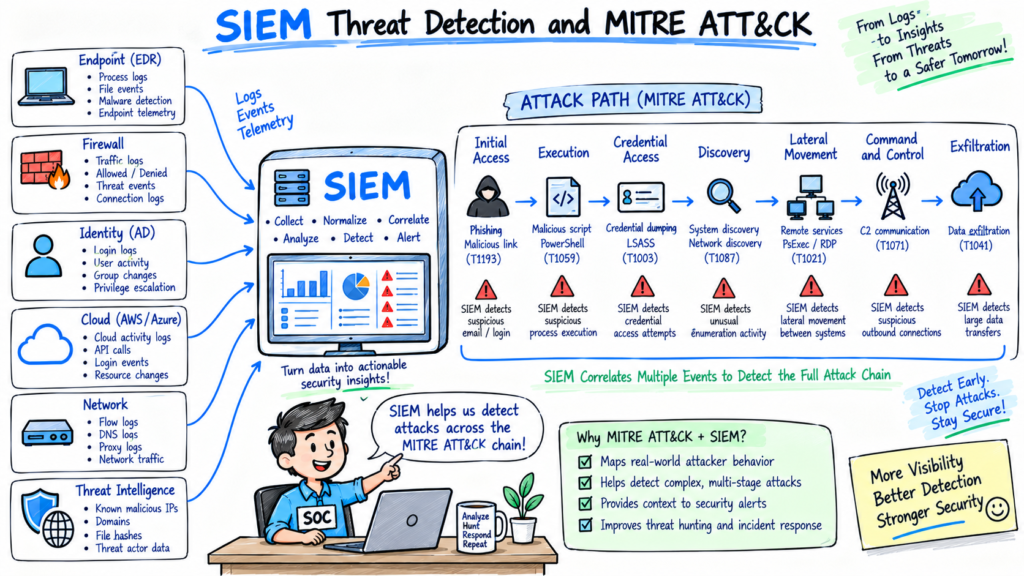
32. What is MITRE ATT&CK, and how is it used with SIEM?
MITRE ATT&CK is a knowledge base describing adversary tactics and techniques.
Common tactics include:
- Initial Access
- Execution
- Persistence
- Privilege Escalation
- Defense Evasion
- Credential Access
- Discovery
- Lateral Movement
- Collection
- Command and Control
- Exfiltration
- Impact
Security teams can map SIEM detection rules to MITRE ATT&CK techniques.
For example:
Suspicious PowerShell execution → T1059.001
This helps organizations understand their detection coverage.
33. What is a detection rule?
A detection rule defines logic used to identify suspicious activity.
Example:
IF
PowerShell is executed
AND
encoded command is detected
AND
the parent process is Microsoft Word
THEN
generate a high-severity alert
Detection rules can be based on:
- Thresholds
- Correlation
- Behavioral analytics
- Threat intelligence
- Known attack patterns
- Statistical anomalies
34. What is a threshold-based detection?
A threshold-based detection triggers when an activity exceeds a predefined limit.
Example:
More than 20 failed logins
from the same IP
within 5 minutes
The SIEM generates an alert when the threshold is reached.
Threshold-based detection is simple and useful, but attackers may attempt to stay below the threshold.
SIEM Interview Questions and Answers 2026
35. What is anomaly-based detection?
Anomaly detection identifies activity that differs from expected behavior.
Example:
A server normally sends 100 MB of outbound traffic per day.
Suddenly, it sends 20 GB.
The SIEM or analytics engine may flag this as anomalous.
Anomaly detection can identify previously unknown patterns, but it may also generate false positives when legitimate behavior changes.
36. What is the role of timestamps in SIEM investigation?
Timestamps are critical for reconstructing the sequence of events.
For example:
09:10 Failed login
09:12 Failed login
09:14 Successful login
09:20 Privilege escalation
09:25 Sensitive file access
09:30 External connection
This timeline helps the analyst understand what happened first and how the incident progressed.
Time synchronization using technologies such as NTP is therefore important.
SIEM Interview Questions and Answers 2026
37. What is time normalization in SIEM?
Different systems may record timestamps differently.
For example:
- UTC
- IST
- EST
- Local server time
SIEM platforms normalize timestamps so analysts can compare events accurately.
Incorrect time synchronization can make incident investigation difficult.
38. What is a SIEM query?
A SIEM query searches security data for specific events or patterns.
For example, an analyst may search for:
failed authentication
AND
source_ip = 10.10.10.20
The exact query language depends on the SIEM.
Examples include:
- SPL in Splunk
- KQL in Microsoft Sentinel
- AQL in IBM QRadar
39. What is SPL?
SPL stands for Search Processing Language and is used by Splunk.
Example:
index=security EventCode=4625
| stats count by src_ip, user
| sort -count
This type of query can help identify repeated Windows authentication failures.
SPL is commonly used for:
- Searching logs
- Filtering events
- Statistical analysis
- Correlation
- Reporting
40. What is KQL in Microsoft Sentinel?
KQL stands for Kusto Query Language.
Microsoft Sentinel uses KQL for searching and analyzing security data.
Example:
SigninLogs
| where ResultType != 0
| summarize FailedAttempts=count() by UserPrincipalName, IPAddress
This can help analysts identify failed authentication activity.
SIEM Interview Questions and Answers 2026
41. What is AQL in IBM QRadar?
AQL stands for Ariel Query Language.
IBM QRadar uses AQL to search and analyze events and flows.
AQL can be used to:
- Filter events
- Search historical data
- Analyze network activity
- Investigate security incidents
It is useful when performing detailed investigations in QRadar.
42. What is a SOC analyst’s role in SIEM monitoring?
A SOC analyst commonly uses SIEM to:
- Monitor alerts.
- Perform initial triage.
- Validate suspicious activity.
- Investigate related events.
- Check threat intelligence.
- Determine the scope of the activity.
- Document findings.
- Escalate confirmed incidents.
- Track remediation.
- Close or tune false-positive alerts.
The exact responsibilities depend on the SOC’s L1, L2, and L3 structure.
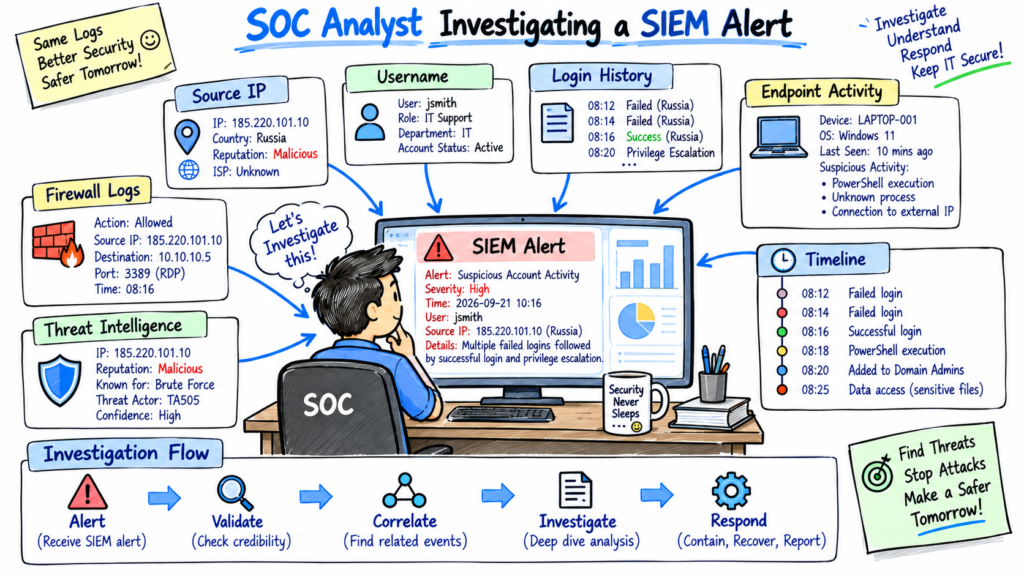
43. How would you investigate a suspicious login alert?
I would follow a structured investigation.
Step 1: Check the user
Identify:
- Username
- Department
- Privilege level
- Normal login behavior
Step 2: Check the source
Investigate:
- Source IP
- Geolocation
- ASN
- VPN/proxy information
- Threat intelligence
Step 3: Check authentication history
Look for:
- Failed attempts
- Successful attempts
- MFA events
- Password changes
- Previous logins
Step 4: Check endpoint activity
Look for:
- Suspicious processes
- Malware detections
- PowerShell
- New persistence mechanisms
Step 5: Check additional systems
Review:
- VPN
- Cloud applications
- Active Directory
- EDR
Then determine whether the login was legitimate, suspicious, or part of a confirmed incident.
SIEM Interview Questions and Answers 2026
44. How would you investigate a malware alert in SIEM?
I would first identify:
- Affected user
- Hostname
- Malware name
- File hash
- File path
- Detection timestamp
- Parent process
- Network connections
Then I would correlate SIEM data with:
- EDR
- Firewall
- DNS
- Proxy
- Authentication
- Threat intelligence
For example:
Malware detected
      ↓
Process executed
      ↓
DNS request
      ↓
Connection to suspicious domain
      ↓
User account activity
This helps determine whether the malware detection is isolated or part of a larger attack.
45. What would you do if a SIEM suddenly stopped receiving logs?
I would troubleshoot systematically.
Step 1: Identify affected log sources
Determine whether:
- One source is affected
- Multiple sources are affected
- An entire log collector is affected
Step 2: Check connectivity
Verify:
- Network connectivity
- Ports
- Firewall rules
- Routing
Step 3: Check the log source
Verify:
- Service status
- Agent status
- Configuration
- Disk space
- CPU and memory
Step 4: Check SIEM ingestion
Verify:
- Collector status
- Parsing
- Queue
- Indexing
- Storage
Step 5: Check recent changes
Look for:
- Firewall changes
- Agent upgrades
- Certificate changes
- Configuration changes
- Network changes
Finally, restore log ingestion and validate that events are reaching the SIEM correctly.
SIEM Interview Questions and Answers 2026
46. How do you reduce SIEM false positives?
False positives can be reduced by improving detection logic.
Common approaches include:
Tune thresholds
Instead of alerting on every failed login, trigger after a reasonable number of attempts.
Create allowlists
Exclude trusted systems such as:
- Vulnerability scanners
- Monitoring systems
- Backup servers
Add context
Use:
- Asset criticality
- User role
- Threat intelligence
- Device information
- Location
- Business context
Improve correlation
Combine multiple events instead of generating an alert from a single low-risk event.
Review alerts regularly
Detection rules should be reviewed and tuned as the environment changes.
47. What is a high-value asset in SIEM monitoring?
A high-value asset is a system that requires increased security monitoring because compromise could have significant consequences.
Examples include:
- Domain controllers
- Payment systems
- Database servers
- Critical applications
- Cloud management accounts
- Security infrastructure
SIEM rules can assign higher priority to suspicious activity involving these assets.
For example:
A failed login against a normal workstation may be low severity.
The same activity against a Domain Controller may require much closer investigation.
SIEM Interview Questions and Answers 2026
48. How would you create a SIEM use case for brute-force detection?
I would define the use case in several steps.
Objective
Detect repeated authentication failures that may indicate credential attacks.
Data Sources
- Active Directory
- VPN
- Cloud identity
- Linux authentication logs
- Application authentication logs
Detection Logic
For example:
More than 10 failed authentication attempts
from the same source
within 5 minutes
Then add context such as:
- Target account
- Source IP
- Geographic location
- Successful login afterward
- User privilege level
Severity
Assign severity based on organizational risk.
Response
The alert could trigger:
- SOC investigation
- User verification
- Account lockout according to policy
- IP blocking where appropriate
- Incident creation
The use case should be tested with both legitimate and malicious scenarios before production deployment.
49. What is SIEM threat hunting?
Threat hunting is the proactive search for suspicious activity that may not have generated an alert.
Instead of waiting for an alert, the analyst searches for patterns such as:
- Rare PowerShell commands
- Unusual administrative logins
- Suspicious DNS requests
- Abnormal authentication
- Rare external connections
- Unexpected privilege changes
For example, a threat hunter may search for all endpoints executing PowerShell with encoded commands during the previous 30 days.
Threat hunting can uncover activity that existing detection rules missed.
SIEM Interview Questions and Answers 2026
50. How would you handle a suspected compromised user account?
I would follow the organization’s incident response process.
Step 1: Validate the alert
Review:
- Login history
- Source IP
- Device
- Location
- MFA activity
- User behavior
Step 2: Determine the scope
Check whether the account accessed:
- VPN
- Internal applications
- Cloud resources
- Sensitive systems
Step 3: Check endpoint activity
Review EDR and SIEM events for suspicious processes or malware.
Step 4: Contain the account
Depending on the organization’s procedures, actions may include:
- Disabling the account
- Revoking sessions
- Resetting credentials
- Requiring MFA reauthentication
Step 5: Investigate persistence
Check for:
- New accounts
- Privilege changes
- OAuth applications
- Mail forwarding rules
- API tokens
- Persistence mechanisms
Step 6: Document and escalate
Record:
- Timeline
- Indicators
- Affected systems
- Actions taken
- Evidence
- Final findings
A compromised account should be treated as an incident until the investigation establishes that the activity was legitimate.
SIEM Interview Questions and Answers 2026
Conclusion
SIEM knowledge is important for SOC Analysts, Cybersecurity Analysts, Security Engineers, Incident Responders, and Security Operations professionals.
For interviews, focus on understanding how security events move through the SIEM:
Log Source → Collection → Parsing → Normalization → Correlation → Detection → Alert → Investigation → Response
You should also practice real-world scenarios such as brute-force attacks, password spraying, suspicious logins, privilege escalation, lateral movement, malware detection, and compromised accounts.
If you can explain both the SIEM concept and your investigation approach, you will be better prepared for technical and scenario-based cybersecurity interviews.
Recommended next step: Practice these 50 questions aloud and prepare 2–3 real-world SIEM investigation examples based on your own experience.
Related Cybersecurity Articles
If you are preparing for a cybersecurity, SOC Analyst, or SIEM interview, these related guides can help you strengthen your knowledge of security monitoring, networking, endpoint security, identity, cloud security, and SIEM.
- Security Information and Event Management: Complete SIEM Guide 2026
- SOC Analyst Roadmap 2026: L1, L2, and L3 Roles, Skills, and Tools
- Endpoint Security Guide 2026 for Every Organization
- Identity and Access Management in 2026
- Cloud Security Basics 2026: Complete Beginner Guide
- Network Security Basics Guide for Beginners 2026
- Firewall in Cybersecurity: Types, Examples and How It Works
- EDR vs XDR vs MDR Comparison 2026
External Resources
For additional information about SIEM, security logging, threat detection, and cybersecurity frameworks, refer to these authoritative resources:
- NIST Guide to Computer Security Log Management
- MITRE ATT&CK
- Microsoft Sentinel Documentation
- Splunk Enterprise Security
- IBM QRadar SIEM
Disclaimer
The information provided in this SIEM Interview Questions and Answers 2026 guide is intended for educational and interview preparation purposes only. SIEM platforms, cybersecurity technologies, detection methods, query languages, and security practices can change over time. Examples and explanations are simplified for learning and may differ depending on an organization’s security architecture, SIEM platform, configuration, and security policies.
TechNaga does not guarantee employment, interview success, certification results, or any specific outcome based on the information provided in this article. Always refer to official vendor documentation and your organization’s security policies when implementing SIEM, security monitoring, detection rules, incident response procedures, or other cybersecurity controls.