If you work in network security, you have probably seen both acronyms in the same vendor slide and wondered whether they mean the same thing. They do not. The SASE vs SSE question decides who owns the project, what hardware changes at your branches and how fast you can retire legacy VPNs.
In this SASE vs SSE guide, I explain what each framework covers, how traffic flows in both models and the 7 differences that matter in real projects. I also show exactly where Zscaler fits, because Zscaler is one of the most common names in both conversations, and walk through three enterprise scenarios you are likely to meet at work or in an interview.
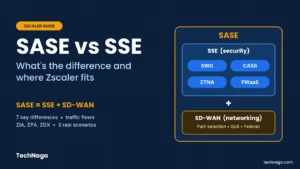
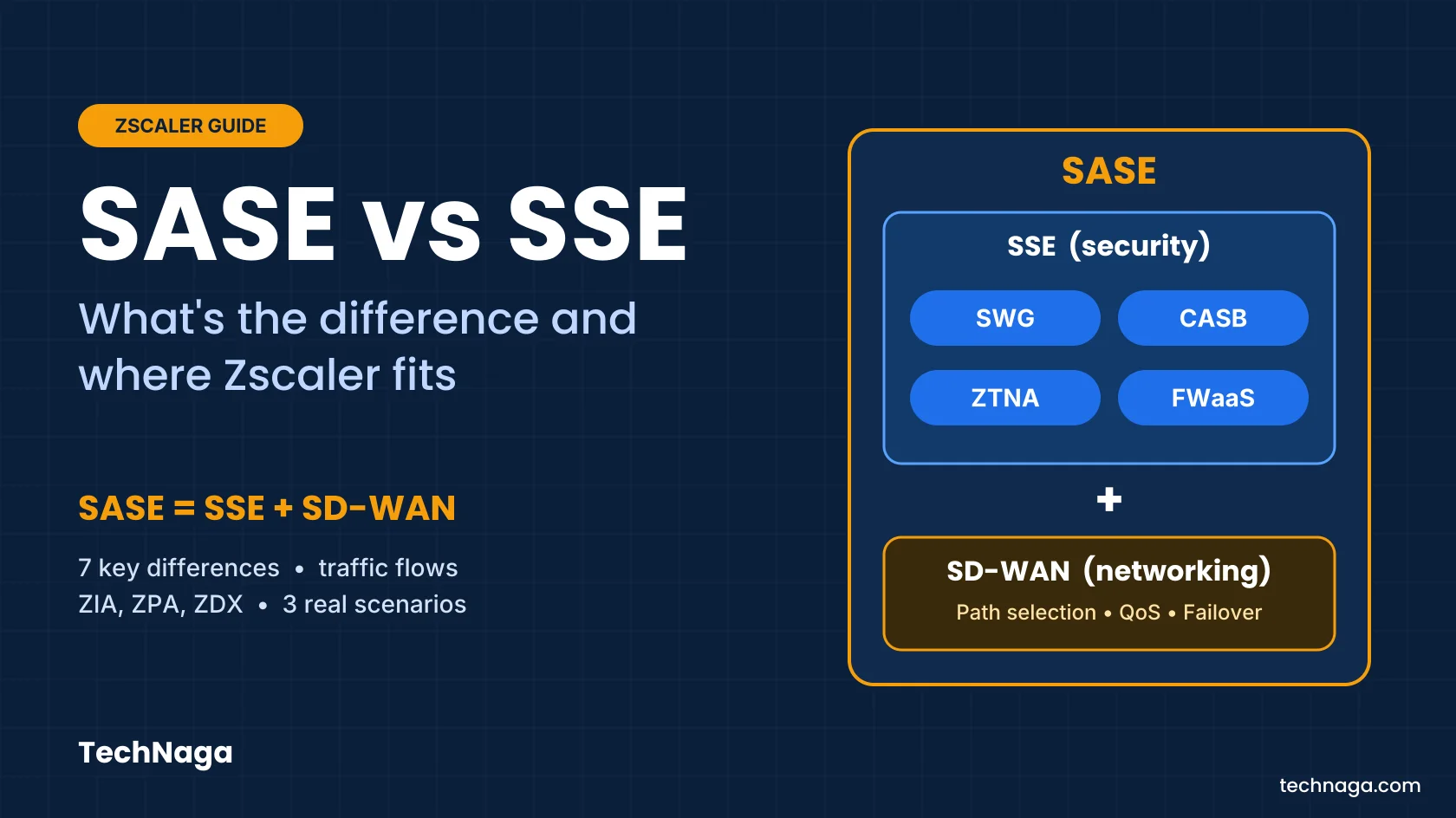
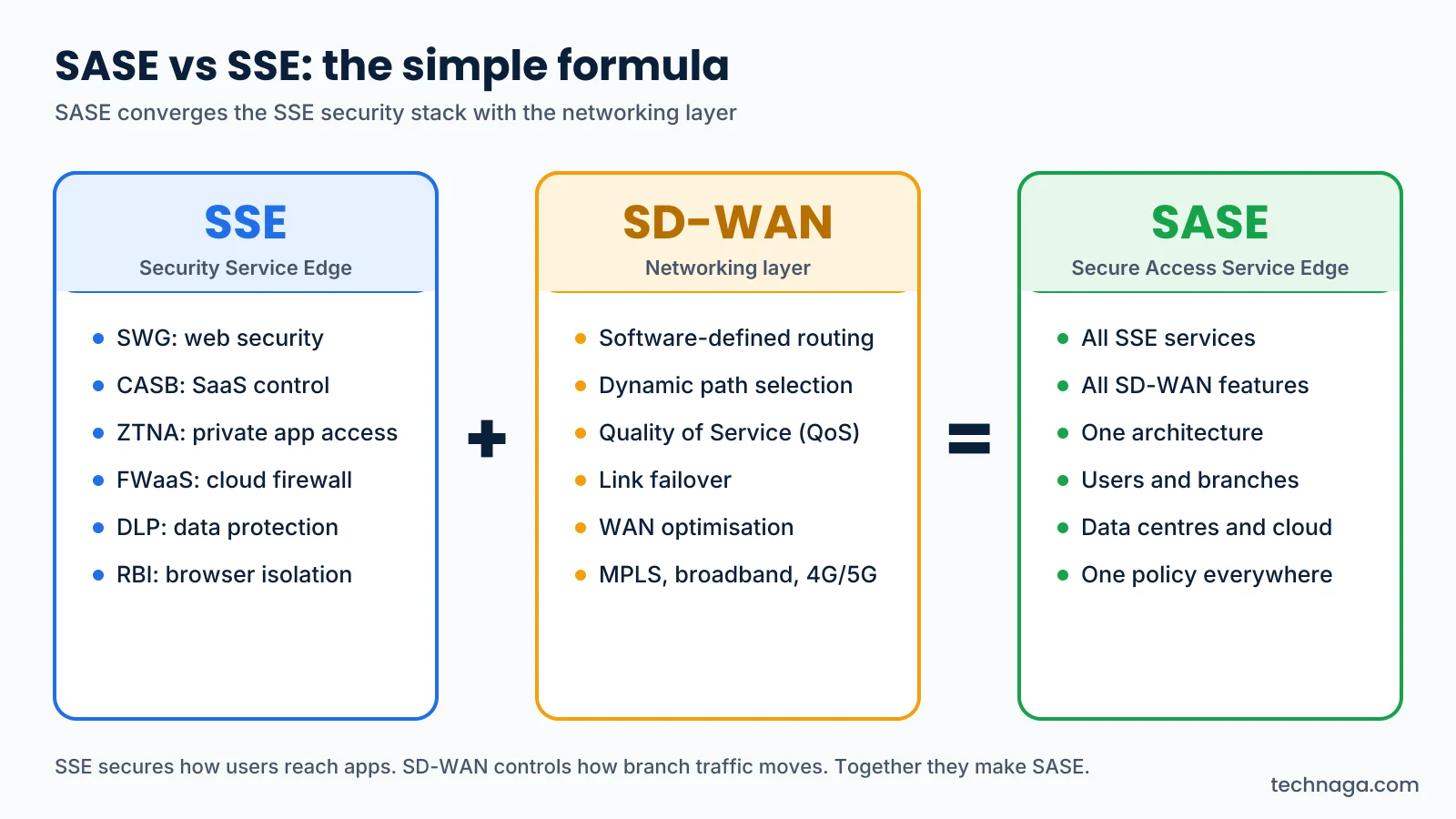
Quick answer: SASE vs SSE Security Service Edge (SSE) is the cloud-delivered security layer: secure web gateway, CASB, ZTNA and firewall as a service. Secure Access Service Edge (SASE) is SSE plus the networking layer, mainly SD-WAN. In short, SASE = SSE + SD-WAN. Zscaler started as an SSE platform and reaches full SASE through SD-WAN partners or its own Zero Trust SD-WAN appliance.
What Is Security Service Edge (SSE)?
Security Service Edge is a set of security services delivered from a vendor’s cloud instead of from appliances in your data centre. Gartner introduced the SSE category in 2021, two years after it defined SASE, to describe the security half of the SASE model.
An SSE platform usually combines these services under one policy engine:
- Secure Web Gateway (SWG): inspects user traffic to the internet, blocks malicious sites and enforces acceptable use policies.
- Cloud Access Security Broker (CASB): gives visibility and control over SaaS applications, both inline and through APIs.
- Zero Trust Network Access (ZTNA): connects users to specific private applications instead of placing them on the network.
- Firewall as a Service (FWaaS): applies firewall and intrusion prevention rules in the cloud for non-web traffic.
- Data protection: Data Loss Prevention (DLP), and often Remote Browser Isolation (RBI), across web and SaaS channels.
The key point is what SSE does not touch. It secures “north-south” traffic, meaning user-to-internet, user-to-SaaS and user-to-private-application flows. It does not change how your branch routers, MPLS circuits or WAN paths work. The Cloud Security Alliance describes this well: SSE services should be network-agnostic and not dependent on the underlying network. Keep this boundary in mind, because it drives most SASE vs SSE decisions later in this guide.
What Is Secure Access Service Edge (SASE)?
Secure Access Service Edge is the broader framework Gartner defined in 2019. It converges network services and security services into one cloud-delivered architecture. In practical terms, SASE is the full SSE security stack plus the WAN edge.
The networking half of SASE typically includes:
- SD-WAN: software-defined routing across multiple links such as MPLS, broadband and 4G/5G.
- Dynamic path selection: choosing the best link per application based on latency, jitter and packet loss.
- Quality of Service (QoS): prioritising voice and video over bulk traffic.
- WAN optimisation: reducing the impact of distance and poor links on application performance.
Because SASE controls how traffic moves, not only how it is secured, it covers more traffic types: branch-to-internet, branch-to-branch, branch-to-data-centre and branch-to-cloud. That wider scope is the heart of the SASE vs SSE difference.
SASE vs SSE: 7 Essential Differences at a Glance
The table below summarises the SASE vs SSE comparison. I explain the differences that cause the most confusion right after it.
| Area | SSE (Security Service Edge) | SASE (Secure Access Service Edge) |
|---|---|---|
| 1. Scope | Security only | Security plus networking |
| 2. Core components | SWG, CASB, ZTNA, FWaaS, DLP | Everything in SSE plus SD-WAN, QoS and path selection |
| 3. Traffic covered | User-to-internet, user-to-SaaS, user-to-private app | All SSE flows plus branch-to-branch, branch-to-data-centre and branch-to-cloud |
| 4. Branch hardware | No change to existing routers | SD-WAN appliances replace or sit beside branch routers |
| 5. Teams involved | Mostly the security team | Security and network teams, often with carrier contracts |
| 6. Time to value | Weeks for first user groups | Months, usually tied to WAN refresh cycles |
| 7. Best starting point | Remote access and web security problems | MPLS cost, branch performance and WAN refresh projects |
Ownership is the hidden difference. An SSE project can be run by the security team alone. A SASE project almost always involves NetOps, procurement and the carrier, because it changes physical circuits and routing. In my experience, this is why many organisations start with SSE and add SD-WAN later.
SSE is not “SASE-lite”. It is a complete security platform. If your WAN is stable and your biggest risks are remote access, web threats and data leaving through SaaS, SSE solves the problem without any network redesign.
SD-WAN alone is not SASE either. An SD-WAN with a basic built-in firewall still extends the corporate network to every branch. Without a full SSE stack, you have modern routing, not modern security.
How Traffic Flows in SSE vs SASE
The easiest way to understand SASE vs SSE is to follow a packet in each model.
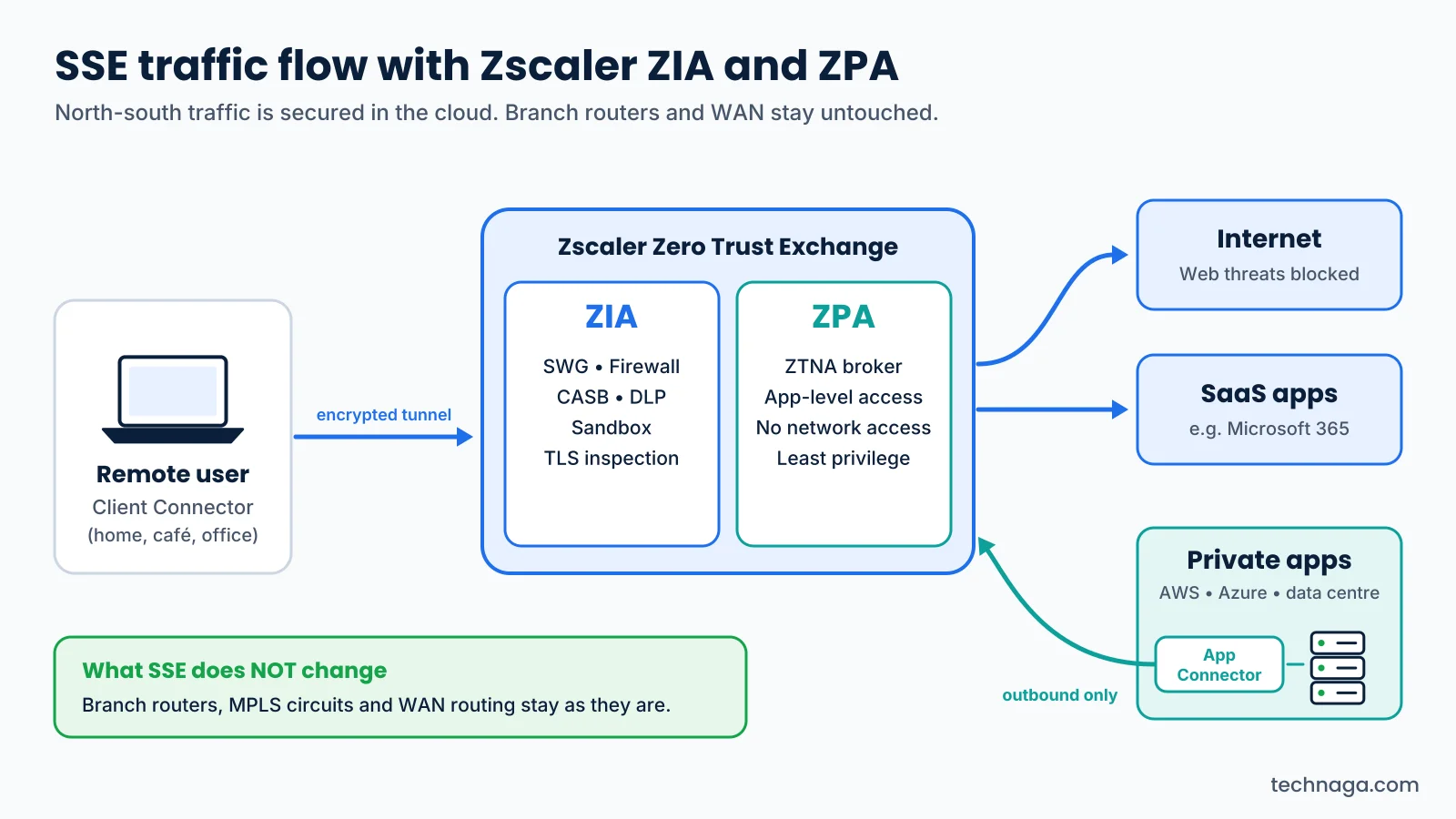
SSE example: a remote user opens Microsoft 365
- The user’s laptop runs an agent, for example Zscaler Client Connector, which forwards traffic to the nearest cloud point of presence.
- The SSE cloud authenticates the user with the identity provider and checks device posture.
- Internet and SaaS traffic goes through the SWG, CASB and DLP policies, including TLS inspection where policy allows.
- Private application traffic is brokered through ZTNA. The user reaches only the approved application, not the subnet behind it.
- The branch router and WAN are never involved.
SASE example: a branch office makes a VoIP call and opens a data centre app
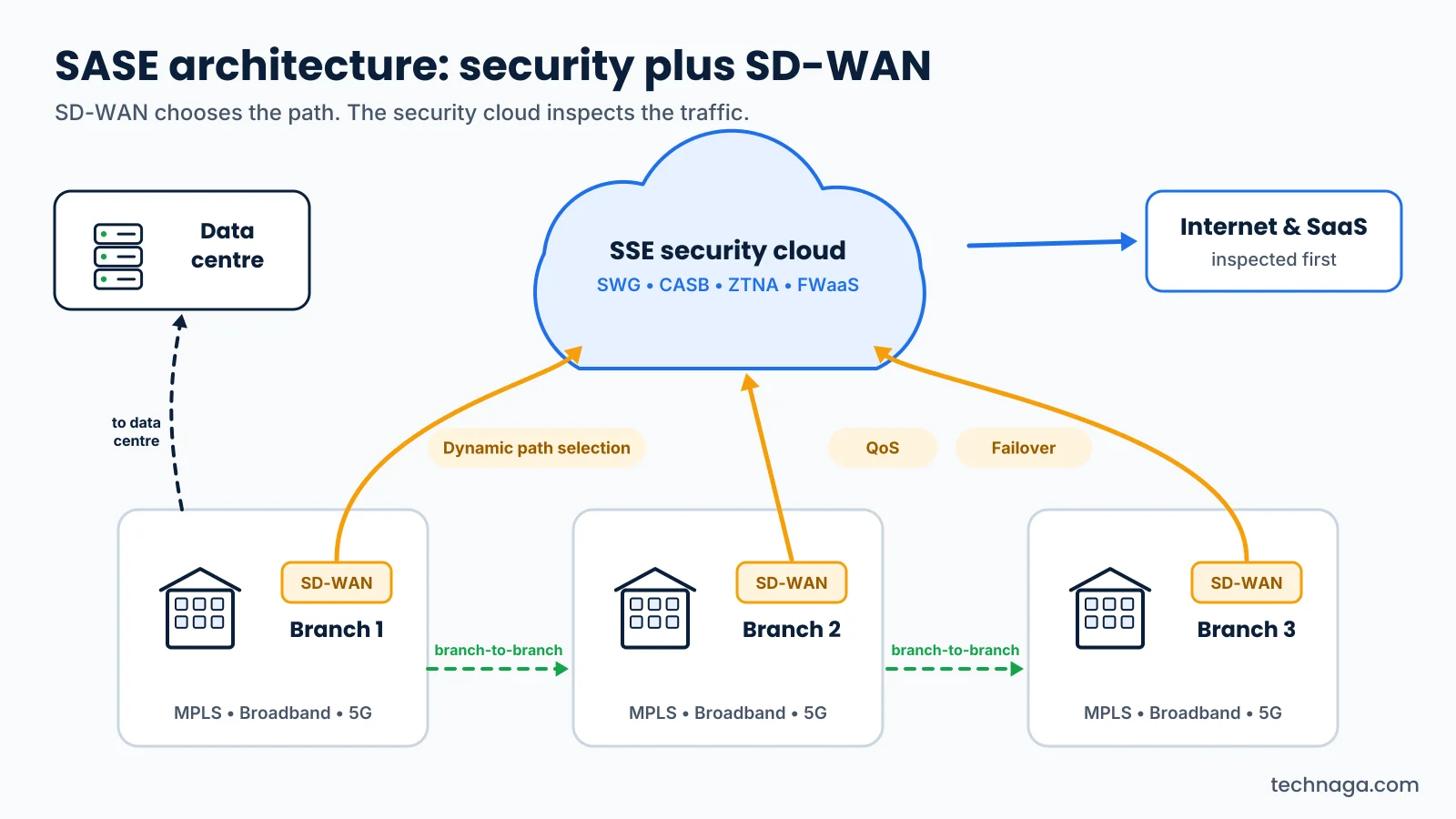
- The branch SD-WAN appliance classifies the traffic and sees one voice flow and one internal application flow.
- It sends the voice call over the healthiest link, for example broadband, and applies QoS.
- Internet-bound traffic is steered through a tunnel to the SSE cloud for inspection.
- If a link degrades, the SD-WAN fails over to another link without the user noticing.
- Security policy stays the same whether the user is in the branch or at home.
Where Zscaler Fits in the SASE vs SSE Picture
In the SASE vs SSE debate, Zscaler is a cloud-native SSE pioneer. Its platform, the Zero Trust Exchange, runs as a multi-tenant security cloud across more than 150 data centres worldwide. Users and branches connect to the nearest data centre, where policy is enforced inline. If you are new to the platform, our Zscaler fundamentals interview guide explains the architecture in detail.
Zscaler Internet Access (ZIA): SSE for internet and SaaS
ZIA is the inline security engine for web and SaaS traffic. It provides SWG, cloud firewall, inline and API-based CASB, DLP, cloud sandbox and browser isolation, with full TLS inspection. Traffic reaches ZIA through Client Connector, GRE or IPsec tunnels from branch devices, or PAC files. You can explore it further in our ZIA interview questions guide.
Zscaler Private Access (ZPA): ZTNA for private apps
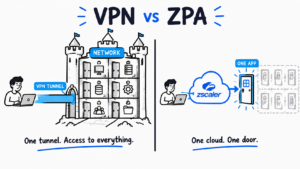
ZPA delivers ZTNA. Lightweight App Connectors sit next to your applications in AWS, Azure or the data centre and make outbound-only connections to the Zscaler cloud. The user connects to an application, never to the network, so there are no inbound firewall ports and far less room for lateral movement. We compared this model with traditional remote access in VPN vs ZPA.
Zscaler Digital Experience (ZDX): visibility across the path
ZDX monitors the full path from the device to the application: Wi-Fi, ISP, the Zscaler cloud and the application itself. It gives each user a ZDX Score, so the help desk can see whether a slow Teams call is caused by the laptop, the home network or the application. See our ZDX interview questions for real troubleshooting examples.
Zscaler SASE: two ways to handle the branch
Zscaler SASE completes the picture at the branch in one of two ways:
- Dual-vendor SASE with SD-WAN partners. Your existing SD-WAN steers internet traffic to ZIA over GRE or IPsec tunnels. Several vendors automate this. Versa added API-driven tunnel provisioning to ZIA in 2026, and Palo Alto Networks Prisma SD-WAN uses a Zscaler CloudBlade to build and maintain the tunnels automatically.
- Zscaler Zero Trust SD-WAN. A physical or virtual Zscaler appliance forwards branch traffic straight to the Zero Trust Exchange over any broadband link. Zscaler describes the goal as treating every branch “much like a café”: no site-to-site VPN and no routed network between sites. In 2024, Zscaler also acquired Airgap Networks to add agentless segmentation for IoT and OT devices inside the branch LAN.
This is the important architectural difference. Many SASE vendors extend a Layer 3 routing fabric to every site. Zscaler connects users and devices to applications instead, so a compromised branch device cannot simply route to other sites.

Single-vendor vs dual-vendor SASE: an honest view
Neither model is automatically better. Single-vendor SASE gives you one console, one support contract and one policy model, which suits smaller teams. Dual-vendor SASE lets you keep a best-of-breed SD-WAN you already trust and pair it with a mature SSE platform, which suits large enterprises with existing WAN investments. The right choice depends on your WAN contracts, team skills and refresh cycle, not on the label.
SASE vs SSE in 3 Real-World Scenarios
These are textbook scenarios based on common enterprise patterns. They show how the SASE vs SSE choice plays out: when SSE alone is enough and when full SASE makes sense.
1. Replacing a legacy VPN for a hybrid workforce (SSE fit)
Situation: An example global company has 15,000 hybrid employees using VPN concentrators in its data centres. Microsoft 365 is slow because traffic hairpins through the VPN, and the exposed VPN gateways are a constant patching worry. The branch WAN is stable and not due for refresh.
Approach: The company deploys Client Connector to laptops and installs ZPA App Connectors in AWS, Azure and its data centres. Internet and SaaS traffic goes to ZIA for inspection, while private apps are brokered through ZPA.
Outcome: The public VPN gateways are retired, Microsoft 365 traffic goes direct to the nearest Zscaler data centre and users no longer join the corporate network. No branch router or carrier contract changes. In SASE vs SSE terms, this is a pure SSE win.
2. Branch modernisation and MPLS offload (full SASE)
Situation: An example retail bank runs 300 branches. All traffic is backhauled over MPLS to a central data centre before reaching the cloud, so SaaS and VoIP performance suffer and circuit costs keep rising.
Approach: The bank deploys SD-WAN appliances at each branch and adds dual broadband links beside MPLS. The SD-WAN steers internet and SaaS traffic into ZIA through automated tunnels, or the bank uses Zscaler Zero Trust SD-WAN for new sites.
Outcome: Expensive MPLS capacity can be reduced, critical apps fail over automatically between links and every branch enforces the same cloud security policy. Here the SASE vs SSE answer is clearly SASE: it needs both halves, so the network team leads alongside security.
3. Mergers, contractors and shadow AI (zero trust application access)
Situation: An example financial services firm acquires smaller companies every year and works with offshore contractors. Merged networks have overlapping IP subnets, contractor network access fails audits and employees paste confidential data into unapproved AI tools.
Approach:
- Contractors: ZPA Browser Access gives agentless, browser-based access to approved web apps, with no network-level access.
- Mergers: Because ZPA connects users at the application layer, not by routing packets between networks, overlapping subnets do not block access. The acquired company can use parent applications without NAT redesign.
- Shadow AI: ZIA inline CASB and DLP inspect outbound sessions and block sensitive data uploads to unsanctioned cloud storage and generative AI sites.
Outcome: Integration time drops sharply, third parties get least-privilege access only and data leaving through web channels is controlled. Again, no WAN redesign is needed, which is why SSE often comes first in M&A.
From the Field: Questions I Ask Before Recommending SSE or SASE
When I design Zscaler deployments, I avoid starting with the SASE vs SSE acronyms. I start with these questions:
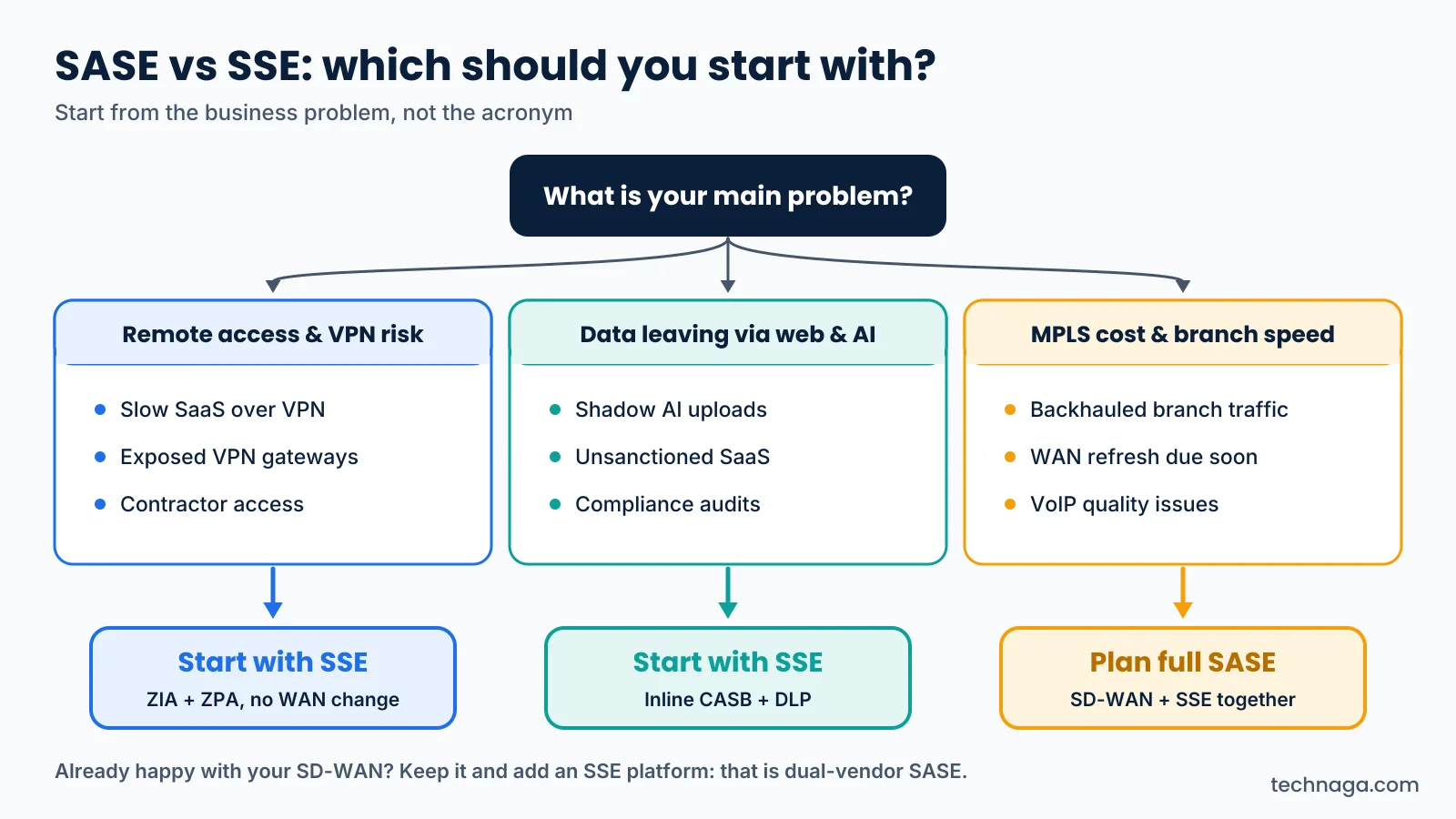
- What is the main problem? If it is remote access, web threats or data leakage, start with SSE. If it is MPLS cost or branch performance, plan for SASE.
- When do WAN contracts and router support end? A WAN refresh in the next 12 to 18 months is the natural moment to add SD-WAN.
- Who owns the budget? Security-led budgets usually fund SSE first. Joint network and security budgets make SASE realistic.
- Which applications are still on-premises? These define your ZPA application segments and App Connector placement.
- Can we inspect TLS? Without TLS inspection, SWG, CASB and DLP lose most of their value. Plan certificate deployment and exemptions early.
- How will we measure success? Agree on numbers such as VPN gateways retired, help desk tickets for slow apps and time to onboard a contractor.
Tip: Run SSE and your existing VPN side by side for a few weeks and move user groups in stages. It keeps rollback simple and builds trust with users.
Common SASE vs SSE Misconceptions
- “SASE means one vendor.” No. Gartner recognises both single-vendor and dual-vendor approaches.
- “SSE is only for remote users.” Branch traffic can reach an SSE cloud through GRE or IPsec tunnels from existing routers or firewalls.
- “SASE replaces every firewall.” Data centre firewalls, OT networks and east-west segmentation still need a plan. Read our network segmentation guide for the basics.
- “Zero Trust and SSE are the same.” Zero Trust is a security model. SSE is one way to deliver it. Our Zero Trust security guide covers the model itself.
Frequently Asked Questions
What is the main difference between SASE vs SSE?
SSE covers only cloud-delivered security services such as SWG, CASB, ZTNA and FWaaS. SASE combines those security services with networking, mainly SD-WAN, so it also controls how branch traffic moves across the WAN.
Is Zscaler SASE or SSE?
Zscaler’s core platform is SSE: ZIA, ZPA and ZDX. It delivers full SASE by integrating with SD-WAN partners or through its own Zero Trust SD-WAN appliance.
Can I start with SSE and move to SASE later?
Yes, and it is the most common path. SSE needs no WAN changes, so you can secure users first and add SD-WAN when your WAN contracts or branch routers are due for refresh.
Does SSE replace a VPN?
For user access to private applications, yes. ZTNA services such as ZPA are designed to replace remote access VPNs. Site-to-site links may still need a separate solution until SD-WAN or Zero Trust SD-WAN is in place.
Is SD-WAN required for SASE?
SD-WAN or an equivalent networking layer is what turns SSE into SASE. Without it, you have a strong security platform but no control over WAN path selection, QoS or branch failover.
Which is better for small businesses: SASE vs SSE?
Small businesses with a few offices and mostly remote staff usually get the fastest value from SSE. A single-vendor SASE bundle can make sense when they also need to replace branch routers.
Conclusion: SASE vs SSE
The SASE vs SSE decision is really about scope. Security Service Edge secures how users reach the internet, SaaS and private applications. Secure Access Service Edge adds the networking layer that controls how branches connect. Zscaler sits firmly in the SSE camp with ZIA, ZPA and ZDX, and extends to Zscaler SASE through SD-WAN partners or its own Zero Trust SD-WAN.
If you are building your Zscaler skills, read VPN vs ZPA next, or test yourself with our ZPA interview questions.
Is your organisation starting with SSE or going straight to SASE? Share your approach in the comments below.
References
- Cloud Security Alliance: Security Service Edge (SSE) reflects a changing market
- Zscaler: What is Security Service Edge (SSE)?
- Zscaler: Zero Trust SD-WAN
- Zscaler press release: Acquisition of Airgap Networks (April 2024)
- Versa: Secure SD-WAN integration with Zscaler Internet Access
- Palo Alto Networks: Prisma SD-WAN and Zscaler Internet Access CloudBlade