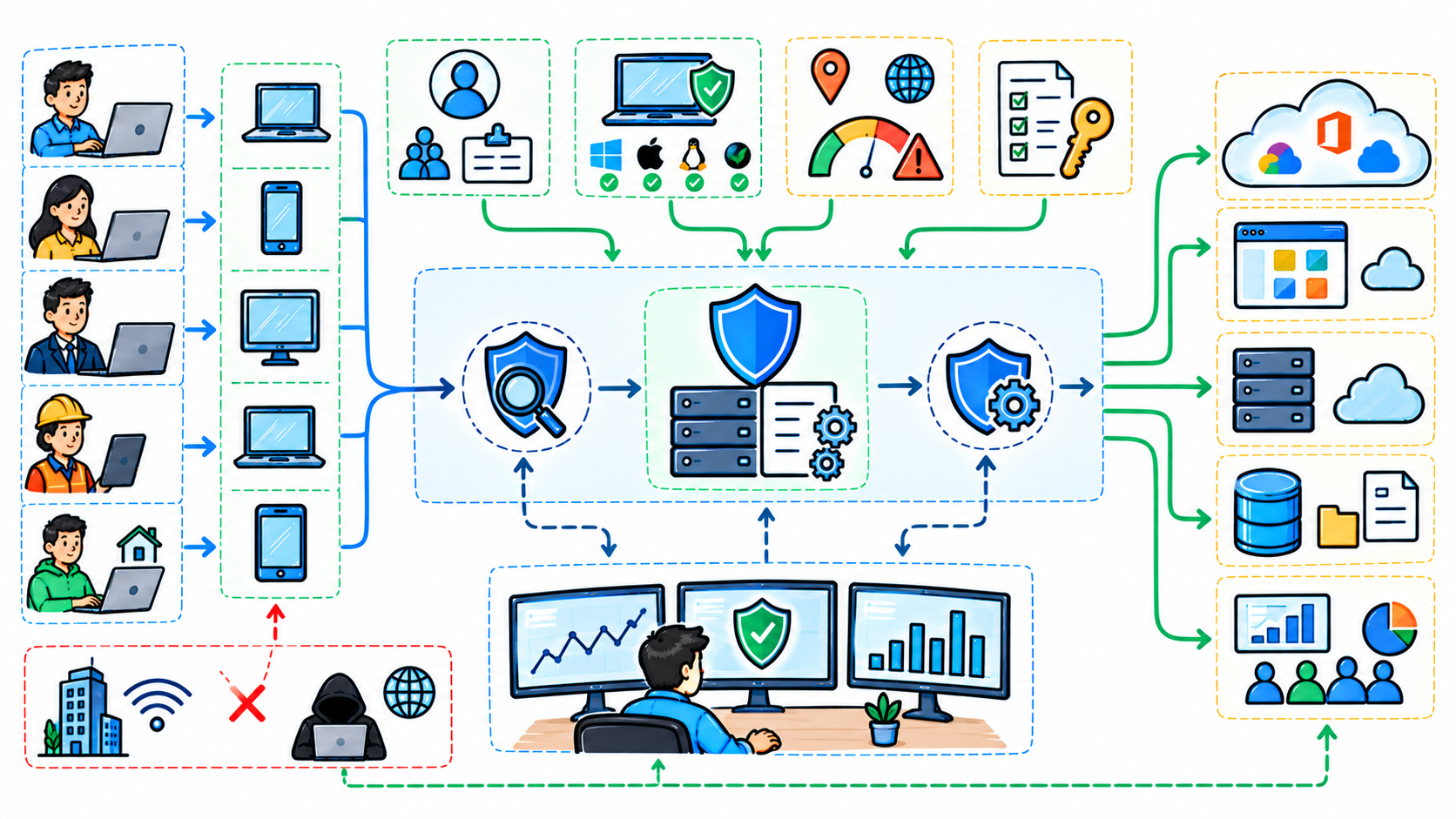
Zero Trust Security has become a major cybersecurity architecture for organizations moving away from traditional perimeter-based security toward identity-aware, application-level, and continuously evaluated access.
For interviews, knowing the definition of Zero Trust is not enough. Interviewers increasingly expect candidates to understand Zero Trust Architecture, NIST SP 800-207, Policy Decision Points, Policy Enforcement Points, identity, device posture, ZTNA, micro-segmentation, continuous access evaluation, cloud workloads, non-human identities, privileged access, telemetry, and real-world implementation scenarios.
This guide contains 50 Zero Trust Security Interview Questions and Answers 2026, starting with architecture fundamentals and progressing into advanced implementation and troubleshooting scenarios.
Zero Trust Architecture Fundamentals
1. What is the foundational definition of Zero Trust Architecture (ZTA) according to NIST SP 800-207, and how does it differ from traditional perimeter-based security?
NIST SP 800-207 defines Zero Trust as a security approach designed to minimize uncertainty when enforcing accurate, least-privilege access decisions for enterprise resources.
Zero Trust Architecture is the operational architecture used to implement this approach.
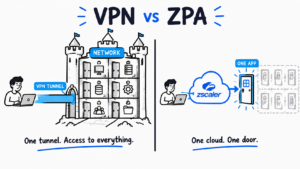
Traditional perimeter security generally trusts users and devices more after they successfully pass through a network boundary. For example, a VPN user may authenticate successfully and then receive network-level access to an internal subnet.
Zero Trust removes this implicit trust.
Every access request is evaluated using information such as:
- User identity
- Device identity
- Device security posture
- Application
- Resource
- Location
- Authentication strength
- Risk signals
- Environmental context
The key difference is that network location does not automatically establish trust.
2. What are the foundational tenets of Zero Trust defined in NIST SP 800-207?
NIST SP 800-207 establishes seven foundational tenets:
- All data sources and computing services are considered resources.
- All communication is secured regardless of network location.
- Access to individual enterprise resources is granted on a per-session basis.
- Access is determined by dynamic policy.
- The enterprise monitors and measures the integrity and security posture of all owned and associated assets.
- All resource authentication and authorization are dynamic and strictly enforced before access is granted.
- The enterprise collects information about asset state, network infrastructure, and communications to improve security posture.
A useful interview explanation is:
Zero Trust is not simply “deny everything.” It is a continuous process of making explicit, contextual, and least-privilege access decisions.
3. Explain the structural separation between the Control Plane and the Data Plane in Zero Trust Architecture.
The Control Plane contains the decision-making and policy-control components.
It includes functions such as:
- Policy Engine
- Policy Administrator
- Identity systems
- Device posture information
- Threat intelligence
- Security telemetry
- Policy evaluation
The Data Plane carries the actual application or resource traffic after access has been authorized.
For example:
Control Plane:
User → Identity Provider → Device posture → Policy Engine → Access decision
Data Plane:
User/device → Policy Enforcement Point → Approved application
Separating these functions allows authorization decisions to be centrally governed while application traffic is handled by enforcement components close to the resource.
4. What are the core operational principles that guide a Zero Trust deployment?
A practical Zero Trust program should be built around several principles:
Assume Breach
Design the environment assuming that an attacker may already have compromised a user, device, workload, or credential.
Explicit Verification
Do not rely solely on network location. Evaluate identity, device posture, application, resource, and context.
Least Privilege
Give users and workloads only the access required for their specific task.
Incremental Implementation
Do not attempt to transform the entire enterprise simultaneously. Start with important applications and high-value resources.
Use Existing Security Capabilities
Existing IdP, EDR, MDM, SIEM, PAM, network, and cloud security technologies can provide valuable Zero Trust signals.
This is particularly important in real enterprise environments because Zero Trust is normally an architecture transformation, not a single product deployment.
5. What are the core logical components of a Zero Trust Architecture (PDP, PEP, PIP), and how do they interact during an access request?
The major logical components are:
Policy Information Points (PIPs)
PIPs provide information required to make an access decision.
Examples include:
- Identity Provider
- EDR
- MDM
- PKI
- SIEM
- Threat intelligence
- Asset inventory
- Vulnerability management systems
Policy Decision Point (PDP)
The PDP evaluates the access request against policy and context.
It determines whether access should be:
- Allowed
- Denied
- Restricted
- Revoked
Policy Enforcement Point (PEP)
The PEP sits in the communication path and enforces the decision.
A simplified flow is:
User → PEP → PDP → Decision → PEP → Application
The PEP enables, monitors, and eventually terminates connections between a subject and an enterprise resource.
6. What is the functional distinction between the Policy Engine (PE) and the Policy Administrator (PA) within the PDP?
The Policy Engine (PE) makes the access decision.
It evaluates:
- Identity
- Device state
- Resource
- Requested action
- Environmental context
- Security risk
- Organizational policy
The Policy Administrator (PA) executes the decision.
For example:
- User requests access.
- PEP sends the request toward the control plane.
- PE evaluates the request.
- PE decides to allow access.
- PA establishes or authorizes the communication path.
- PEP enforces the resulting access.
The PE is therefore focused on decision logic, while the PA is focused on executing that decision.
7. What architectural trade-offs exist regarding centralized versus distributed Policy Decision Points (PDPs)?
A centralized PDP provides:
- Centralized policy management
- Consistent authorization logic
- Easier auditing
- Central governance
However, it can introduce:
- Latency
- Availability concerns
- Dependency on network connectivity
- Scalability challenges
Distributed PDPs can perform authorization decisions closer to workloads or users.
For example, a distributed authorization service can evaluate local requests without sending every transaction to a single remote decision engine.
A practical enterprise architecture often combines:
Central policy governance + distributed policy evaluation
This provides centralized control while reducing latency and dependency on a single decision point.
8. Compare traditional VPNs, Software-Defined Perimeters (SDP), and Zero Trust Network Access (ZTNA).
| Feature | Traditional VPN | SDP | ZTNA |
|---|---|---|---|
| Access level | Network | Service | Application/resource |
| Trust approach | Authentication often establishes broader access | Explicit access | Explicit contextual access |
| Visibility | Internal network may become reachable | Resources can be hidden | Applications can remain hidden |
| Segmentation | Network/subnet based | Service based | Application identity based |
| Lateral movement | Higher potential | Reduced | Strongly restricted |
| Policy | Often network-centric | Identity/context-aware | Identity, device, application and context-aware |
The biggest practical difference is that ZTNA aims to provide access to the specific application or resource rather than placing the user on the internal network.
9. How does Single Packet Authorization (SPA) render server infrastructure “dark” to unauthorized internet scanners?
SPA can be used to prevent unauthorized users from discovering exposed services.
Instead of allowing publicly reachable service ports to respond normally to unsolicited traffic, a gateway can operate with a default-deny posture.
An authorized client sends a specially constructed and cryptographically protected authorization packet.
The gateway validates the request before allowing the subsequent connection.
Therefore, an unauthorized scanner does not receive the same response it would receive from a conventional publicly exposed service.
SPA is particularly useful when organizations want to reduce the externally visible attack surface.
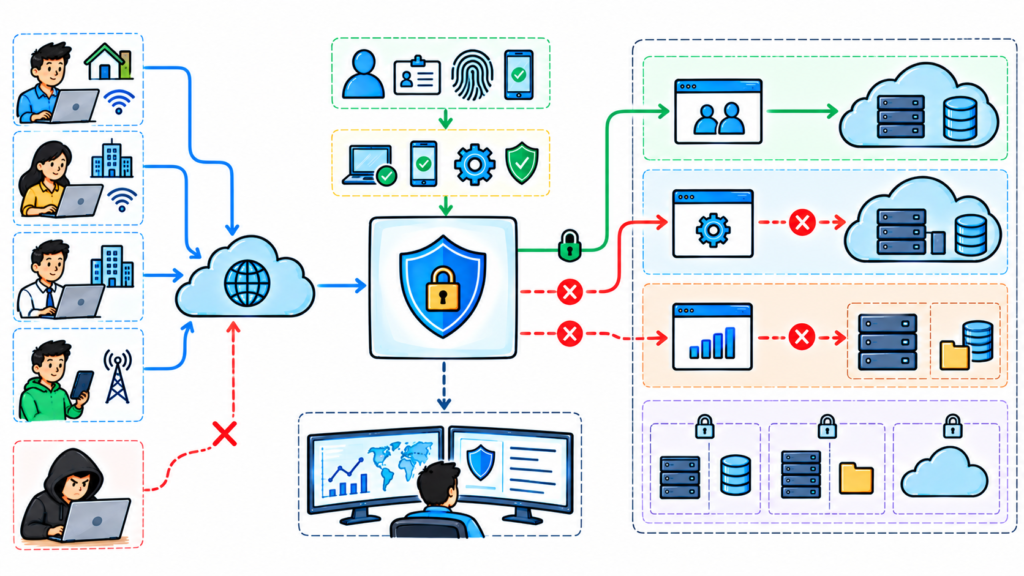
10. How does ZTNA achieve application-level micro-segmentation compared to traditional network segmentation?
Traditional segmentation generally uses:
- VLANs
- Subnets
- IP addresses
- Network ACLs
- Firewalls
These controls can restrict network paths, but they do not necessarily understand the specific application identity of a request.
ZTNA can create access policies around individual applications.
For example:
A user may be allowed to access:
HR Application
but denied access to:
Finance Application
even though both applications are hosted inside the same data center or cloud environment.
The user does not receive broad network connectivity.
This reduces the opportunity for lateral movement.
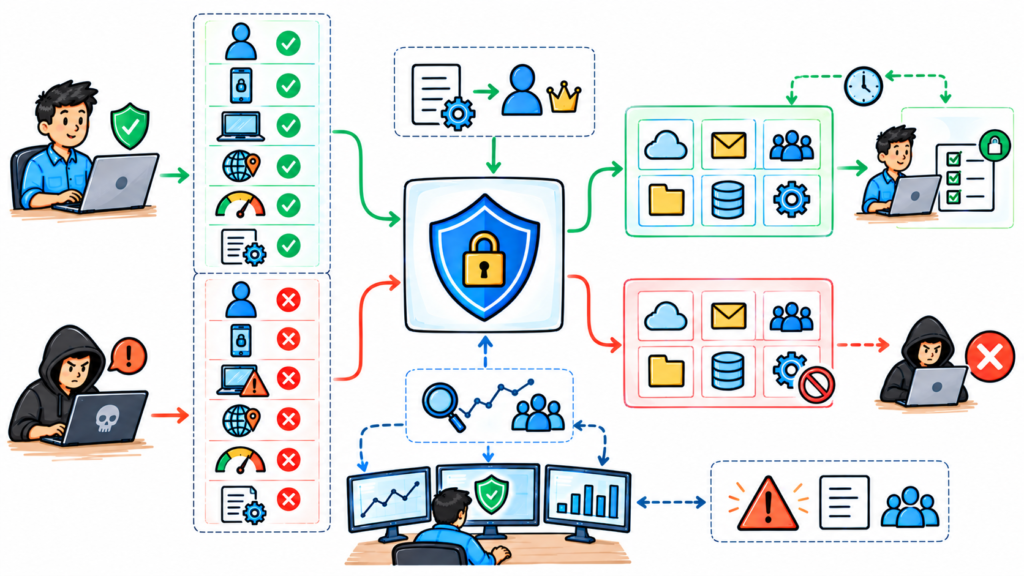
11. What is the “session enforcement gap” in traditional IAM, and how do short-lived tokens compare to event-driven session enforcement?
The session enforcement gap occurs when authorization is evaluated mainly when a session begins.
For example, a user may authenticate successfully and receive a token valid for a defined period.
If the user’s security posture changes after authentication, the application may continue accepting that token until it expires.
Short-Lived Tokens
Short-lived tokens reduce the exposure period.
However, they do not automatically eliminate the risk between token issuance and expiration.
Event-Driven Enforcement
Event-driven approaches can distribute security events when important conditions change.
For example:
EDR detects compromise → security event generated → identity/control system receives signal → active access is restricted or revoked
This enables faster response to changes in security posture.
12. Differentiate between the Shared Signals Framework (SSF) and the Continuous Access Evaluation Profile (CAEP).
The Shared Signals Framework (SSF) provides a standardized mechanism for security event sharing between cooperating systems.
CAEP is a profile built on the Shared Signals Framework for communicating events that can affect access decisions.
Examples of CAEP events include:
- Session revoked
- Token claims changed
- Credential changed
- Assurance level changed
- Device compliance changed
For example:
EDR → Security signal → SSF/CAEP → Identity/Access system → Session enforcement
This allows security state changes to influence access decisions beyond the initial authentication event.
13. Compare OpenID CAEP and the AuthZEN specification.
CAEP and AuthZEN address different parts of the Zero Trust control plane.
CAEP
CAEP is primarily concerned with security events and changes in session or security state.
For example:
The device is no longer compliant.
AuthZEN
AuthZEN standardizes communication between authorization components for authorization decisions.
For example:
Is user A allowed to perform action B on resource C?
Therefore:
CAEP = security state/event signal
AuthZEN = authorization decision interface
They can complement each other in a Zero Trust architecture.
14. What are the five core pillars and four maturity stages outlined in the CISA Zero Trust Maturity Model?
CISA’s Zero Trust Maturity Model organizes Zero Trust around five pillars:
- Identity
- Devices
- Networks
- Applications and Workloads
- Data
The model also describes four maturity stages:
- Traditional
- Initial
- Advanced
- Optimal
Cross-cutting capabilities include:
- Visibility and Analytics
- Automation and Orchestration
- Governance
This model is useful for organizations that need to measure Zero Trust progress rather than treating Zero Trust as a one-time implementation.
15. How does access control evolve across the Identity pillar from Traditional to Optimal maturity?
The maturity progression can be viewed as an evolution from static identity controls toward dynamic access decisions.
Traditional
- Password-based authentication
- Static roles
- Manual identity processes
Initial
- Centralized identity provider
- MFA adoption
- Improved identity lifecycle management
Advanced
- Strong authentication
- Attribute-based policies
- Automated identity governance
- Better device and risk integration
Optimal
- Dynamic risk-based access
- Continuous evaluation
- Automated security signals
- Rapid access revocation
The key progression is:
Static identity → centralized identity → contextual identity → continuously evaluated identity
16. What key operational metrics and KPIs should be tracked to measure Zero Trust maturity?
Useful Zero Trust metrics should measure actual security coverage rather than simply counting deployed products.
Examples include:
Identity Coverage
Percentage of users protected by strong authentication.
Device Posture Coverage
Percentage of enterprise devices reporting security posture to the access-control system.
Application Coverage
Percentage of critical applications protected by Zero Trust access controls.
Privileged Access Coverage
Percentage of privileged operations using JIT or controlled privileged access.
Micro-Segmentation Coverage
Percentage of critical workloads protected by fine-grained access policies.
Session Revocation Time
Time between detecting a compromised identity or device and terminating active access.
Policy Exception Rate
Number of active exceptions that bypass standard Zero Trust policies.
These metrics can provide a more meaningful view of Zero Trust maturity than simply measuring how many security tools have been purchased.
17. What are the primary threats against cryptographic tokens and assertions, and how should organizations protect them?
Tokens and assertions can become high-value targets because they can represent authenticated identity or authorization.
Threats include:
- Token theft
- Token replay
- Token forgery
- Signing-key compromise
- Improper token validation
- Excessive token lifetime
- Weak audience validation
- Insecure storage
- Compromised federation infrastructure
Important controls include:
- Strong key management
- Correct token validation
- Audience restriction
- Short token lifetimes where appropriate
- Secure token storage
- Revocation mechanisms
- Monitoring token issuance and use
- Protection of signing keys
- Continuous security monitoring
Organizations should treat tokens and signing keys as security-sensitive assets because compromise can allow an attacker to bypass some of the protections applied during the initial authentication process.
18. Why do Non-Human Identities (NHIs) pose unique challenges for Zero Trust?
Non-Human Identities include:
- Service accounts
- API identities
- Workload identities
- Automation accounts
- CI/CD identities
- Machine-to-machine credentials
They are difficult because they may use credentials without human interaction.
Common problems include:
- Long-lived API keys
- Hardcoded secrets
- Excessive permissions
- Shared service accounts
- Poor ownership
- Lack of lifecycle management
A Zero Trust approach should use:
- Workload identity
- Short-lived credentials
- Federated identity
- Least privilege
- Automated rotation
- Strong monitoring
- Clear ownership
The goal is to move away from:
Permanent secret + permanent privilege
toward:
Verified workload + temporary identity + minimum required privilege
19. How can legacy applications and OT/SCADA systems be integrated into a Zero Trust architecture without completely replacing them?
Legacy systems often cannot support modern authentication protocols directly.
Instead of immediately replacing them, organizations can place enforcement and identity controls around them.
For legacy web applications, an Identity-Aware Proxy can provide:
- Modern authentication
- MFA
- Device posture checks
- Authorization
- Session control
- Application-level access
For OT environments, organizations can use:
- Network segmentation
- Industrial firewalls
- Secure jump hosts
- PAM
- Strong operator authentication
- Protocol filtering
- Monitoring
For example:
Operator → MFA → PAM Jump Host → Authorization → OT Segment → PLC/SCADA resource
The objective is to protect the legacy asset without assuming that the legacy system itself can implement every modern security capability.
20. What are the five operational steps for designing and executing Zero Trust around a Protect Surface?
A practical Zero Trust implementation can be organized into five steps.
1. Define the Protect Surface
Identify the critical:
- Data
- Applications
- Assets
- Services
2. Map Transaction Flows
Understand:
- Who accesses the resource
- Which applications communicate
- Which services communicate
- What protocols are used
- Where traffic originates
3. Architect the Zero Trust Environment
Design the:
- Control Plane
- Data Plane
- PEPs
- Identity systems
- Policy decision mechanisms
- Security telemetry
4. Create Policies
Define access based on:
- Identity
- Device
- Application
- Resource
- Action
- Context
- Risk
5. Monitor and Improve
Continuously review:
- Access logs
- Security events
- Policy violations
- Device posture
- Identity risk
- Application behavior
This approach is more practical than attempting to implement Zero Trust across the entire enterprise simultaneously.
Advanced Zero Trust Interview Questions
21. What is the difference between Zero Trust Architecture and Zero Trust Network Access?
Zero Trust Architecture is the broader security architecture and philosophy.
ZTNA is one technology approach used to implement Zero Trust access to applications and resources.
For example:
Zero Trust Architecture
→ Identity
→ Device
→ Network
→ Application
→ Workload
→ Data
→ Policy
→ Monitoring
ZTNA
→ User authentication
→ Device posture
→ Policy evaluation
→ Application access
→ Session enforcement
Therefore, ZTNA should not be treated as synonymous with the entire Zero Trust program.

22. What is the difference between Zero Trust and micro-segmentation?
Micro-segmentation is a security control that restricts communication between workloads, applications, or network segments.
Zero Trust is a broader architecture.
A Zero Trust policy may consider:
- User identity
- Device identity
- Application identity
- Workload identity
- Resource
- Action
- Device posture
- Risk
Micro-segmentation can therefore be one component of a Zero Trust architecture.
A useful interview statement is:
Micro-segmentation limits communication paths. Zero Trust determines whether a communication request should be authorized based on identity, context, and policy.
23. How does device posture influence a Zero Trust access decision?
Device posture provides information about the security state of an endpoint.
Signals may include:
- Operating system version
- EDR status
- Disk encryption
- Firewall status
- Security agent status
- Patch level
- Device compliance
- Certificate status
- Jailbreak or root detection
- Malware detection
For example:
User = authenticated
but:
Device = non-compliant
The policy may therefore deny access or provide restricted access.
This demonstrates why Zero Trust evaluates more than user identity alone.
24. How would you design a Zero Trust policy for a corporate HR application?
I would first identify the Protect Surface.
For example:
Resource: HR application
Then define policy inputs:
- User identity
- Department
- Device posture
- Authentication strength
- Location
- Application sensitivity
- Risk score
Example policy:
Employees in the HR department can access the HR application only from compliant managed devices using strong authentication.
For privileged HR administrators:
Require stronger authentication, compliant devices, and additional access controls for administrative functions.
The policy should also specify what happens when the device becomes non-compliant during an active session.
25. How would you implement Zero Trust for remote employees?
A remote-user Zero Trust design could include:
- Centralized identity provider
- Strong authentication
- Device management
- EDR
- Device posture validation
- ZTNA
- Application-level access
- SIEM monitoring
- Risk-based policies
- Session revocation
The important point is that remote employees should not automatically receive broad network access simply because they successfully connected through a VPN.
26. How does Zero Trust reduce lateral movement during a compromised endpoint incident?
Suppose an employee laptop becomes compromised.
Traditional network access may allow the attacker to discover internal systems depending on network segmentation and permissions.
In a Zero Trust environment:
- The user has limited application access.
- The device posture can be evaluated.
- Internal applications are not necessarily exposed.
- Network connectivity is restricted.
- Identity-based policies limit resource access.
- Security telemetry can trigger access changes.
Example:
Compromised laptop → EDR alert → device becomes non-compliant → Zero Trust policy denies application access
This reduces the attacker’s opportunity to use the compromised endpoint as a pivot point.
27. How would you troubleshoot a Zero Trust access request that is unexpectedly denied?
I would troubleshoot from the identity layer toward the enforcement layer.
Step 1: Verify Identity
Check:
- Username
- Authentication status
- Group membership
- Identity provider logs
Step 2: Check Device Posture
Verify:
- Device registration
- EDR status
- MDM compliance
- Certificate
- OS version
Step 3: Check Policy
Determine which policy matched the request.
Check:
- Identity condition
- Device condition
- Application
- Location
- Risk
- Time-based conditions
Step 4: Check PEP
Verify whether the enforcement point received the request and what decision it received.
Step 5: Check Application Connectivity
Verify:
- DNS
- Routing
- Connector
- Firewall
- Application availability
Step 6: Review Logs
Correlate identity, device, access gateway, and application logs.
This approach prevents randomly changing policies without identifying the actual failure point.
28. A user is authenticated but cannot access one internal application. How would you investigate?
I would first confirm whether the issue is authentication or authorization.
If authentication succeeds, investigate:
- Application assignment
- User/group membership
- Application segment
- Device posture
- Access policy
- ZTNA connector
- DNS resolution
- Firewall rules
- Application availability
- PEP logs
For a ZTNA environment, I would specifically check whether the application is correctly defined and whether the connector or enforcement point can reach the application.
This distinction is important:
Successful authentication does not automatically mean successful authorization.
29. How would you handle a device that becomes non-compliant during an active Zero Trust session?
The response depends on the organization’s policy.
Possible actions include:
- Revoke the session
- Block new connections
- Require re-authentication
- Restrict access
- Trigger remediation
- Move the device into a quarantine state
Example:
EDR detects malware → device posture changes → security signal generated → access policy updated → active application session terminated
The important principle is that the access decision should be able to respond to changes in device security state.
30. How would you integrate EDR with Zero Trust?
EDR can act as a major source of device security telemetry.
For example, EDR can provide:
- Malware status
- Device health
- Risk level
- Endpoint identity
- Security agent status
- Suspicious activity
The Zero Trust policy engine can use these signals.
Example:
Normal device
→ Access allowed
High-risk device
→ Access restricted
Compromised device
→ Access denied or session terminated
This creates a connection between endpoint detection and access enforcement.
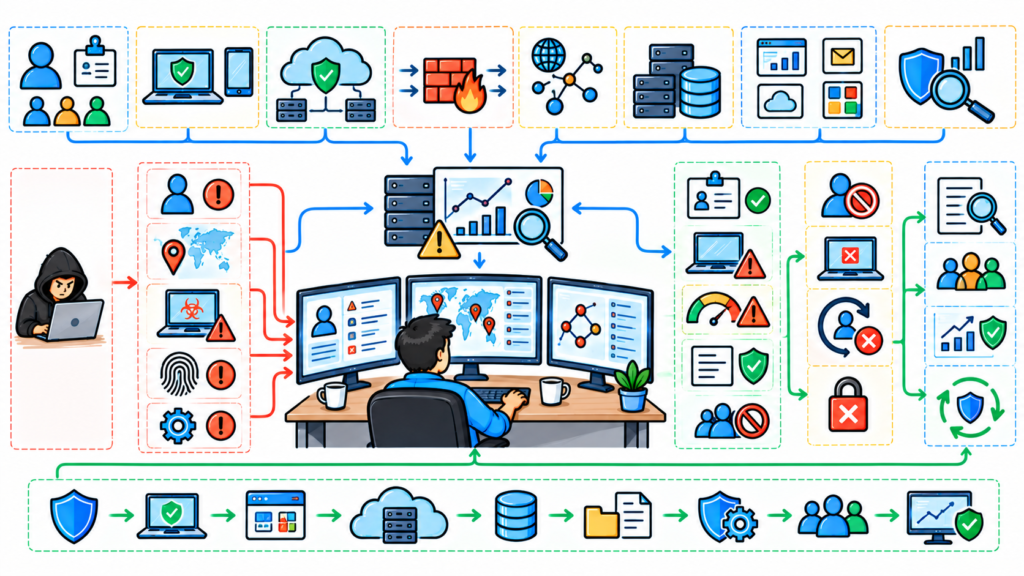
31. How does SIEM support a Zero Trust architecture?
SIEM provides centralized security visibility.
A Zero Trust environment can send SIEM events from:
- Identity providers
- ZTNA gateways
- EDR
- Firewalls
- Cloud platforms
- Applications
- PAM
- Network infrastructure
- Authorization systems
SIEM can then correlate events.
For example:
Impossible login + unmanaged device + unusual application access
may create a higher-risk security event.
SIEM therefore helps Zero Trust with:
- Visibility
- Detection
- Investigation
- Policy improvement
- Incident response
- Compliance reporting
32. What role does Identity and Access Management play in Zero Trust?
IAM provides the identity foundation required for Zero Trust.
Important IAM capabilities include:
- Authentication
- Authorization
- MFA
- SSO
- Federation
- RBAC
- ABAC
- Identity lifecycle management
- Access reviews
- Privileged access
- Identity governance
Zero Trust extends IAM by combining identity with additional context.
Instead of:
Is this user authenticated?
the access decision becomes:
Is this user authorized to access this resource from this device, under this context, at this time?
33. How does Privileged Access Management support Zero Trust?
PAM applies Zero Trust principles to privileged accounts.
Traditional privileged access may involve:
Permanent administrator account + permanent privilege
A Zero Trust approach aims for:
Verified administrator + approved task + temporary privilege + monitored session
PAM can provide:
- JIT access
- Approval workflows
- MFA
- Credential vaulting
- Session recording
- Command monitoring
- Automatic privilege expiration
This reduces standing administrative privileges.
34. What is Just-In-Time access and why is it useful in Zero Trust?
Just-In-Time access provides privileged access only when it is required.
For example:
An administrator needs production access for 30 minutes.
Instead of maintaining permanent administrator privileges:
- Administrator requests access.
- Identity is verified.
- Device posture is checked.
- Approval is performed if required.
- Temporary privilege is issued.
- Activity is monitored.
- Privilege automatically expires.
This reduces the amount of time that privileged access exists.
35. How would you apply Zero Trust principles to cloud workloads?
Cloud Zero Trust should consider both human and workload identities.
Important controls include:
- Cloud IAM
- Workload identity
- Least privilege
- Security groups
- Network policies
- Encryption
- Secrets management
- Cloud logging
- CSPM
- Runtime monitoring
- API security
- Short-lived credentials
For example, a cloud workload should not receive broad permissions simply because it runs inside a trusted cloud network.
Its identity and requested action should be evaluated against policy.
36. How does Zero Trust apply to Kubernetes?
Kubernetes introduces several identities and communication paths.
A Zero Trust approach can include:
- Kubernetes RBAC
- Service accounts
- Workload identity
- Network policies
- Admission controls
- Secrets management
- Image security
- API server authentication
- Runtime monitoring
For example, one application namespace should not automatically be able to communicate with every other namespace.
Policies should define which workloads can communicate and which actions they can perform.
37. How would you protect APIs using Zero Trust principles?
API Zero Trust should validate more than the existence of a valid token.
Controls can include:
- Strong authentication
- OAuth/OIDC
- Token validation
- Audience validation
- Scope validation
- Short-lived access tokens
- Rate limiting
- API gateway enforcement
- Device or workload identity
- Continuous monitoring
The authorization decision should evaluate:
Who is calling?
What resource is being requested?
What action is being performed?
Is the client authorized for this action?
38. How do you prevent excessive permissions in a Zero Trust environment?
I would use a combination of:
- Least privilege
- RBAC
- ABAC
- Access reviews
- PAM
- JIT access
- Entitlement management
- Automated provisioning/deprovisioning
- Privilege analytics
For example, if an administrator only needs read access to a production system, granting full administrator privileges violates the least-privilege principle.
Permissions should be reviewed regularly and removed when no longer required.
39. What is the role of policy-as-code in Zero Trust?
Policy-as-code represents security and authorization rules in machine-readable form.
This can provide:
- Version control
- Automated testing
- Consistent policy deployment
- Change tracking
- Review workflows
- Easier rollback
For example:
IF
user.department = HR
AND device.compliant = true
AND authentication = strong
AND application = HR-App
THEN
allow
A policy-as-code approach helps organizations manage Zero Trust policies consistently across environments.
40. How should Zero Trust policies handle emergency access?
Emergency access should not become a permanent bypass.
An emergency access process should include:
- Strong authentication
- Explicit approval
- Limited duration
- Restricted scope
- Monitoring
- Logging
- Post-use review
For example:
Emergency administrator access
→ MFA
→ Approval
→ 30-minute access
→ Session monitoring
→ Automatic expiration
→ Review
This preserves operational flexibility while maintaining Zero Trust principles.
Real-World Zero Trust Scenario Questions
41. A user’s account is compromised. What Zero Trust controls would you use?
I would immediately evaluate:
- Identity risk
- Active sessions
- Authentication tokens
- Device posture
- Recent application access
- Privileged activity
- Geographic anomalies
- Unusual behavior
Possible actions include:
- Disable or restrict the identity
- Revoke active sessions
- Revoke tokens where supported
- Require credential reset
- Enforce stronger authentication
- Isolate the endpoint
- Review application access
- Investigate SIEM and identity logs
The response should address both the identity and the device, because a compromised account may be associated with a compromised endpoint.
42. A user’s device is infected with malware but the user’s credentials are still valid. Should the user retain application access?
Not automatically.
Zero Trust separates authentication from overall access authorization.
Even if the credentials remain valid, the device security posture has changed.
A policy may therefore:
- Deny access
- Restrict access
- Require remediation
- Require a compliant device
- Terminate active sessions
For example:
Valid identity + compromised device = access denied
This is one of the practical differences between identity-only access control and contextual Zero Trust access control.
43. An administrator requests production access from an unmanaged laptop. How would you handle it?
I would evaluate the organization’s privileged access policy.
For a highly sensitive production system, the policy could require:
- Managed device
- EDR
- Strong authentication
- PAM
- JIT privilege
- Approved administrative workflow
If the device is unmanaged, the request should normally be denied or redirected through an approved administrative workstation or PAM jump host.
The decision should be based on policy rather than simply trusting the administrator’s job title.
44. How would you design Zero Trust access for third-party contractors?
I would avoid providing broad internal network access.
Instead:
- Create controlled identities.
- Apply strong authentication.
- Define contractor-specific authorization.
- Restrict application access.
- Validate device posture where possible.
- Limit session duration.
- Monitor activity.
- Automatically remove access when the contract ends.
For example:
Contractor → IdP → MFA → Device validation → ZTNA → Specific application
rather than:
Contractor → VPN → Internal network
45. How would you investigate suspicious lateral movement in a Zero Trust environment?
I would correlate:
- Identity logs
- ZTNA logs
- Firewall logs
- EDR telemetry
- DNS logs
- Authentication events
- Application access
- Network flow data
- SIEM alerts
I would determine:
- Initial compromised identity/device
- First unauthorized access
- Applications accessed
- Resources contacted
- Privilege changes
- Authentication anomalies
- Data accessed
- Whether Zero Trust policies blocked additional movement
The investigation should measure not only what the attacker accessed but also which controls prevented further movement.
46. What would you check if a Zero Trust policy is accidentally granting too much access?
I would review:
- Policy conditions
- Group membership
- Role assignments
- ABAC attributes
- Application definitions
- Resource mapping
- Default policies
- Policy precedence
- Exceptions
- Service accounts
- Administrative overrides
I would also test the policy with different identities and device states.
A useful troubleshooting method is:
Expected access → Actual access → Matching policy → Input attributes → Enforcement point
This helps identify whether the problem exists in policy logic, identity data, device posture, or enforcement.
47. How would you migrate an organization from VPN-based remote access to ZTNA?
I would avoid replacing the VPN for every application on day one.
A phased approach would be:
Phase 1: Discovery
Identify:
- Applications
- Users
- Dependencies
- Network flows
- Authentication methods
Phase 2: Protect Critical Applications
Start with selected applications that are suitable for ZTNA.
Phase 3: Integrate Identity
Connect the ZTNA platform with:
- IdP
- MFA
- Device management
- EDR
Phase 4: Apply Application-Level Policies
Define who can access which application and under what conditions.
Phase 5: Monitor
Compare:
- Access success
- User experience
- Policy violations
- Security events
Phase 6: Expand
Gradually move additional applications away from broad VPN access.
The goal is controlled migration rather than a risky “big bang” replacement.
48. What are common Zero Trust implementation mistakes?
Common mistakes include:
Treating Zero Trust as a Product
Buying a ZTNA or security product does not automatically create a Zero Trust architecture.
Ignoring Identity
Identity is one of the central decision inputs.
Ignoring Device Posture
A valid identity from a compromised device can still create risk.
Giving Excessive Access
Zero Trust should reduce unnecessary privileges.
Protecting Only Remote Users
Zero Trust should also cover internal users, workloads, service accounts, applications, and cloud resources.
Creating Complex Policies Without Testing
Overly complex policies can cause outages and inconsistent access.
Failing to Monitor
A Zero Trust architecture requires visibility into access decisions and security events.
Implementing Everything at Once
A phased implementation is usually easier to manage and validate.
49. How would you explain a complete Zero Trust access flow in an interview?
I would explain it like this:
A user attempts to access an application.
Step 1: Identity
The user is authenticated through the organization’s identity provider.
Step 2: Device
The system checks whether the device is known and compliant.
Step 3: Context
The system evaluates relevant context such as location, risk, authentication strength, and requested resource.
Step 4: Policy
The policy engine evaluates the request.
Step 5: Authorization
The system determines whether the user is authorized to access that specific application.
Step 6: Enforcement
The PEP enforces the decision.
Step 7: Session Monitoring
The session is monitored for changes in identity, device posture, or security risk.
Step 8: Response
If the security state changes, access may be restricted or revoked.
A concise interview flow is:
Identity → Device → Context → Policy → Authorization → Enforcement → Monitoring → Re-evaluation
50. How would you design and implement a Zero Trust security architecture for a large enterprise?
I would start with business requirements rather than immediately selecting products.
Step 1: Identify Critical Resources
Map:
- Critical applications
- Sensitive data
- Administrative systems
- Cloud workloads
- Important services
- High-value assets
Step 2: Identify Identities
Include:
- Employees
- Contractors
- Administrators
- Service accounts
- Workloads
- Applications
Step 3: Establish Strong Identity Controls
Implement:
- Centralized IAM
- MFA
- SSO
- Federation
- Lifecycle management
- PAM
Step 4: Establish Device Trust Signals
Integrate:
- MDM
- EDR
- Device certificates
- Compliance status
- Vulnerability information
Step 5: Implement Application-Level Access
Use ZTNA or application-aware enforcement to provide access to specific applications rather than broad network connectivity.
Step 6: Implement Segmentation
Restrict unnecessary communication between:
- Users
- Applications
- Servers
- Workloads
- Cloud environments
- Critical systems
Step 7: Integrate Telemetry
Send security information from:
- IAM
- EDR
- ZTNA
- Firewalls
- Cloud
- Applications
- PAM
into security monitoring and SIEM platforms.
Step 8: Implement Dynamic Policies
Policies should consider:
- Identity
- Device
- Application
- Resource
- Action
- Context
- Risk
Step 9: Establish Continuous Monitoring
Monitor:
- Authentication
- Authorization
- Device posture
- Application access
- Privileged activity
- Policy violations
- Security events
Step 10: Measure and Improve
Track:
- Protected applications
- Strong authentication coverage
- Device compliance
- Privileged access coverage
- Policy exceptions
- Access violations
- Session revocation time
- Lateral movement prevention
Internal Links
- Zero Trust Security in 2026: Architecture, Real Examples, and Implementation Guide
- Forget the Perimeter: Zero Trust vs Traditional Security Technical Comparison 2026
- Identity and Access Management in 2026: A Practical Guide for Cloud Security Professionals
- Multi-Factor Authentication (MFA): Critical Guide to Secure Your Systems (2026)
- Cloud Security Basics 2026: Complete Beginner Guide
- Essential Endpoint Security Guide 2026 for Every Organization
- Network Segmentation Explained with Real-World Example
- Security Information and Event Management: Complete SIEM Guide 2026
- Best SOC Analyst Roadmap 2026: Complete Guide to L1, L2, L3 Roles, Skills, and Tools
- Cloud Misconfiguration: 10 Critical Errors Leading to Data Breaches in 2026
External Resources
- NIST SP 800-207: Zero Trust Architecture
- CISA Zero Trust Maturity Model Version 2.0
- NIST SP 800-207A: Zero Trust Architecture for Cloud-Native Applications
- OpenID Shared Signals Framework and CAEP
- OpenID AuthZEN Authorization API
- NIST IR 8587: Protecting Tokens and Assertions
Disclaimer
The information provided in this Zero Trust Security Interview Questions and Answers 2026 guide is intended for educational, informational, and interview preparation purposes only. This article is designed to help cybersecurity professionals, security engineers, SOC analysts, IAM professionals, network security professionals, students, and job seekers understand Zero Trust security concepts and prepare for technical interviews.
Zero Trust Architecture, ZTNA, IAM, authentication methods, authorization technologies, cloud security platforms, security standards, and cybersecurity practices may change over time. While reasonable efforts have been made to provide accurate and up-to-date information, this article should not be considered professional cybersecurity, legal, compliance, or security consulting advice.
Always verify important technical information with official documentation and follow your organization’s security policies before implementing Zero Trust controls, access policies, authentication mechanisms, network segmentation, or security architecture in a production environment.
The examples provided in this Zero Trust Security Interview Questions and Answers 2026 guide are intended to explain general cybersecurity concepts and interview scenarios. Actual Zero Trust implementations may differ depending on an organization’s infrastructure, applications, identity systems, cloud environment, security requirements, and business processes.
TechNaga does not guarantee employment, interview selection, certification results, or any specific career outcome based on the information provided in this article.
Use this information responsibly and verify important technical details before making security or production decisions.
Thanks for this article. it is really helpful.