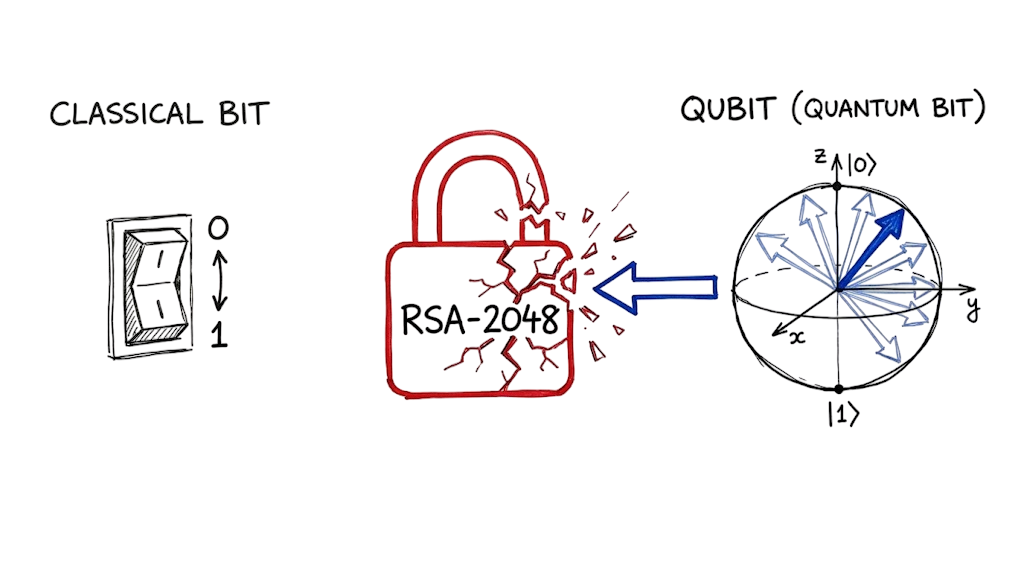
In August 2024, the National Institute of Standards and Technology (NIST) published the first finalized post-quantum cryptography standards to help protect digital systems from future quantum computing threats. These new standards represent an important step toward securing sensitive data against the next generation of computing technology.
Unlike traditional computers that process information using bits, Qubits allow quantum computers to solve certain mathematical problems much more efficiently. As quantum computing advances, it could eventually break many of today’s public-key encryption algorithms that protect websites, online banking, digital signatures, and confidential communications.
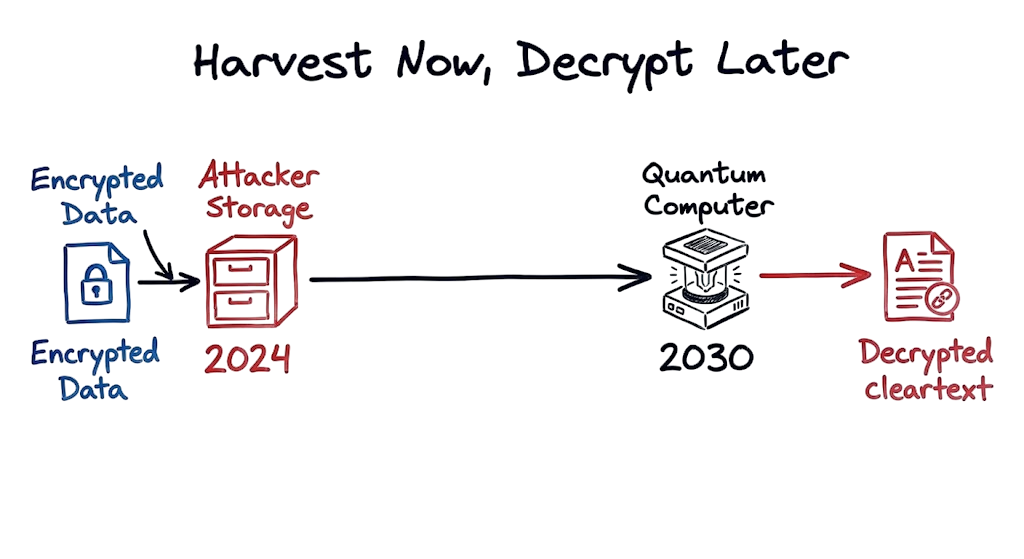
One of the biggest concerns is the “harvest now, decrypt later” strategy. Attackers can collect encrypted data today and store it until quantum computers become powerful enough to decrypt it in the future. This makes long-term data protection an important challenge for governments, businesses, and cybersecurity professionals.
In this guide, you’ll learn what Qubits are, how they work, why they are different from classical bits, and why understanding quantum computing is becoming increasingly important for cybersecurity.
What are Qubits?
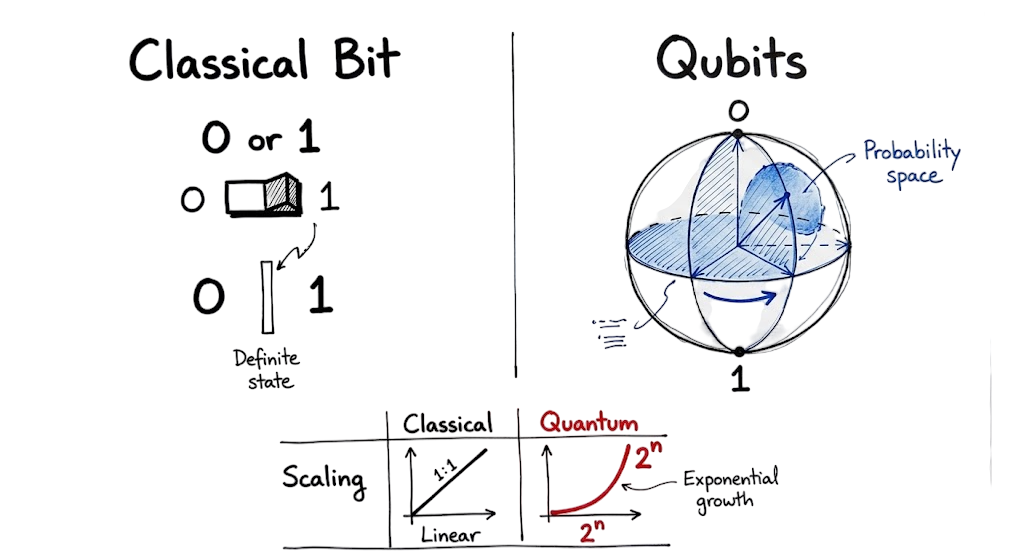
A qubit (quantum bit) is the basic unit of information in a quantum computer. In a traditional computer, a bit can store only one value at a time, either 0 or 1. Every application, website, and operating system ultimately processes information using these binary values.
A qubit works differently. Instead of being limited to only 0 or 1, it can exist in a superposition, meaning it can represent multiple possible states until it is measured. This unique property allows quantum computers to process certain types of calculations much more efficiently than classical computers.
Unlike classical computers that use electronic transistors, quantum computers store information using quantum particles such as electrons, photons, or trapped ions. These particles follow the principles of quantum mechanics rather than classical physics.
Why Is This Important?
One of the biggest advantages of qubits is that their computing power grows rapidly as more qubits are added. While a classical computer evaluates many possibilities one after another, a quantum computer can represent a vast number of possible states simultaneously through quantum superposition.
For example, a quantum processor with 50 qubits can theoretically represent more than 1 quadrillion (2⁵⁰) possible states. This enormous computational capability is why researchers believe sufficiently powerful quantum computers could eventually break many of today’s public-key encryption algorithms, including RSA and Elliptic Curve Cryptography (ECC).
The Science Behind Qubits
From a physics perspective, a qubit is mathematically represented as a vector in a two-dimensional Hilbert space. When a qubit is measured, its quantum state collapses into either 0 or 1. Although this concept is based on advanced quantum mechanics, the key idea is simple: before measurement, a qubit can exist in a combination of multiple states, enabling quantum computers to solve certain problems far more efficiently than traditional computers.
This ability to process complex calculations is one of the main reasons quantum computing is expected to transform fields such as cryptography, cybersecurity, scientific research, and artificial intelligence.
How Qubits Work
Three Fundamental Principles of Quantum Computing
Quantum computers work because of three unique properties of quantum mechanics: superposition, entanglement, and interference. These principles allow quantum computers to solve certain problems much faster than traditional computers.
Understanding these concepts will help you see why quantum computing could eventually change fields such as cybersecurity, cryptography, artificial intelligence, and scientific research.
1. Superposition
Superposition allows a qubit to exist in multiple possible states before it is measured. Unlike a classical bit, which can only be 0 or 1, a qubit can represent a combination of both states at the same time.
This capability allows quantum computers to process many possible solutions simultaneously instead of evaluating them one after another.
For example, when a quantum algorithm performs a calculation, it can work with multiple possible states at once, making certain computations much more efficient than on a classical computer.
2. Entanglement
Entanglement is a unique quantum property that links two or more qubits together. Once qubits become entangled, the state of one qubit is closely related to the state of the others, even when they are physically separated.
This relationship allows qubits to work together as a single quantum system instead of acting independently. By coordinating their behavior, quantum computers can solve complex problems more efficiently than traditional computers.
Entanglement is one of the key reasons quantum computers can achieve computational capabilities that are difficult for classical systems to match.
3. Interference
Interference helps a quantum computer arrive at the correct answer by increasing the probability of correct solutions while reducing the probability of incorrect ones.
Quantum algorithms carefully manipulate qubits so that useful computational paths reinforce each other, while less useful paths gradually cancel out. Instead of testing every possible answer one at a time, the computer uses interference to guide the calculation toward the most likely correct result.
This process allows quantum computers to solve specific mathematical and cryptographic problems much faster than conventional computers.
Together, superposition, entanglement, and interference form the foundation of quantum computing. These three principles enable quantum computers to tackle problems that would take today’s fastest classical supercomputers years or even centuries to solve.
Technical Flow and Architecture
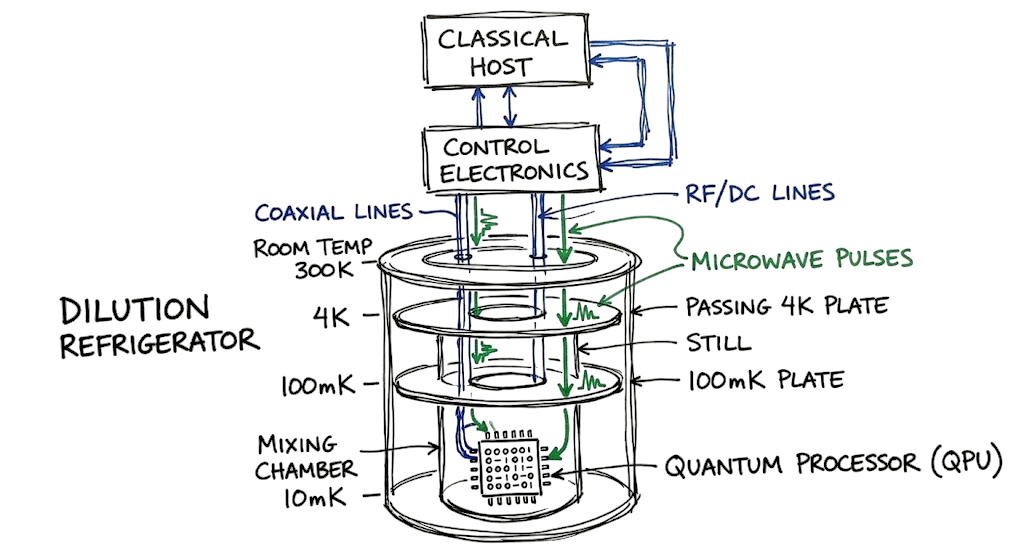
Using a quantum computer is very different from using a traditional computer. Instead of simply running a program, the system must carefully maintain the quantum state throughout the computation. One of the biggest challenges is preventing decoherence, which is the loss of a qubit’s quantum state due to interactions with its environment. Even small amounts of heat, vibration, or electrical interference can introduce errors.
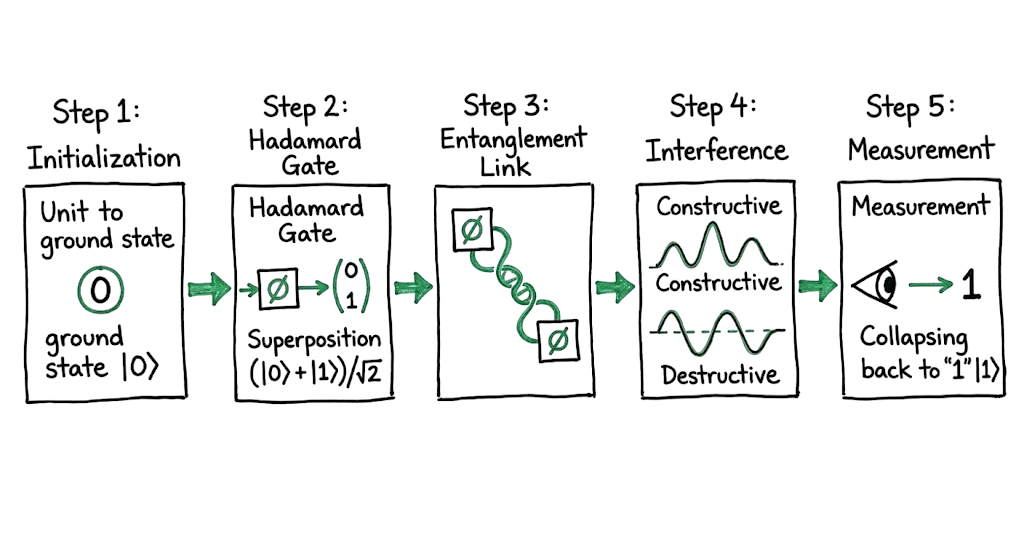
A typical quantum computation follows these steps:
Step 1: Initialize the Qubits
The system begins by resetting every qubit to a known starting state, usually |0⟩. This provides a consistent starting point for the computation.
Step 2: Create Superposition
Quantum gates are applied to place the qubits into a state of superposition, allowing them to represent multiple possible states during the computation.
Step 3: Perform the Quantum Algorithm
Additional quantum gates manipulate the qubits and create entanglement where required. These operations carry out the logic of the quantum algorithm.
Step 4: Use Interference
The algorithm adjusts the probability of different outcomes. Correct solutions become more likely through constructive interference, while incorrect outcomes are reduced through destructive interference.
Step 5: Measure the Result
Finally, the qubits are measured. This measurement causes the quantum state to collapse into a classical sequence of binary values that can be interpreted by a traditional computer.
Engineering Challenges
Building a reliable quantum computer requires extremely precise control systems. Every operation must be performed with high accuracy while minimizing environmental interference.
For example, Google’s Willow quantum processor contains 105 qubits and demonstrated significant improvements in quantum error correction and benchmark performance. While quantum processors continue to advance rapidly, practical large-scale quantum computing still depends on overcoming challenges such as error rates and hardware stability.
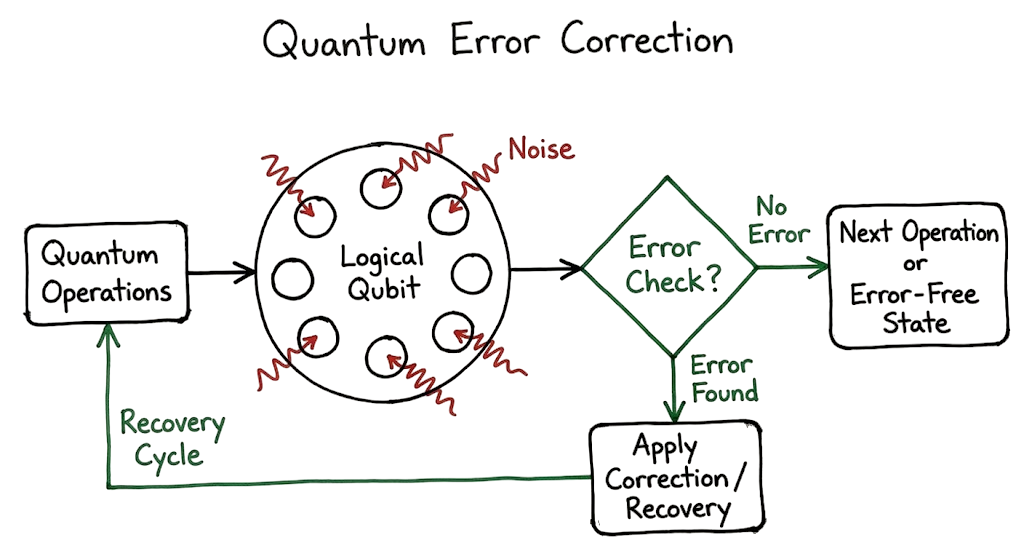
One of the biggest obstacles is quantum error correction (QEC). Because individual qubits are extremely sensitive, a single logical qubit is often created by combining many physical qubits. This approach allows the system to detect and correct errors without losing the stored information, making QEC one of the most important areas of current quantum computing research.
Types of Quantum Hardware
Different organizations use different technologies to build quantum processors. Each approach has unique advantages and engineering challenges.
Superconducting Circuits
Superconducting quantum processors are currently among the most widely used architectures. Companies such as IBM and Google create tiny superconducting circuits that operate at temperatures close to absolute zero.
Advantages
- Fast quantum operations
- Compatible with modern chip manufacturing techniques
- Well suited for scaling to larger processors
Challenges
- Require complex cryogenic cooling systems
- Sensitive to environmental noise
- Short coherence times
Trapped Ions
Trapped-ion quantum computers use individual atoms, such as ytterbium or barium, suspended in electromagnetic fields inside a vacuum chamber. Lasers manipulate the quantum states of these atoms with very high precision.
Advantages
- Excellent gate accuracy
- Long coherence times
- Naturally identical qubits
Challenges
- Slower gate operations
- More difficult to scale to very large systems
Other Quantum Computing Technologies
Several other hardware approaches are also being actively developed.
- Photonic Systems use photons to process quantum information. They offer excellent resistance to noise and can support long-distance quantum communication.
- Neutral Atom Systems trap individual neutral atoms using laser beams, providing another promising approach for scalable quantum computing.
- Silicon Spin Qubits store information using the spin of electrons inside silicon devices, making them compatible with existing semiconductor manufacturing processes.
- Topological Qubits are an experimental technology designed to protect quantum information from errors at the hardware level. Although still under development, they have the potential to greatly improve the reliability of future quantum computers.
Each hardware technology represents a different path toward building practical, large-scale quantum computers. Researchers continue to improve performance, reduce error rates, and develop more stable systems capable of solving real-world scientific and engineering problems.
Real-World Example: Factoring RSA-2048
Quantum Computing and Cybersecurity
One of the most widely discussed applications of quantum computing in cybersecurity is its potential impact on modern public-key encryption algorithms such as RSA-2048.
RSA encryption is based on the mathematical difficulty of factoring very large numbers. For today’s classical computers, solving this problem would take an impractically long time, making RSA one of the foundations of secure internet communication, online banking, digital signatures, and encrypted data exchange.
Shor’s Algorithm
In 1994, mathematician Peter Shor developed Shor’s algorithm, a quantum algorithm capable of factoring large numbers far more efficiently than classical algorithms.
A sufficiently large, fault-tolerant quantum computer could use Shor’s algorithm to break encryption methods such as RSA and Elliptic Curve Cryptography (ECC). However, building a machine with enough reliable logical qubits to perform this task remains one of the biggest engineering challenges in quantum computing.
Researchers continue to develop new hardware architectures and improved quantum error correction techniques that reduce the resources required for large-scale quantum computations. While significant progress has been made, practical cryptographically relevant quantum computers are still under active research.
Harvest Now, Decrypt Later
One of the biggest concerns for cybersecurity professionals is the “Harvest Now, Decrypt Later” strategy.
Instead of attacking encrypted data today, adversaries can capture and store sensitive encrypted communications with the expectation that future quantum computers may eventually decrypt them. This approach is particularly concerning for information that must remain confidential for many years, such as government records, healthcare data, financial information, and intellectual property.
Because of this long-term risk, many organizations have already started planning their migration to post-quantum cryptography (PQC) by following the standards published by the National Institute of Standards and Technology (NIST).
Preparing for the quantum era is not just about adopting new encryption algorithms. Organizations should also inventory their cryptographic assets, identify systems that rely on vulnerable algorithms, and develop a long-term migration strategy to ensure sensitive information remains protected as quantum computing continues to advance.
Related Reading: If you’re interested in protecting digital identities against future threats, read our Identity and Access Management (IAM) Guide and Zero Trust Security Guide on Tech Naga to understand how modern identity security complements post-quantum cryptography.
Advantages and Limitations
Advantages and Limitations
Quantum computing has the potential to solve problems that are extremely difficult or even impractical for today’s classical computers. However, the technology still faces several engineering and practical challenges before it becomes widely available.
Advantages
Solving Complex Scientific Problems
One of the biggest advantages of quantum computing is its ability to model complex molecular and chemical interactions. Certain molecules, such as FeMoco (the active component of the nitrogenase enzyme), are extremely difficult to simulate accurately using classical supercomputers.
Quantum computers could simulate these molecular interactions more naturally, helping researchers develop new medicines, advanced materials, better batteries, and more efficient industrial processes. For example, improving ammonia production could reduce energy consumption and lower carbon emissions in fertilizer manufacturing.
Faster Optimization and Research
Quantum computers also have the potential to improve optimization problems used in logistics, finance, supply chain management, artificial intelligence, and scientific research. While they will not replace classical computers, they can significantly accelerate specific types of calculations.
Limitations
High Error Rates
One of the biggest challenges facing quantum computing is reliability. Quantum states are extremely sensitive to environmental factors such as heat, vibration, and electromagnetic interference.
Unlike classical computers, where errors are relatively rare, individual quantum operations are much more susceptible to errors. Researchers use quantum error correction (QEC) to combine many physical qubits into a smaller number of reliable logical qubits, but this requires substantial hardware resources.
High Cost and Complex Infrastructure
Building and operating a quantum computer requires highly specialized equipment, including cryogenic cooling systems, precision control electronics, vacuum chambers, and carefully isolated environments.
Because of these infrastructure requirements, developing large-scale quantum computers requires significant investment and specialized engineering expertise.
Limited Availability
Today, most organizations access quantum computers through cloud platforms rather than purchasing their own hardware. Major technology companies and research organizations provide cloud-based access, allowing developers and researchers to experiment with quantum computing without maintaining expensive physical infrastructure.
As the technology continues to mature, quantum computing is expected to become more accessible, but widespread commercial deployment will take time. Researchers continue working to improve stability, reduce error rates, and build larger, more reliable quantum systems.
Conclusion
Quantum computing is rapidly moving from research laboratories toward practical applications. Although large-scale, fault-tolerant quantum computers are still under development, recent advances show that the technology is progressing faster than many experts expected.
Understanding how qubits work is becoming increasingly important for cybersecurity professionals, developers, and organizations responsible for protecting sensitive data. As quantum computing continues to evolve, some of today’s widely used public-key encryption algorithms, including RSA and Elliptic Curve Cryptography (ECC), may eventually require replacement with quantum-resistant alternatives.
Preparing for this transition should begin now. Organizations should identify systems that rely on vulnerable cryptographic algorithms, inventory their cryptographic assets, and develop a long-term migration plan aligned with the latest NIST post-quantum cryptography standards.
The move to quantum-resistant security will take time, careful planning, and ongoing investment. By understanding the fundamentals of quantum computing today and monitoring future developments, you can better prepare for the next generation of cybersecurity challenges.
At Tech Naga, we’ll continue covering the latest developments in quantum computing, post-quantum cryptography, and cybersecurity to help you stay informed and ready for the future.
Quantum & Cybersecurity
What is Quantum Computing in Simple Terms?
https://technaga.com/what-is-quantum-computing-simple-terms
Identity and Access Management in 2026: A Practical Guide for Cloud Security Professionals
Zero Trust Security in 2026: Architecture, Real Examples, and Implementation Guide
https://technaga.com/zero-trust-security-2026
Forget the Perimeter: Zero Trust vs Traditional Security Technical Comparison 2026
Multi-Factor Authentication (MFA): Critical Guide to Secure Your Systems (2026)
Security Fundamentals
What Is Cybersecurity and Why It Is Important Today
Password Security Guide 2026
Top 10 Cybersecurity Best Practices for 2026
Cloud Security Basics 2026: Complete Beginner Guide
Critical API Security Risks in the Cloud and Best Practices for 2026
Networking Fundamentals
Complete Network Security Basics Guide for Beginners 2026
OSI Model Guide: 7 Powerful Layers Every Engineer Must Know
4 Secrets of the TCP/IP Model for Security Analysts
3-Way Handshake Troubleshooting Guide
Essential Endpoint Security Guide 2026
External References
NIST (Recommended)
NIST Post-Quantum Cryptography Project
https://csrc.nist.gov/projects/post-quantum-cryptography
FIPS 203 (ML-KEM)
https://csrc.nist.gov/pubs/fips/203/final
FIPS 204 (ML-DSA)
https://csrc.nist.gov/pubs/fips/204/final
FIPS 205 (SLH-DSA)
https://csrc.nist.gov/pubs/fips/205/final
IBM Quantum
IBM Quantum
https://www.ibm.com/quantum
IBM Quantum Learning
https://learning.quantum.ibm.com/
Google Quantum AI
Google Quantum AI
https://quantumai.google/
Microsoft Quantum
Microsoft Azure Quantum
https://azure.microsoft.com/products/quantum
Quantinuum
IonQ
PsiQuantum
Intel Quantum
https://www.intel.com/quantum-computing
QuEra
Xanadu Quantum Technologies
Educational Resources
Qiskit Documentation
https://docs.quantum.ibm.com/
Qiskit
https://qiskit.org/
Research
Nature Quantum Information
https://www.nature.com/npjqi/