You wake up to a critical PagerDuty alert at 3 AM. The edge firewall CPU is running at 100%, and your inbound internet links are fully saturated.
At first, it might look like a sudden traffic spike, a misconfigured application, or an aggressive web crawler. However, the real culprit is a DNS Amplification Attack.
This type of attack remains one of the most effective forms of distributed denial-of-service (DDoS) attacks. Instead of generating massive traffic themselves, attackers abuse legitimate DNS servers across the internet to flood a victim with overwhelming amounts of data.
What makes this attack particularly dangerous is that the traffic appears to come from trusted DNS infrastructure. As a result, identifying and blocking the attack can be difficult during the initial stages of an incident.
In this article, you will learn how a DNS Amplification Attack works, how attackers exploit open DNS resolvers, how to detect the signs of an active attack, and the best practices to protect your infrastructure from large-scale DNS DDoS attacks.
What is a DNS Amplification Attack?
A DNS Amplification Attack is a type of Distributed Denial-of-Service (DDoS) attack that uses publicly accessible DNS servers to flood a target with massive amounts of traffic.
The attack takes advantage of the User Datagram Protocol (UDP), which is commonly used for DNS communication. Unlike TCP, UDP is a connectionless protocol and does not perform a three-way handshake before sending data.
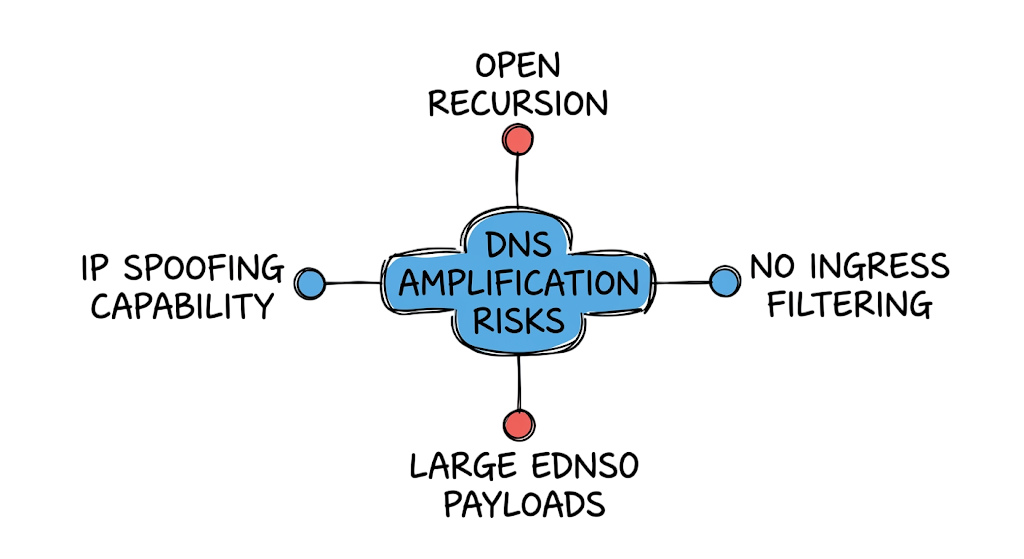
Because UDP does not verify the sender’s identity, attackers can easily spoof the source IP address in a DNS request. Instead of using their own IP address, they insert the victim’s IP address into the packet.
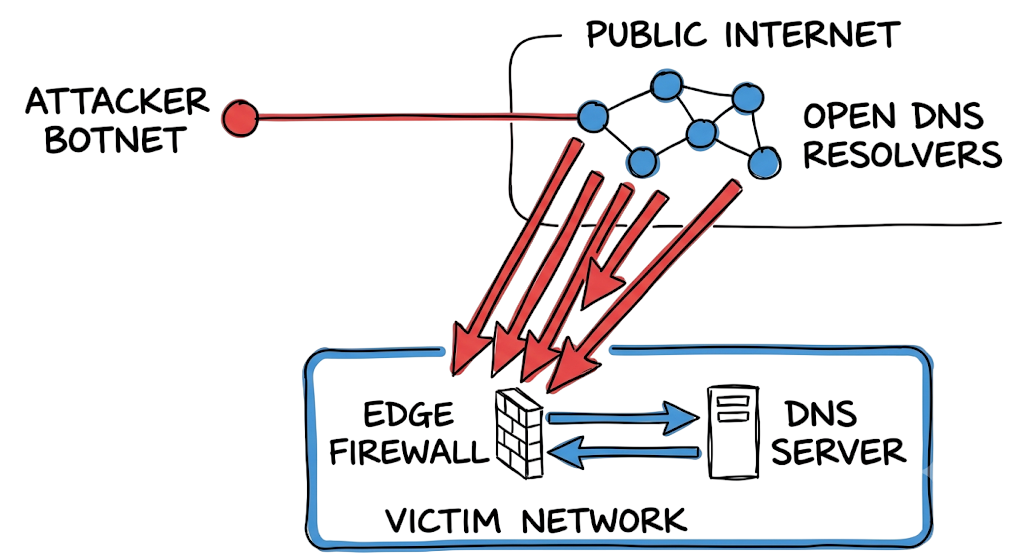
The attacker then sends these forged requests to open DNS resolvers that accept queries from any internet user. The DNS servers process the requests and send the responses to the spoofed address.
As a result, the victim receives a large volume of legitimate DNS responses that they never requested. When thousands of DNS servers respond simultaneously, network bandwidth, firewalls, and servers can quickly become overwhelmed.
This amplification effect allows attackers to generate massive traffic floods using very little bandwidth of their own, making DNS Amplification Attacks one of the most effective DNS DDoS attack techniques used today.
How a DNS Amplification Attack Works
Attackers do not need large botnets to launch a successful DNS Amplification Attack. In many cases, a list of vulnerable DNS servers is enough to generate massive amounts of traffic.
The attack works because DNS responses are often much larger than the original DNS requests. This difference in size creates the “amplification” effect.
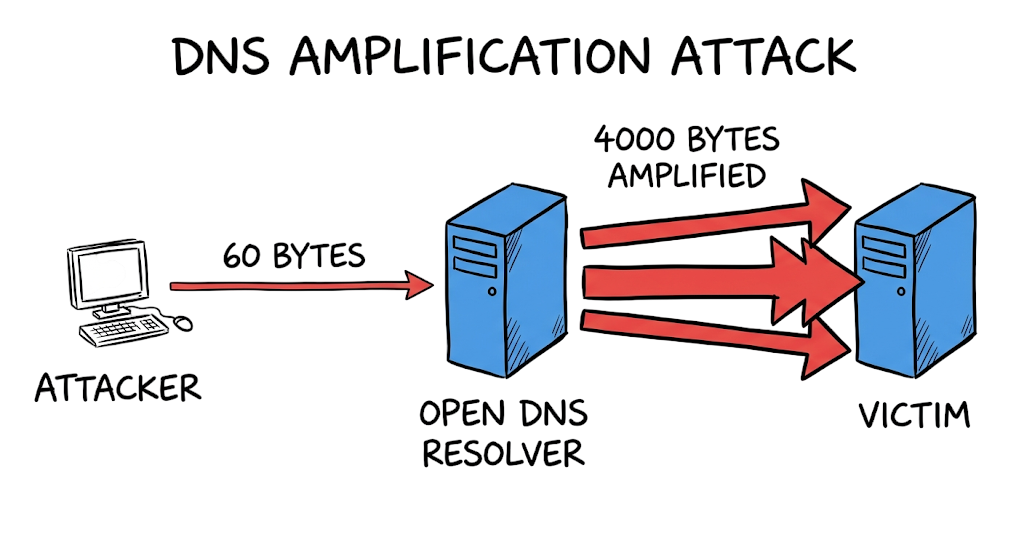
For example, an attacker may send a small DNS query requesting DNSSEC records, TXT records, or other large DNS responses. The request might be only 60 bytes in size.
The DNS server processes the query and generates a response that can exceed 4,000 bytes. This creates an amplification factor that can be dozens of times larger than the original request.
The attacker then spoofs the victim’s IP address in the DNS request. As a result, the DNS server sends the large response to the victim instead of the attacker.
Each individual response may not seem significant. However, when thousands of open DNS resolvers send these responses simultaneously, the traffic volume grows rapidly.
The attacker uses very little bandwidth and computing power. The victim, on the other hand, must handle gigabits of unexpected inbound traffic that can overwhelm routers, firewalls, servers, and internet links.
This imbalance between a small request and a large response is what makes DNS Amplification Attacks one of the most effective forms of DNS DDoS attacks.
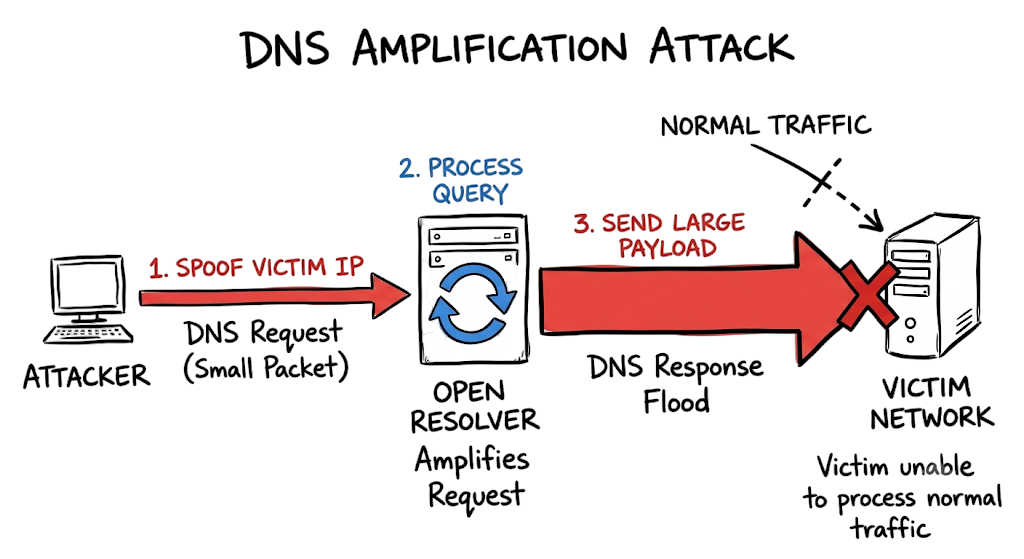
DNS Amplification Attack Technical Flow
Let us examine how a DNS Amplification Attack occurs on the network.
Step 1: Attacker Identifies Open DNS Resolvers
The attacker scans the internet to find open DNS resolvers that accept queries from any IP address. These vulnerable servers will later be used as traffic amplifiers.
Step 2: Attacker Creates a Spoofed DNS Request
The attacker crafts a small UDP-based DNS query. Instead of using their own IP address, they spoof the source IP address and replace it with the victim’s public IP address.
Step 3: Query Sent to Multiple DNS Servers
Thousands of spoofed DNS requests are sent to open resolvers simultaneously. The requests often target domains that generate large DNS responses, such as TXT records or DNSSEC-related records.
Step 4: DNS Resolvers Process the Requests
The DNS servers receive the requests and treat them as legitimate. Since UDP does not validate the sender’s identity, the servers have no way to verify that the request actually came from the victim.
Step 5: Large Responses Are Generated
The resolvers gather the requested DNS data and create responses that are much larger than the original query. A small 60-byte request can generate a response exceeding 4,000 bytes.
Step 6: Amplified Traffic Hits the Victim
Because the victim’s IP address was spoofed in the request, all DNS responses are sent directly to the victim. Thousands of legitimate DNS servers begin sending large responses at the same time.
Step 7: Network Resources Become Overwhelmed
The sudden flood of DNS traffic consumes bandwidth, overloads routers and firewalls, and can make applications or websites unavailable. This results in a DNS DDoS attack capable of disrupting business operations.
Summary
The attack succeeds because a small spoofed request triggers a much larger response. By abusing open DNS resolvers and UDP-based communication, attackers can generate enormous traffic volumes while using very little of their own bandwidth.
Key Components of a DNS Amplification Attack
- UDP Protocol — A connectionless transport mechanism that allows easy IP spoofing because it never requires a three-way handshake to establish trust.
- IP Spoofing — The act of forging the source address in a packet header so that all replies are directed to the victim instead of the actual sender.
- Open DNS Resolver — A misconfigured public server that answers queries from any IP address on the internet rather than restricting answers to a local authorized network.
- EDNS0 Extension — A domain name system feature that allows responses larger than the standard 512 bytes, maximizing the attack payload up to 4096 bytes.
- ANY Query — A specific request type that asks the server for all available records for a given domain, ensuring the absolute largest possible response size.
Real-World DNS Amplification Attack Example
Plaintext
14:22:10.101234 IP 192.0.2.53.53 > 203.0.113.10.49152: 45012$ q: ANY example.com. 18/0/1 example.com. TXT “v=spf1 include:_spf.example.com ~all”, … (3280 bytes)
14:22:10.101567 IP 198.51.100.53.53 > 203.0.113.10.49152: 45012$ q: ANY example.com. 18/0/1 example.com. TXT “v=spf1 include:_spf.example.com ~all”, … (3280 bytes)
14:22:10.101890 IP 203.0.113.53.53 > 203.0.113.10.49152: 45012$ q: ANY example.com. 18/0/1 example.com. TXT “v=spf1 include:_spf.example.com ~all”, … (3280 bytes)
Several indicators suggest a DNS Amplification Attack is in progress.
First, the traffic originates from UDP port 53, which is commonly used for DNS communication. The responses are being sent to a high-numbered destination port on the target system.
Second, the DNS response size is unusually large. Each packet contains approximately 3,280 bytes of data, which is significantly larger than a typical DNS query.
Third, the responses are arriving from multiple external DNS servers. This behavior is commonly observed in DNS Reflection and Amplification Attacks where open DNS resolvers are used to generate traffic toward a victim.
Most importantly, the victim server never initiated the original DNS requests. It is receiving unsolicited DNS responses from numerous external sources.
When thousands of similar packets arrive every second, bandwidth consumption, firewall utilization, and router resources can quickly become exhausted, resulting in a DNS DDoS attack.
Recommended Investigation Steps
- Verify whether the destination system initiated any outbound DNS queries.
- Review firewall, IDS/IPS, and NetFlow logs for unusual UDP port 53 activity.
- Determine whether the DNS responses match legitimate business traffic.
- Check bandwidth utilization and interface statistics on edge devices.
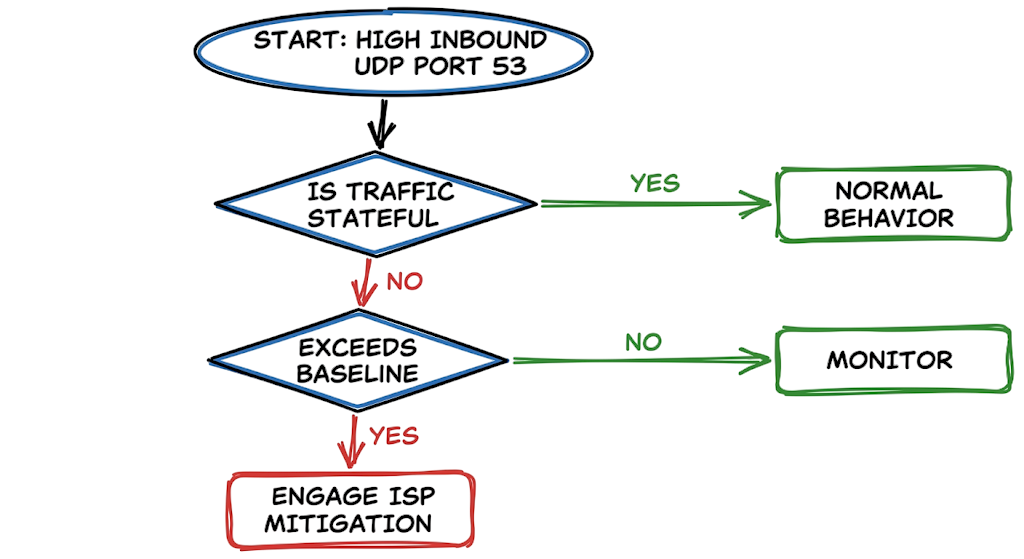
- Engage upstream DDoS mitigation services or your ISP if the traffic volume is causing service degradation.
- Apply filtering and rate-limiting controls based on verified attack characteristics while minimizing impact on legitimate DNS traffic.
The key indicator is not simply the source IP address. Instead, focus on unsolicited DNS responses, abnormal packet sizes, unexpected traffic volumes, and the absence of corresponding outbound DNS requests.
Practical Implementation and Mitigation
- Verify your external exposure by running external port scans against your own public IP ranges to ensure no internal servers are answering queries from the public internet.
- Implement Response Rate Limiting (RRL) on your authoritative name servers to ensure they drop identical, repetitive queries before they can be used to amplify an attack against someone else.
- Apply strict unicast reverse path forwarding (uRPF) on your edge routers to drop outbound packets that have spoofed source IP addresses, ensuring your network cannot be the origin point for an attack.
- Configure edge firewalls to block inbound responses that exceed a specific byte threshold unless they strictly correlate with an established, stateful outbound query.
- Shift your authoritative hosting to a distributed Anycast network to absorb volumetric floods across multiple geographic points of presence rather than bottlenecking at a single datacenter.
- Set up dedicated SIEM alerts to trigger when inbound UDP traffic spikes beyond 200% of your established baseline during normal business operations.
Advantages and Limitations of DNS Amplification Attacks
DNS Amplification Attacks remain popular among attackers because they require very little infrastructure. An attacker can generate a significant amount of malicious traffic using a simple script and access to vulnerable DNS resolvers.
Another advantage for attackers is anonymity. The victim only sees traffic originating from legitimate DNS servers rather than the actual source of the attack. This makes identifying the attacker much more difficult.
The attack is also highly efficient. Small DNS requests can generate responses many times larger than the original query, allowing attackers to create massive traffic floods while consuming minimal bandwidth.
However, DNS Amplification Attacks have limitations.
Modern network security teams are better equipped to detect the characteristic patterns associated with DNS reflection and amplification attacks. Sudden spikes in UDP port 53 traffic, unusually large DNS responses, and traffic from multiple DNS servers are common indicators.
Because the attack relies on volumetric flooding, internet service providers (ISPs) can often mitigate it through upstream filtering, traffic scrubbing, and access control lists (ACLs) when detected early.
Organizations that use cloud-based DDoS protection services are also better protected. These services absorb and filter malicious traffic at distributed edge locations before it reaches the target network.
As a result, while DNS Amplification Attacks can still be highly disruptive, their effectiveness is significantly reduced when organizations implement proper DNS security controls, DDoS protection services, and continuous network monitoring.
Common Mistakes During DNS DDoS Attack Response
When responding to a DNS Amplification Attack, many engineers focus on the wrong indicators and unintentionally make the situation worse.
Mistake 1: Blocking the Source IP Addresses
One of the most common mistakes is attempting to block the IP addresses generating the traffic.
During a DNS Reflection Attack, the traffic often comes from legitimate DNS resolvers such as public DNS services. The actual attacker is hidden behind spoofed source addresses.
Blocking these resolvers may disrupt legitimate DNS services for your users while doing little to stop the attack.
Mistake 2: Applying Aggressive Firewall Rate Limits
Another common error is implementing overly restrictive rate-limiting policies on firewalls and edge devices.
While rate limiting can reduce malicious traffic, aggressive settings may also block legitimate DNS responses and business-critical applications. This can create a self-inflicted denial-of-service condition.
Mistake 3: Ignoring Internal DNS Infrastructure
Many organizations focus only on protecting themselves and forget to secure their own DNS infrastructure.
Misconfigured internal DNS servers, lab systems, or test environments may accidentally function as open DNS resolvers. These systems can be abused by attackers to launch amplification attacks against other organizations.
Mistake 4: Focusing Only on Source Addresses
Engineers often spend too much time investigating source IP addresses instead of analyzing traffic behavior.
In most DNS DDoS attacks, the more valuable indicators include:
- Unusually large DNS response packets
- High volumes of UDP port 53 traffic
- Unexpected inbound DNS responses
- Traffic from multiple DNS servers simultaneously
- Abnormal bandwidth consumption
DNS Amplification Attack Best Practices
Separate Internal and External DNS Infrastructure
Organizations should keep internal recursive DNS resolvers separate from external authoritative DNS servers.
Using the same infrastructure for both functions increases risk and can make DNS services more vulnerable during a DNS Amplification Attack. Proper separation reduces the attack surface and prevents internal systems from being abused as amplification sources.
Secure Open DNS Resolvers
Review DNS server configurations regularly to ensure they do not accept recursive queries from unauthorized internet hosts.
Misconfigured open DNS resolvers are one of the primary enablers of DNS Reflection and Amplification Attacks.
Keep DNS Software Updated
Maintain current versions of DNS software and apply security updates promptly.
Regular patching helps address vulnerabilities, improve performance, and reduce the risk of exploitation by attackers.
Monitor Network Traffic Baselines
Establish normal DNS traffic baselines for your environment. Track average query volumes, response sizes, bandwidth usage, and peak utilization periods.
Understanding normal traffic patterns makes it easier to detect abnormal spikes that may indicate an active DNS DDoS attack.
Enable Response Rate Limiting (RRL)
Configure Response Rate Limiting on authoritative DNS servers to reduce the impact of repeated or abusive queries.
RRL helps prevent attackers from using your infrastructure as an amplification source.
Implement Anti-Spoofing Controls
Deploy ingress and egress filtering mechanisms such as BCP 38 and Unicast Reverse Path Forwarding (uRPF).
These controls help prevent IP address spoofing, which is a critical requirement for DNS Amplification Attacks.
Use DDoS Protection Services
Consider cloud-based DDoS protection platforms and Anycast DNS services for public-facing infrastructure.
These solutions can absorb and filter malicious traffic before it reaches your network edge.
Continuously Monitor DNS Security
DNS Security requires ongoing visibility. Configure alerts for unusual increases in UDP port 53 traffic, oversized DNS responses, and unexpected query patterns.
Early detection allows security teams to respond before bandwidth, firewalls, and critical services become overwhelmed.
Troubleshooting Scenario: DNS Reflection Attack Investigation
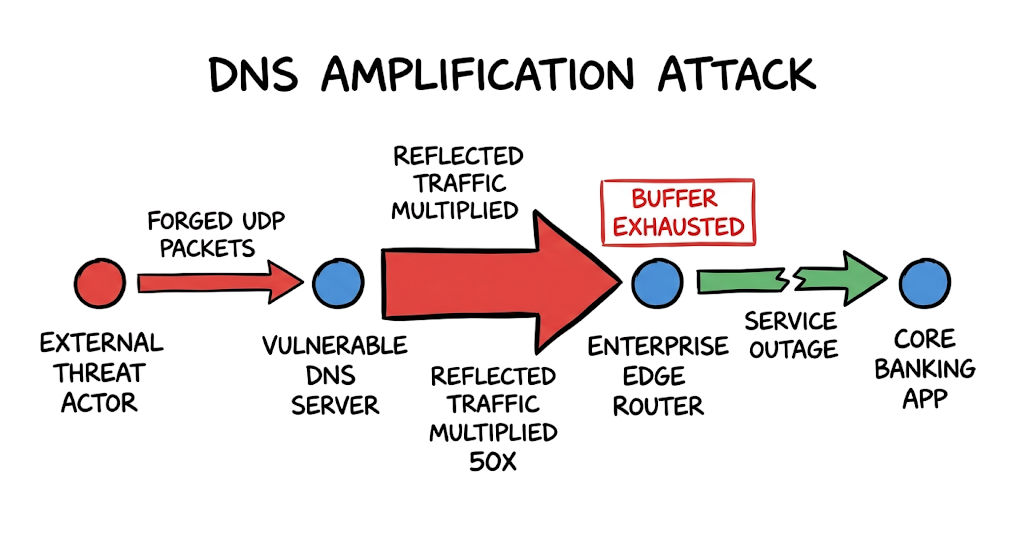
Symptom: The core banking application at a major financial institution suddenly drops offline. Customers cannot log in, and internal monitoring shows the main application gateway is unreachable.
Wrong assumption: The initial incident responders assume the application server crashed or a database lock occurred, wasting 30 minutes digging through application logs.
Actual root cause: The edge routers are silently dropping legitimate TCP traffic because the interface buffers are completely exhausted by a massive flood of inbound UDP packets hitting port 53. In real environments, it doesn’t work this cleanly. The firewall might not even log the drops because its CPU is overwhelmed just trying to inspect the garbage packets, leaving you blind to the actual UDP Attack.
Fix: You immediately engage your upstream ISP to drop unrequested inbound UDP port 53 traffic before it reaches your circuit. This instantly frees up the bandwidth, clears the interface buffers, and restores the banking application.
DNS Amplification Attack Interview Questions
Q: What is the exact mechanism that causes the amplification effect in this attack?
A: The amplification occurs because an attacker requests a very large record, like an ANY or TXT record with DNSSEC enabled, using a very small query packet. The server responds with a payload that can be exponentially larger than the request.
Q: Why do attackers use UDP instead of TCP for this specific attack?
A: UDP is a stateless protocol that does not require a three-way handshake to establish a connection. This allows the attacker to forge the source IP address in the packet header, ensuring the massive response goes directly to the victim.
Q: If you see inbound UDP port 53 traffic saturating your link, should you block all UDP port 53 traffic at your firewall?
A: No, blocking all UDP port 53 traffic will break legitimate name resolution for your own internal users. You should apply stateful inspection, restrict by packet size, or work with your ISP to scrub the traffic upstream.
Q: Explain the difference between reflection and amplification.
A: Reflection means bouncing traffic off a third-party server by spoofing the source IP address to hide the attacker’s origin. Amplification is a specific type of reflection where the response sent by the third-party server is significantly larger than the initial request.
Q: How does BCP 38 help prevent these attacks?
A: BCP 38 involves implementing ingress filtering at the network edge to verify that the source IP of outbound packets actually belongs to the network sending them. This prevents attackers from successfully spoofing IP addresses, killing the attack at the source.
Future Trends in DNS Security (2026 and Beyond)
DNS-based attacks continue to evolve as attackers develop more sophisticated amplification and reflection techniques.
Traditional DNS Amplification Attacks often relied on large DNS responses generated through ANY queries. However, modern attack methods are becoming more complex. One notable example is NXNSAttack, which abuses DNS referral mechanisms to trigger excessive recursive queries and increase the workload on DNS resolvers.
Organizations are also facing increasing regulatory and compliance requirements related to cybersecurity resilience. Financial institutions, telecommunications providers, and critical infrastructure operators are expected to demonstrate stronger protections against DDoS attacks and service disruptions.
At the same time, artificial intelligence and machine learning technologies are becoming more common in network security platforms. These systems can analyze traffic patterns, identify anomalies, and automatically respond to suspicious activity faster than traditional rule-based approaches.
Cloud-based DDoS protection services, Anycast DNS architectures, and automated threat detection are expected to play a larger role in defending against large-scale DNS attacks.
As attack techniques continue to advance, organizations will need to focus on proactive monitoring, infrastructure resilience, and adaptive security controls to maintain reliable DNS services and protect critical business operations.
Frequently Asked Questions (FAQ)
What makes a resolver “open”?
An open resolver is a server configured to accept and process recursive queries from any IP address on the public internet. Properly configured resolvers should only accept queries from authorized, local network subnets.
Can this attack steal my data?
No, this is purely an availability attack. The goal is to consume network bandwidth and computing resources to take systems offline, not to breach databases or exfiltrate sensitive information.
How long do these attacks usually last?
They can last anywhere from a few minutes to several days. Often, attackers run short, high-intensity bursts to test defenses or distract security teams while they launch a secondary, more targeted attack elsewhere in the network.
Is there any way to track the real attacker?
It is extremely difficult. Because the attacker spoofs the source IP address, the victim only sees traffic coming from legitimate servers. Tracking the true origin requires cooperation across multiple international ISPs to trace the spoofed packets back to their true source.
Does DNSSEC make this attack worse?
Yes, ironically it can. DNSSEC adds cryptographic signatures to records to verify their authenticity. These signatures significantly increase the size of the response, providing a much higher amplification factor for attackers.
Conclusion
A DNS Amplification Attack is one of the most effective forms of DNS DDoS attacks because it allows attackers to generate massive traffic volumes using relatively small requests. By exploiting open DNS resolvers, UDP-based communication, and IP address spoofing, attackers can overwhelm network resources and disrupt critical services.
Organizations can reduce their risk by securing DNS infrastructure, disabling open resolvers, implementing anti-spoofing controls, enabling Response Rate Limiting (RRL), and monitoring DNS traffic patterns continuously.
Effective DNS Security is built on visibility, preparation, and layered defenses. Understanding how DNS Amplification Attacks work and implementing proactive security controls can help organizations detect threats early and maintain service availability during large-scale attack attempts.
As DNS-based threats continue to evolve, regular security assessments, traffic analysis, and DDoS protection strategies remain essential components of a strong network security program.
Recommended External Links
- Cloudflare DNS Amplification Attack Guide
Good reference for DNS amplification concepts and DDoS mitigation. - CISA DDoS Quick Guide
Government guidance on DDoS attack prevention and response. - ICANN DNS Security Resources
DNS security best practices and DNS ecosystem protection. - ISC BIND Response Rate Limiting (RRL) Documentation
Technical guidance on implementing Response Rate Limiting. - RFC 5358 Preventing DNS Amplification Attacks
Official IETF guidance on preventing DNS amplification attacks. - BCP 38 Network Ingress Filtering (RFC 2827)
Explains anti-spoofing controls used to stop reflection attacks. - OWASP Denial of Service Cheat Sheet
General DDoS and availability protection best practices.
Recommended Internal Links
- OSI Model Guide: 7 Powerful Layers Every Engineer Must Know
- Helps readers understand where DNS operates in the network stack.
- https://technaga.com/osi-model-7-layers-troubleshooting-guide/
- 4 Secrets of the TCP IP Model for Security Analysts
- Useful for explaining UDP, IP spoofing, and packet flow during DNS amplification attacks.
- https://technaga.com/tcp-ip-model-security-guide/
- Network Segmentation Explained with Real-World Example
- Relevant for limiting the impact of DDoS attacks and protecting critical services.
- https://technaga.com/network-segmentation-guide-ransomware-prevention/
- Cloud Security Basics 2026: Complete Beginner Guide
- Connects well with cloud-based DDoS mitigation and DNS security services.
- https://technaga.com/cloud-security-basics-2026/
- Zero Trust Security in 2026: Architecture, Real Examples, and Implementation Guide
- Supports discussions around modern security architecture and infrastructure resilience.
- https://technaga.com/zero-trust-security-2026-guide/