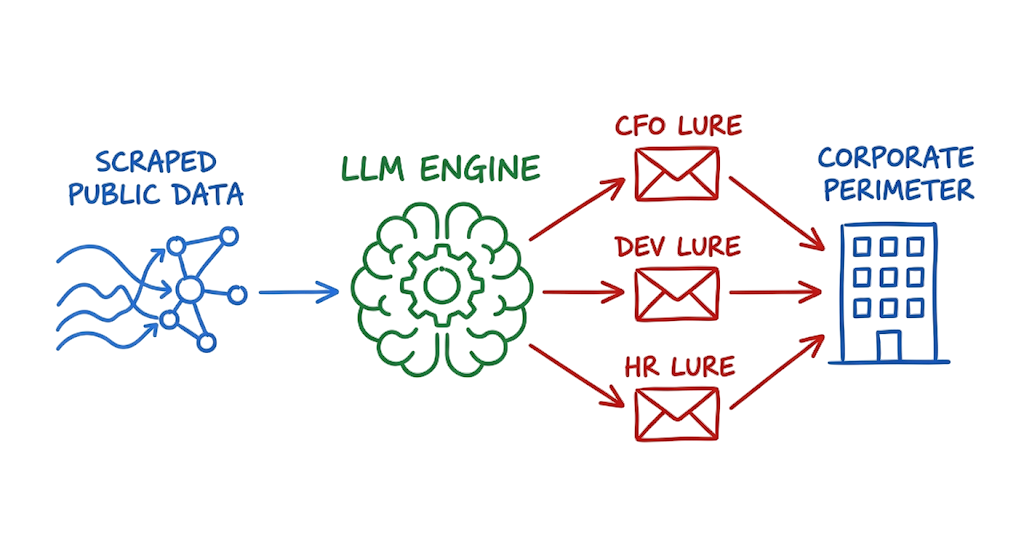
A finance manager in Bengaluru recently received what appeared to be a routine email from her CFO requesting approval for a pending vendor payment. The message contained no spelling or grammatical errors, referenced a legitimate contractor, and even matched the CFO’s usual writing style and email signature.
Believing the request was genuine, she approved the payment immediately. The fraudulent transaction was discovered only during a Monday morning leadership meeting.
This incident highlights how AI-powered phishing attacks have evolved. Instead of sending generic spam messages, cybercriminals now use Large Language Models (LLMs) to generate highly personalized phishing emails in seconds using publicly available information gathered from company websites, social media platforms, and leaked data sources.
Modern AI-powered phishing attacks are far more convincing than traditional phishing campaigns. Attackers use spear phishing using AI to craft messages that closely match an executive’s tone, business context, and communication style, making them significantly harder for employees to identify.
Another growing concern is LLM-based social engineering, where generative AI creates realistic conversations, email threads, and follow-up messages designed to manipulate victims into transferring funds, revealing credentials, or approving fraudulent requests.
As these attacks become more sophisticated, organizations must improve ChatGPT phishing email detection capabilities by combining AI-powered email security tools, behavioral analytics, and employee awareness training. Traditional rule-based email filtering alone is no longer enough to stop advanced phishing campaigns.
Enterprises must also prepare for AI email spoofing enterprise attacks, where threat actors combine AI-generated content with spoofed domains, compromised business accounts, or Business Email Compromise (BEC) techniques to impersonate executives and trusted partners.
In this guide, you’ll learn how AI-powered phishing attacks work, how spear phishing using AI bypasses modern email security controls, how LLM-based social engineering is changing cybercrime, and the practical security measures organizations can implement to strengthen ChatGPT phishing email detection and defend against AI email spoofing enterprise attacks.
UNDERSTANDING AI-POWERED PHISHING ATTACKS 2026
AI phishing is the use of large language models (LLMs) and behavioral profiling tools to create highly personalized messages that trick people into sharing credentials, financial information, or sensitive data.
Unlike traditional phishing campaigns that send the same email to thousands of recipients, AI-powered attacks focus on individual targets. Attackers collect publicly available information from social media, company websites, and professional profiles.
This data is then fed into a language model to analyze the writing style, tone, and communication patterns of a trusted executive, colleague, or business partner.
The AI generates a customized message designed specifically for the target. Because the email matches real business context and communication habits, it appears legitimate and trustworthy.
This shift from mass phishing to precision targeting makes AI-powered phishing attacks far more convincing and difficult to detect than traditional phishing attempts.
How AI-Powered Phishing Attacks Work?
Traditional phishing campaigns relied on mass distribution because creating a personalized message for every target required significant manual effort. Attackers sent millions of identical emails and accepted a low success rate.
Large language models (LLMs) have completely changed this approach. They can analyze large amounts of data and generate highly customized content within seconds.
Attackers feed AI models with publicly available information collected from corporate websites, social media platforms, code repositories, and leaked databases. The model processes this information and creates a message tailored to a specific individual.
For example, if an attacker targets fifty employees, the AI does not produce a single template with different names inserted. Instead, it generates fifty unique emails based on each employee’s role, responsibilities, and recent activities.
A junior developer might receive an alert about a failing build in a software repository. An accounting manager could receive an urgent invoice request referencing a real supplier or ongoing project.
These attacks are effective because they match the exact business context the employee expects to see. When a message appears relevant, timely, and familiar, people are more likely to trust it.
In many cases, the success of AI-powered phishing attacks comes from this ability to create realistic context. The more convincing the context, the higher the chance of the victim taking the requested action.
Technical Flow of an AI-Powered Phishing Attack
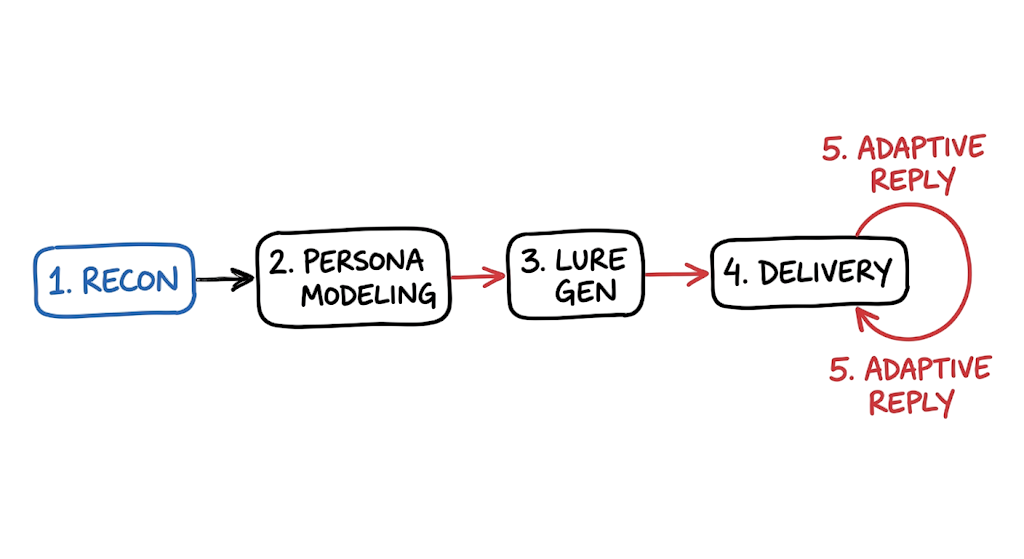
The attack chain behind AI-powered phishing attacks typically begins with automated reconnaissance. Threat actors use scripts and intelligence-gathering tools to collect information about potential targets from publicly available sources.
This data collection phase gathers email formats, employee names, job roles, internal project references, and organizational hierarchies from company websites, social media platforms, and data breaches. This information becomes the foundation for highly targeted spear phishing using AI.
Once enough information is collected, the attacker moves to the persona modeling stage. Here, a large language model (LLM) is trained to mimic the communication style of a trusted executive, manager, or business partner.
The AI analyzes public statements, social media posts, and leaked email samples to replicate writing patterns, tone, and vocabulary. This process enables highly effective LLM-based social engineering campaigns.
Next comes the lure generation phase. The AI-powered phishing system creates highly personalized messages designed for specific recipients. Unlike traditional phishing campaigns, these messages are customized based on the target’s role, responsibilities, and recent activities.
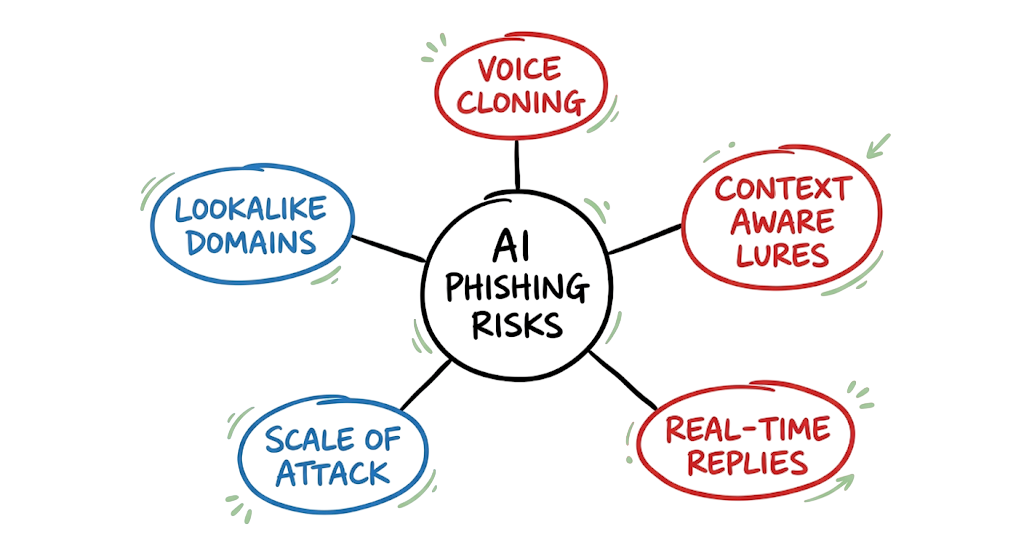
Instead of generating a single template, the system can process an entire corporate directory and create unique AI-generated phishing emails for every employee simultaneously. This dramatically increases the success rate of phishing campaigns.
The delivery phase follows. Attackers send these emails through compromised business accounts or lookalike domains that closely resemble legitimate company domains. This technique is commonly used in AI email spoofing enterprise attacks.
Because these accounts often have valid authentication records and security certificates, the messages can bypass many traditional email security controls and evade basic spam filters.
Modern AI-powered phishing attacks can also adapt in real time. If a target responds with questions or expresses concerns, the language model continues the conversation automatically.
The AI generates convincing replies, answers objections, and maintains the impersonation until the victim clicks a malicious link, shares credentials, or authorizes a fraudulent transaction.
This ability to create personalized conversations at scale makes AI phishing one of the fastest-growing cybersecurity threats organizations face in 2026.
Key Components Behind AI Phishing Campaigns
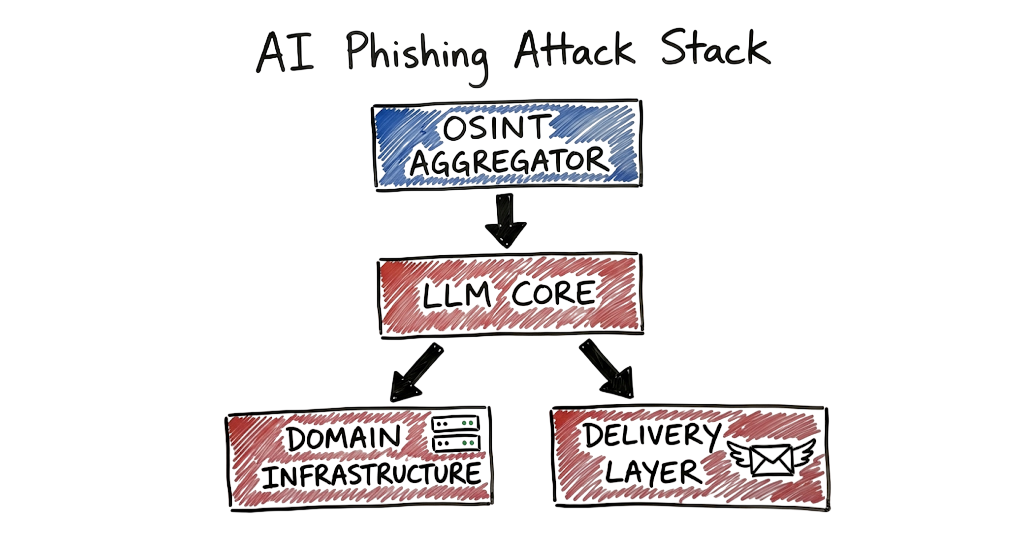
- LLM Core: Generates the actual text and handles real time replies to maintain the illusion of a human sender.
- Data Scraper: Pulls target information from public sites and breach databases to give the language model accurate context.
- Domain Infrastructure: Registers typo variations of your company domain and provisions valid security certificates to avoid browser warnings.
- Delivery Layer: Routes the outgoing emails through compromised accounts or clean servers to bypass basic reputation filters.
- Voice Module: Clones the voice of the impersonated executive to handle phone verifications when the target gets suspicious.
Real-World Example of an AI-Powered Phishing Email
Plaintext
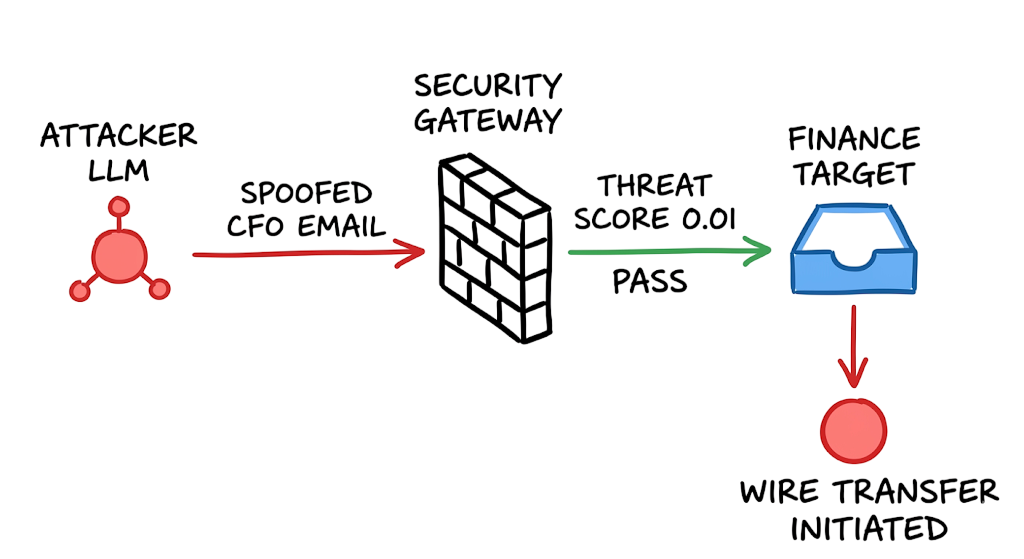
[Gateway Security Log]
Time: 2026-03-14 08:14:22 UTC
Event: Inbound Message Received
Authentication: SPF=Pass, DKIM=Pass, DMARC=Pass
Threat_Score: 0.01 (Clean)
Action: Delivered to Inbox
[Intercepted Message Body]
From: suresh.kumar.cfo@targetcompany-finance.com
To: accounts.payable@targetcompany.com
Subject: Payment Hold URGENT
Hi Priya,
Following up on the InfraBuild invoice we discussed last Thursday. Finance ops
has flagged a 24 hour hold on the payment pending a vendor bank detail
re-verification. I have already spoken to the vendor and they confirmed the
new account details are on their end.
Can you process this directly through the alternate wire portal I shared
below? Need this cleared before EOD to avoid the penalty clause kicking in.
Portal link: [redacted]
Password for first login: [redacted]
Let me know once done. Do not loop in the broader team on this. The vendor
specifically asked to keep it quiet until the verification cycle is complete.
Regards,
Naga
This log and email combination provides a clear example of spear phishing using AI successfully bypassing traditional perimeter defenses.
At first glance, the message appears completely legitimate. The sender domain is only slightly altered, yet it passes authentication checks because the attacker registered a lookalike domain and configured the required security records correctly.
The threat score remains extremely low because the email contains perfect grammar, no malicious attachments, and no blacklisted IP addresses. This is one reason why AI-generated phishing emails are difficult for traditional email security tools to detect.
Another warning sign is the request to keep the transaction confidential and avoid involving other team members. This isolation tactic is commonly used in LLM-based social engineering attacks to prevent victims from verifying the request.
The email also demonstrates how AI-powered phishing attacks exploit trust rather than technical vulnerabilities. Instead of relying on malware, the attacker uses realistic business context and persuasive communication to influence the target’s decision.
In this case, the attack nearly resulted in a significant financial loss. The fraud was only prevented because the employee contacted the CFO for an unrelated reason and discovered that the request was fraudulent.
This example shows why organizations must combine technical controls with strong verification processes. Even advanced email security solutions can struggle to detect sophisticated AI phishing campaigns when the message appears authentic and contextually accurate.
Practical Defenses Against AI-Powered Phishing Attacks
- Configure your domain authentication policy to reject unauthorized senders immediately. Setting your policy to monitor mode tells servers to report fake emails but still deliver them to user inboxes, which completely defeats the purpose of the protocol.
- Integrate machine learning phishing prevention tools directly at your email gateway. Relying on static IP blocklists fails instantly against modern attacks that use clean cloud infrastructure.
- Run external reconnaissance on your own organization every quarter. Search for exposed employee directories and predictable email formats so you can secure your data before attackers feed it into their generation models.
- Append external sender warnings to every email arriving from outside your network. Do not disable these warnings for executives or external partners, because attackers specifically spoof those trusted identities to manipulate lower level staff.
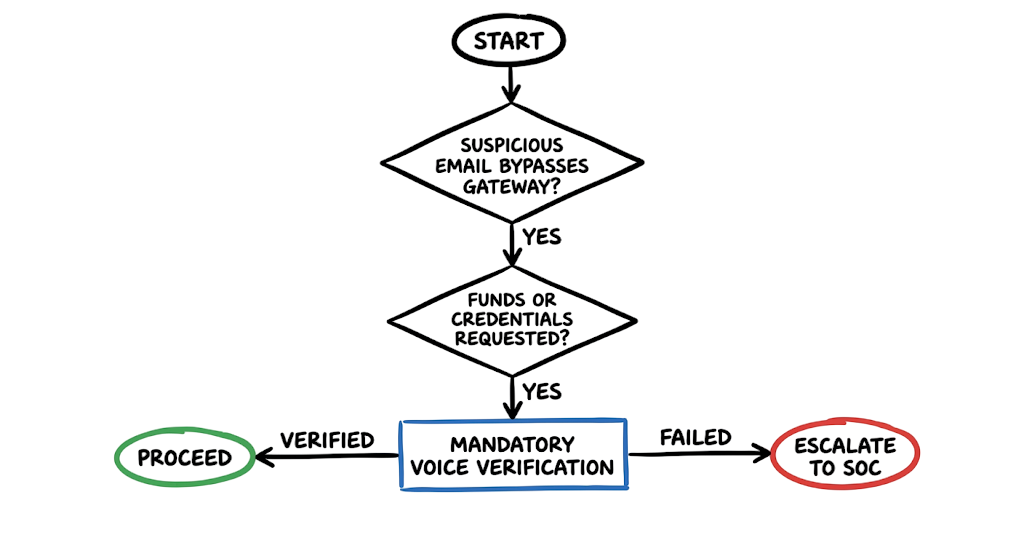
- Enforce strict out of band verification for all payment modifications. If an email requests a wire transfer or bank account update, require the recipient to call the sender on a known phone number to confirm the transaction.
- Track domain registrations that mimic your corporate brand. Use monitoring feeds to alert your security operations center when a typo variation of your domain is registered, allowing you to block it at your web proxy before the attack begins.
Advantages and Limitations of AI Phishing Detection
Modern email security tools provide strong protection against many threats, but they are not perfect. Organizations should not rely solely on technology to defend against AI-powered phishing attacks.
Behavioral anomaly detection works well when security platforms have enough historical data to establish a communication baseline. By understanding normal user behavior, these tools can identify unusual activity and flag potential threats.
However, this approach has limitations. Newly hired employees often have little or no communication history, making it difficult for security systems to determine what normal activity looks like. Attackers frequently exploit this gap by targeting new hires during their first few weeks.
Another challenge involves ChatGPT phishing email detection and similar AI phishing detection techniques. Many organizations attempt to identify machine-generated content using text analysis and pattern-based classifiers.
Unfortunately, this approach can generate a high number of false positives. Marketing teams, recruiters, customer support representatives, and sales professionals increasingly use AI tools to create legitimate business communications.
If a security platform blocks every email that appears AI-generated, it can disrupt normal business operations and create unnecessary friction for employees.
This is why effective AI phishing prevention requires more than advanced filtering technology. Security teams must combine email security controls with strong business processes, employee awareness training, and out-of-band verification procedures.
The most effective defense against AI-generated phishing emails is a layered security strategy that includes technical controls, human verification, and clear approval workflows for sensitive actions such as wire transfers, account changes, and credential requests.
Common Mistakes Organizations Make Against AI Phishing
Many security engineers deploy an advanced email gateway and assume the threat has been completely eliminated. They configure filters to detect malicious attachments, known malicious domains, and common spam indicators.
This approach works well against traditional phishing campaigns, but AI-powered phishing attacks operate differently. Modern attackers often avoid malware attachments and instead rely on highly convincing social engineering techniques.
Many AI-generated phishing emails are sent from newly registered domains that have no negative reputation history. As a result, traditional reputation-based security controls may fail to identify the threat.
The delivery mechanism itself often appears completely legitimate. The real danger lies in the request contained within the message, whether it involves a wire transfer, credential submission, account verification, or sensitive data disclosure.
This is one of the biggest challenges in AI phishing detection. Technical filters can analyze links, attachments, and sender reputation, but they often struggle to evaluate business context and human intent.
Another common mistake is leaving email authentication protocols such as SPF, DKIM, and DMARC in monitoring mode for extended periods. Organizations often avoid moving to enforcement mode because they fear disrupting legitimate email traffic.
Unfortunately, this delay can create opportunities for AI email spoofing enterprise campaigns to target customers, suppliers, and business partners while security teams collect logs without actively blocking threats.
Employee awareness training can also fall short. Many security programs still teach users to identify phishing emails by looking for spelling mistakes, poor grammar, and unusual formatting.
However, LLM-based social engineering attacks generate messages with flawless grammar, professional formatting, and realistic business context. As a result, employees may incorrectly assume that a well-written email is trustworthy.
To defend against AI-powered phishing attacks, organizations must combine technical controls with strong verification processes, employee training, and clear approval workflows for high-risk transactions.
Best Practices to Prevent AI-Powered Phishing Attacks
A real-world incident demonstrated how effective AI-powered phishing attacks can be against modern organizations. An AI-generated phishing email bypassed multiple layers of email security because the sending domain had an established reputation and the writing style closely matched that of a senior executive.
The incident highlighted an important lesson: cybersecurity awareness training should be tailored to specific departments rather than delivered as a generic program.
Finance teams should receive specialized training on payment fraud, vendor impersonation, business email compromise (BEC), and AI-generated phishing emails. These departments are frequently targeted because they have authority over financial transactions.
Human resources teams face different threats. Their training should focus on fake employee complaints, payroll fraud, manipulated tax documents, and social engineering attempts designed to access employee records.
Role-specific security awareness programs are far more effective than generic training modules because employees learn to recognize the threats most relevant to their daily responsibilities.
Organizations should also centralize authentication failure logs from email gateways, identity providers, and security platforms. This allows the security operations center (SOC) to identify potential AI email spoofing enterprise campaigns and suspicious authentication patterns before an attack reaches users.
In addition, organizations should regularly monitor domain registrations that resemble their corporate brand. Detecting lookalike domains early can help prevent spear phishing using AI and business email compromise attacks.
For regulated industries such as banking, healthcare, and financial services, incident response plans should include clear procedures for handling AI-powered phishing attacks. These plans must account for regulatory reporting requirements and defined notification timelines when unauthorized access to sensitive data occurs.
A combination of targeted training, proactive monitoring, and strong incident response procedures provides a more effective defense against modern LLM-based social engineering campaigns than relying on email filtering alone.
AI-Powered Phishing Attack Troubleshooting Scenario
Symptom: A highly targeted phishing email lands in a senior director’s inbox, bypasses the security gateway completely, and is only caught because the director called the vendor to verify.
Wrong assumption most engineers make: The gateway failed and requires immediate replacement or tighter heuristic rules.
Actual root cause: In real environments, it doesn’t work this cleanly. The gateway evaluated exactly what it was built to check. The email originated from a compromised vendor account, so the sender authentication passed. The message contained no attachments, and the included link pointed to a newly registered site with a valid security certificate.
Fix: The root cause was not a technology failure, but rather an attack designed to circumvent technical checks entirely. The fix is implementing a mandatory business process rule that requires voice confirmation for any sensitive request, taking the burden of verification completely off the software.
AI-Powered Phishing Interview Questions and Answers
Q: How does a language model make attacks more dangerous than traditional static templates?
A: Language models generate contextually accurate and highly personalized content at massive scale. They eliminate the manual labor previously required for spear phishing, allowing an attacker to produce hundreds of customized emails in minutes.
Q: Your authentication policy is deployed but spoofed emails are still landing. What is the first thing you check?
A: You check the policy enforcement level to see if it is set to monitor mode instead of reject mode. Then, verify if the attacks use lookalike domains rather than spoofing your exact domain, since authentication only protects your specific address.
Q: Why do traditional filter rules struggle with machine generated phishing emails?
A: Traditional filters look for specific linguistic markers, obvious spelling errors, and artificial urgency patterns. Machine generated emails use perfect grammar and coherent context, which fail to trigger the risk scoring weights built into older systems.
Q: A user clicks a link in a suspicious email but insists they never typed their password. How do you respond?
A: You treat the machine as compromised immediately. You isolate the endpoint, pull the proxy logs to analyze the connection, and search for drive by downloads or background credential harvesting scripts that run without user interaction.
Q: How would you explain this specific threat to a non technical executive in sixty seconds?
A: Attackers use software to write emails that sound exactly like you, using your vocabulary and real business context. These messages bypass our technical filters because they look completely legitimate. We must enforce a rule where any unusual request requires a phone call to confirm.
Future Trends in AI-Powered Phishing Attacks (2026 and Beyond)
The future of AI-powered phishing attacks will extend far beyond email. Security researchers expect multimodal attack chains to become the standard approach used by cybercriminals over the next few years.
Instead of relying on a single communication channel, attackers are already combining AI-generated phishing emails, deepfake voice calls, SMS messages, and messaging platform communications to create a convincing and coordinated attack.
This technique makes verification significantly more difficult. A victim may receive an email from a supposed executive, followed by a deepfake phone call that appears to confirm the request. As a result, traditional single-channel verification processes become far less effective.
Financial institutions and large enterprises are increasingly concerned about spear phishing using AI because attackers can now mimic both written and spoken communication with a high degree of accuracy.
Another major trend is the rise of autonomous AI agents. Rather than manually managing a phishing campaign, threat actors can deploy systems that automate the entire attack lifecycle.
These autonomous systems can gather intelligence from public sources, generate personalized content, launch phishing campaigns, monitor responses, and adapt their tactics in real time. This evolution will make LLM-based social engineering attacks more scalable and difficult to detect.
Organizations should also expect increased regulatory oversight. Governments and industry regulators are beginning to recognize the growing risks associated with AI-powered phishing attacks and automated social engineering.
Regulatory frameworks such as India’s Digital Personal Data Protection (DPDP) Act and evolving cybersecurity standards in the Middle East are encouraging organizations to strengthen controls for detecting, preventing, and responding to AI-driven threats.
As these regulations mature, organizations may be required to demonstrate that they have implemented security awareness training, incident response procedures, email authentication controls, and AI phishing prevention measures capable of addressing modern attack techniques.
The organizations that prepare early by investing in layered security controls, employee awareness, and threat detection capabilities will be better positioned to defend against the next generation of AI-generated phishing campaigns.
Frequently Asked Questions About AI-Powered Phishing Attacks
Q: What makes this type of attack different from standard phishing?
A: Standard phishing uses identical static messages sent to thousands of random targets hoping someone clicks. This modern approach uses software to analyze a specific target and generate a highly personalized message tailored exclusively to them.
Q: Can current spam filters block these new customized emails?
A: Standard filters struggle because the emails contain no bad links, no malware, and perfect grammar. Upgrading to a behavioral analysis tool improves detection, but no technical filter catches every single customized message.
Q: How much data does an attacker need to create a convincing fake message?
A: An attacker only needs a professional networking profile, a corporate website, and a few writing samples. They can scrape this data automatically and feed it into a generator without ever breaching your internal network.
Q: What is the most reliable defense against financial fraud initiated by fake emails?
A: The best defense is a strict out of band verification policy. Any request to alter payment details or wire funds must be confirmed by calling the requester on a known, verified phone number.
Q: How should a security team react when they spot a customized campaign currently in progress?
A: The team should immediately search the mail server for similar messages and quarantine them retroactively. They must identify all recipients, isolate any endpoints where the user interacted with the message, and alert the staff members being impersonated.
Conclusion: How to Protect Your Organization from AI-Powered Phishing Attacks
AI-powered phishing attacks in 2026 are no longer limited to poorly written spam emails or basic credential theft attempts. Modern attackers use artificial intelligence, LLM-based social engineering, deepfake technology, and highly personalized messaging to exploit human trust and bypass traditional security controls.
While email security solutions, authentication protocols, and threat detection platforms remain important, technology alone cannot stop every attack. Many successful phishing campaigns succeed because they exploit weaknesses in business processes rather than technical vulnerabilities.
Organizations must adopt a layered security strategy that combines AI phishing prevention tools, employee awareness training, strong email authentication, and clearly defined verification procedures for sensitive transactions.
Most importantly, critical actions such as wire transfers, vendor payment changes, password resets, and account modifications should never rely solely on an email request. Independent verification through a trusted communication channel can prevent significant financial and operational damage.
As AI-generated phishing emails become more sophisticated, businesses that strengthen both their technical defenses and human verification processes will be best positioned to reduce risk and protect their users, customers, and data.
Now is the time to review your security controls, audit your financial approval workflows, and implement voice verification or out-of-band confirmation for any high-risk request that arrives through email.
Recommended External Links
- NIST Cybersecurity Framework
- CISA Phishing Guidance
- Microsoft Security Blog
- OWASP Security Awareness Guide
- India Digital Personal Data Protection (DPDP) Act
Related Articles
Continue improving your cybersecurity knowledge with these guides:
- How to Identify Phishing Attacks in 2026 (Complete Guide)
https://technaga.com/how-to-identify-phishing-attacks-in-2026/ - Multi-Factor Authentication (MFA): Critical Guide to Secure Your Systems (2026)
https://technaga.com/multi-factor-authentication-mfa-guide-2026/ - Zero Trust Security in 2026: Architecture, Real Examples, and Implementation Guide
https://technaga.com/zero-trust-security-2026-guide/ - Identity and Access Management in 2026: A Practical Guide for Cloud Security Professionals
https://technaga.com/identity-and-access-management-cloud-security-2026/ - Security Information and Event Management (SIEM): Complete Guide 2026
https://technaga.com/security-information-and-event-management-2026/ - Essential Endpoint Security Guide 2026 for Every Organization
https://technaga.com/endpoint-security-2026-guide/ - Top 10 Cybersecurity Best Practices for 2026
https://technaga.com/top-10-cybersecurity-best-practices-2026/ - 15 Common Online Scams in India: Complete Guide 2026
https://technaga.com/tech-naga-com-online-scams-india-2026-guide/