What Is EDR, XDR, and MDR?
Endpoint Detection and Response (EDR), Extended Detection and Response (XDR), and Managed Detection and Response (MDR) represent three different approaches to modern cybersecurity. Understanding the differences between EDR vs XDR vs MDR is essential when selecting the right security solution for your organization.
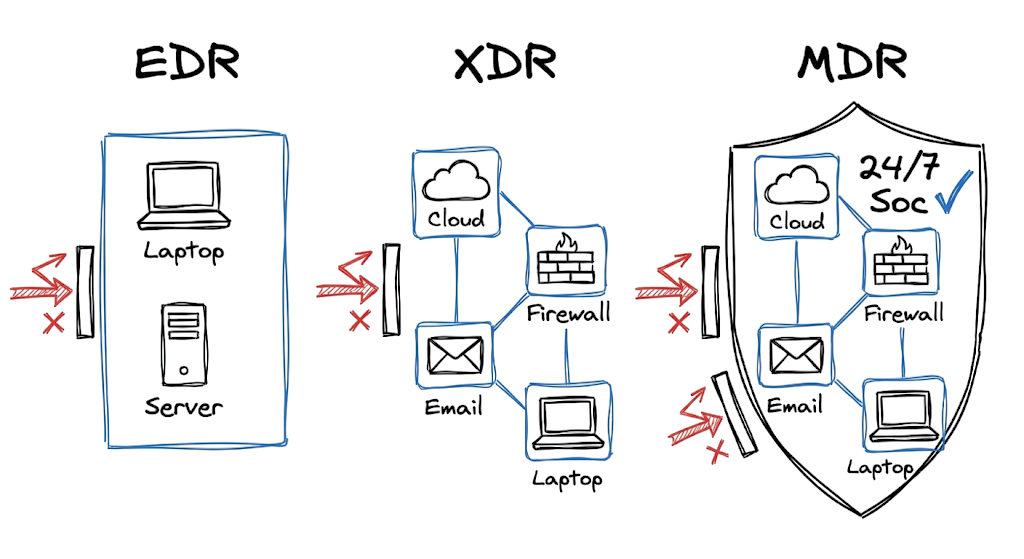
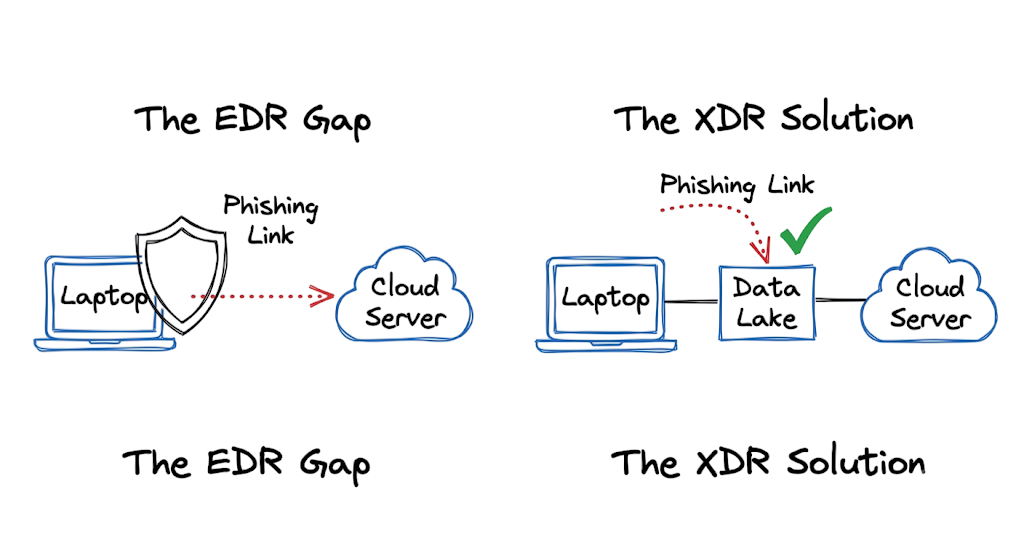
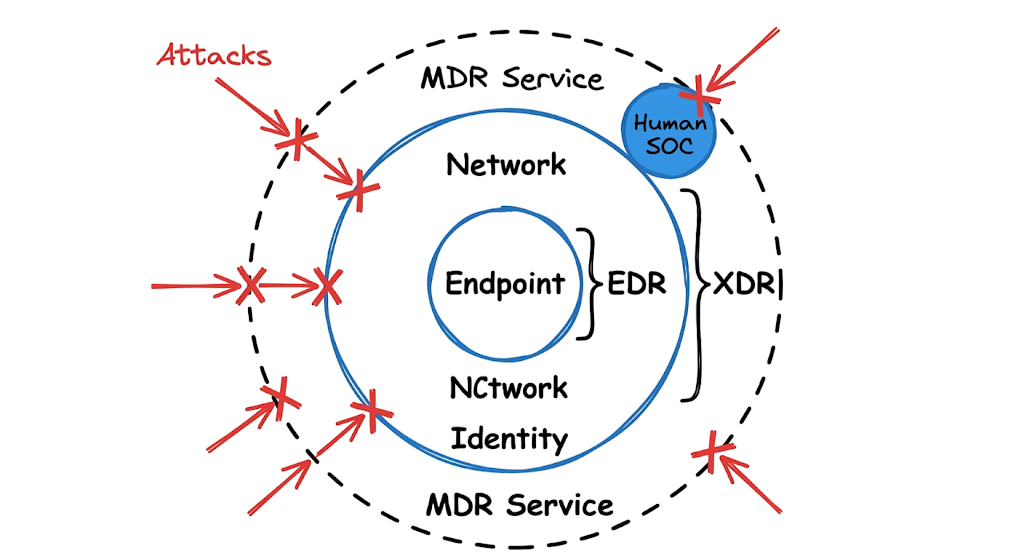
Endpoint Detection and Response (EDR) functions as a sophisticated flight data recorder for your laptops, desktops, and servers. It continuously records process executions, file modifications, user activities, and network connections occurring directly on the endpoint. This visibility helps security teams detect and investigate threats such as malware and ransomware attacks.
Extended Detection and Response (XDR) takes the Endpoint Detection and Response concept beyond individual devices. XDR collects and correlates security telemetry from endpoints, email gateways, cloud workloads, identity providers, and network firewalls. By combining data from multiple security layers, Extended Detection and Response provides a unified view of an attack and improves threat detection accuracy.
Managed Detection and Response (MDR) is different because it is not simply a software platform. Managed Detection and Response is a security service delivered by experienced analysts who monitor, investigate, and respond to threats on your behalf. MDR providers operate as an extension of your security team, offering 24/7 monitoring, threat hunting, and incident response expertise.
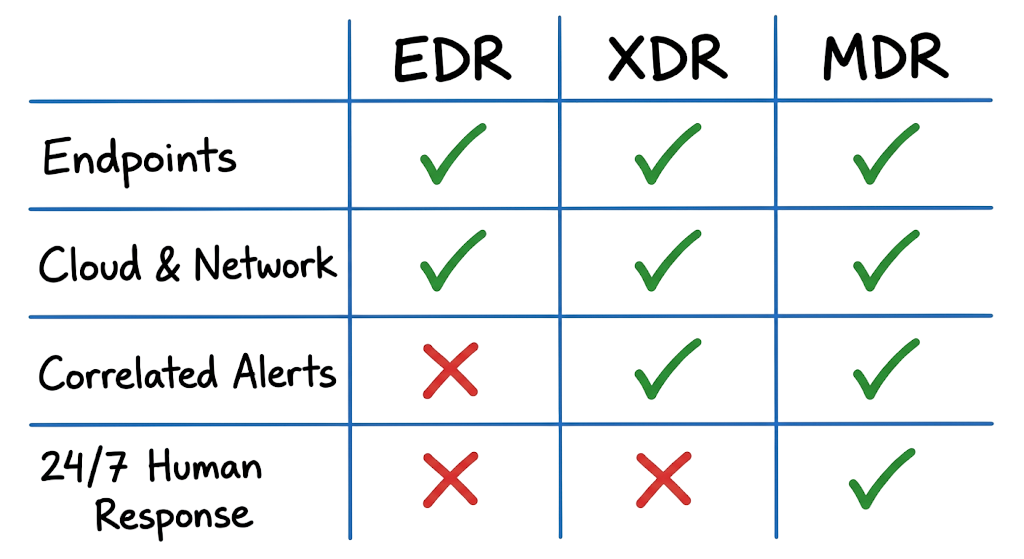
In the EDR vs XDR vs MDR comparison, EDR provides endpoint visibility, XDR expands visibility across the entire environment, and MDR delivers the human expertise required to manage and respond to security incidents. Organizations typically choose the software solution for visibility and control, while choosing Managed Detection and Response services when they need dedicated security expertise without building a full Security Operations Center (SOC).
How EDR, XDR, and MDR Work
You must understand the underlying mechanics to configure these systems correctly. Endpoint agents install directly at the operating system level. They hook into the system kernel to monitor software execution in real time. When a user double clicks a malicious PDF file, the agent watches Adobe Reader attempt to spawn a command prompt. The agent kills the process immediately because that behavior violates its core behavioral ruleset.
Extended Detection and Response operates one layer higher. It uses application programming interfaces to pull telemetry from multiple independent security tools into a centralized data lake. The system uses a graph database to link disparate events together. If a user clicks a phishing link in their email, the system records the email click, tracks the subsequent file download on the endpoint, and monitors the outbound communication through the firewall. The platform automatically stitches these three separate logs into one coherent incident timeline.
Managed services operate by consuming the outputs from those platforms. The external provider connects their proprietary security information and event management system to your environment. Their human analysts review the correlated alerts generated by your software. When they spot active malicious behavior, they execute predefined playbooks to disable compromised user accounts and quarantine infected machines.
Real World Example of EDR vs XDR vs MDR
Security tools generate thousands of raw logs. A correlation engine groups these logs into a single actionable alert for the analyst to investigate.
JSON
{
  "incident_id": "XDR_88341_CRITICAL",
  "threat_type": "Credential Theft and Lateral Movement",
  "correlated_events": [
    {
      "time": "02:14:05",
      "source": "Azure Active Directory",
      "event": "Successful login from unrecognized IP 185.199.110.153",
      "user": "finance.director@company.com"
    },
    {
      "time": "02:18:22",
      "source": "Microsoft 365 Exchange",
      "event": "Inbox rule created: forward all emails to external domain"
    },
    {
      "time": "02:45:11",
      "source": "CrowdStrike Falcon",
      "event": "powershell.exe executed with encoded command",
      "host": "FIN_LAPTOP_04",
      "action": "Process Blocked"
    }
  ],
  "automated_response": "Host FIN_LAPTOP_04 Isolated from Network"
}
This output shows exactly why correlating data matters. The endpoint agent caught the encoded PowerShell command and isolated the finance laptop successfully. Without the identity logs provided by the broader platform, the analyst would just clean the local machine and close the ticket. The correlated events reveal the attacker actually compromised the user credentials first and set up a malicious inbox forwarding rule. You must reset the user password and delete the inbox rule to fully eradicate the attacker from your environment.
Common EDR, XDR, and MDR Detection Techniques
Attackers constantly evolve their methods to bypass traditional security controls and basic signature-based protections. Understanding these techniques is important when evaluating EDR vs XDR vs MDR solutions because each platform detects different stages of an attack.
Many attacks begin with credential harvesting campaigns that use convincing phishing websites to steal usernames and passwords. Once attackers obtain valid credentials, they can log in directly to corporate systems without triggering traditional malware alerts.
After gaining access, attackers often use legitimate administrative tools such as PowerShell and Windows Management Instrumentation (WMI) to move laterally across the network. Since these tools are native to the operating system, they frequently evade traditional antivirus solutions.
This is where Endpoint Detection and Response (EDR) becomes valuable. EDR solutions monitor endpoint activities and can detect suspicious behavior, even when attackers use trusted system tools instead of malware.
Attackers may then dump privileged credentials from system memory and deploy command-and-control frameworks such as Cobalt Strike to maintain persistence within the environment. They often establish outbound communications over HTTPS on port 443, allowing malicious traffic to blend in with legitimate encrypted web traffic.
Extended Detection and Response (XDR) improves visibility by correlating events across endpoints, identity systems, email platforms, cloud workloads, and network devices. This broader visibility helps security teams identify attack patterns that might otherwise appear harmless when viewed in isolation.
Over time, attackers may silently exfiltrate sensitive customer information, financial records, or intellectual property to external cloud storage services. In many cases, data theft occurs long before the final stage of the attack.
A modern ransomware attack often follows a double-extortion strategy. Attackers first steal sensitive data and then encrypt local systems. This approach increases pressure on organizations because they face both operational disruption and the risk of public data exposure.
Managed Detection and Response (MDR) services help organizations combat these advanced threats by providing 24/7 monitoring, threat hunting, investigation, and incident response. When comparing EDR vs XDR vs MDR, the goal is not only to detect ransomware attacks but also to identify and stop attackers during the earlier stages of the attack lifecycle.
EDR, XDR, and MDR Detection Methods
You must configure your monitoring platform to detect behavioral anomalies rather than relying solely on static file hashes. Modern attackers frequently use legitimate tools and trusted processes that can bypass traditional signature-based detection methods.
Start by monitoring parent-child process relationships on your endpoints. For example, if Microsoft Word launches Command Prompt, PowerShell, or another scripting engine, your security rules should immediately flag that activity for investigation.
You should also track Windows Event ID 4624 for successful logons and correlate that information with Sysmon Event ID 3, which records outbound network connections. Combining these data sources helps identify suspicious activity that may otherwise appear normal when viewed independently.
Many organizations collect massive amounts of firewall logs, Active Directory events, and endpoint telemetry. However, they often fail to create the correlation rules needed to connect related events across multiple systems.
For example, a suspicious login followed by a large outbound data transfer may indicate account compromise. Without proper correlation, these events can remain unnoticed among thousands of daily log entries.
Security teams should use query languages such as Kusto Query Language (KQL) to track a single user identity across endpoints, email platforms, cloud services, and authentication systems. This approach provides a more complete picture of user activity throughout the environment.
Another important detection technique is identifying impossible travel scenarios. An alert should be generated if an employee authenticates from Mumbai and then accesses a cloud database from London only ten minutes later.
You should also establish behavioral thresholds for unusual activity. For instance, an alert may be triggered when a single user account attempts to access more than fifty file shares within a five-minute period.
By focusing on behavioral analytics, event correlation, and user activity monitoring, security teams can identify suspicious activity much earlier in the attack lifecycle and reduce the likelihood of a successful compromise.
Business Impact of EDR, XDR, and MDR
Consider a core banking application operating under Reserve Bank of India (RBI) regulations. An attacker gains access through a compromised third-party vendor account that has privileged access to the bank’s internal environment.
Once inside, the attacker deploys ransomware payloads across both the primary database servers and backup storage systems. By targeting production and backup infrastructure simultaneously, the attackers significantly increase the difficulty of recovery.
As a result, the bank loses its ability to process electronic transactions. Customers cannot withdraw cash from ATMs, access online banking portals, or use mobile banking applications. Critical financial services come to an immediate halt.
This operational disruption triggers mandatory incident reporting requirements to CERT-In within a six-hour window. Regulatory authorities may launch investigations to determine the cause, impact, and effectiveness of the organization’s security controls.
The bank also faces potential penalties under the Digital Personal Data Protection Act if customer financial records are exposed or inadequately protected. Compliance failures can result in substantial financial and reputational consequences.
Every hour of downtime leads to significant revenue loss through interrupted transaction processing, missed service fees, and business disruptions. The financial impact can quickly reach millions of rupees during a major incident.
Customer confidence often suffers long-term damage. Concerned account holders may move their funds to competing financial institutions, resulting in customer attrition and reduced market trust.
Recovery is rarely immediate. Security teams must rebuild affected servers, restore data, perform forensic investigations, validate system integrity, and ensure that attackers no longer have access to the environment.
The organization may also need to work closely with cyber insurance providers, legal teams, regulators, and incident response specialists. These additional costs can substantially increase the overall impact of the breach.
This example demonstrates how a single ransomware incident can create operational, financial, regulatory, and reputational challenges that continue long after the initial attack has been contained.
EDR, XDR, and MDR Prevention Best Practices
You must deploy security agents to every endpoint across your environment without exceptions. A single unmanaged workstation or legacy server can become an entry point for attackers and provide a foothold for further compromise.
Comprehensive coverage is essential because attackers actively search for systems that are missing security controls. Even one unprotected device can undermine the effectiveness of the entire security program.
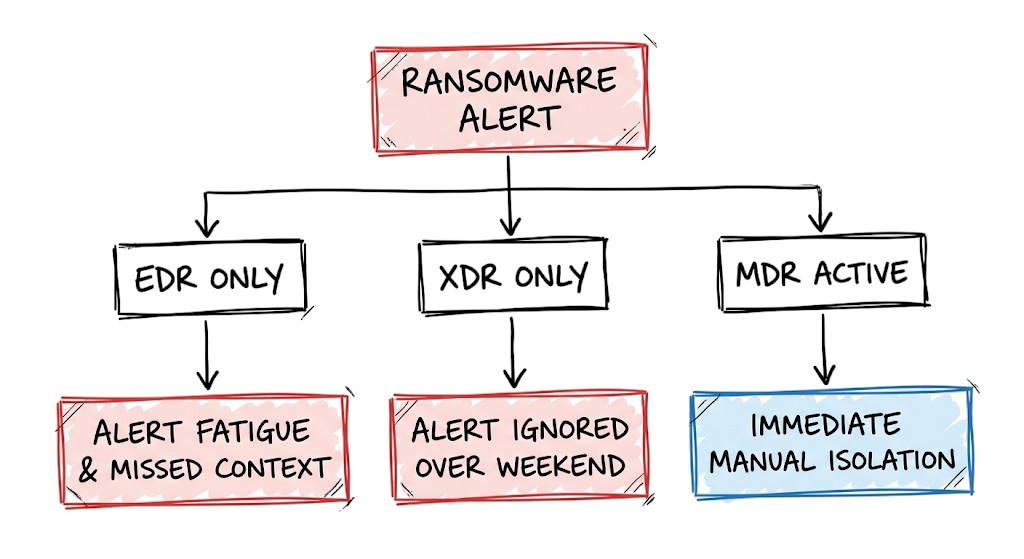
Organizations should also enable automated isolation capabilities within their security platform. When a critical threat is detected, the affected device should be automatically disconnected from the network to prevent lateral movement and contain the incident before it spreads.
Many companies hesitate to enable automated response actions because of concerns about false positives. However, disabling protection features entirely can create significant security gaps.
During a deployment for a mid-sized logistics company, the security team discovered that a previous provider had disabled automatic quarantine functionality due to excessive alerts during business hours. While this reduced operational disruptions, it also increased the organization’s exposure to potential attacks.
Instead of disabling critical protections, security teams should focus on tuning detection rules and establishing accurate behavioral baselines. Proper tuning reduces alert fatigue while maintaining the ability to respond quickly to genuine threats.
Strong access controls are equally important. All administrators should be required to use multifactor authentication when accessing security management consoles, cloud portals, and privileged systems.
Organizations should also integrate identity provider logs into their monitoring platform. Correlating authentication events with endpoint and network activity provides better visibility into suspicious account behavior.
This approach helps security teams detect account takeover attempts, credential abuse, and unauthorized access activity before attackers can gain control of critical systems.
By combining complete endpoint coverage, automated response capabilities, proper detection tuning, multifactor authentication, and identity monitoring, organizations can significantly reduce their risk of a successful security breach.
Top EDR, XDR, and MDR Security Tools
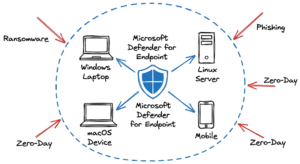
Microsoft Defender for Endpoint is a widely adopted security platform that offers deep integration with the Windows operating system. It provides strong threat detection, automated investigation capabilities, and seamless integration with the Microsoft security ecosystem.
The platform is particularly effective for organizations already using Microsoft Azure, Microsoft 365, and other Microsoft security services. However, some advanced features require higher licensing tiers, which can increase overall costs.
CrowdStrike Falcon is known for its lightweight agent architecture and strong threat detection capabilities. The platform excels at identifying sophisticated attacks, including memory-based threats, fileless malware, and zero-day exploits.
Its extensive threat intelligence network makes it a popular choice among large enterprises and global organizations. The primary challenge for some businesses is the premium pricing, which may be difficult for smaller organizations to justify.
SentinelOne focuses heavily on automation and rapid response. One of its most notable features is automated rollback, which can help restore systems affected by ransomware by reverting malicious changes made during an attack.
This capability can significantly reduce recovery time and operational disruption. However, automated tools are not a complete replacement for skilled security professionals. Complex incidents often require human analysis and investigation to understand the full scope of an attack.
Arctic Wolf takes a different approach by delivering a managed security service. Instead of providing only a technology platform, the company supplements security tools with a dedicated team of analysts who continuously monitor and investigate security events.
This model is particularly attractive for mid-sized organizations that lack an internal Security Operations Center (SOC) or dedicated cybersecurity staff. The service provides 24/7 monitoring and incident response support without requiring the organization to build its own security team.
Organizations should remember that no security product operates entirely on autopilot. Even the most advanced platforms require proper configuration, ongoing tuning, and experienced personnel to investigate alerts, validate threats, and respond effectively to security incidents.
EDR vs XDR vs MDR FAQ
Q: Is XDR better than EDR?
A: XDR provides broader visibility across multiple security layers like email, network infrastructure, and cloud platforms. EDR focuses strictly on protecting the physical devices and servers. You choose the broader option when you need to track attacks moving between different environments.
Q: Does MDR replace EDR?
A: No. Managed services actually require endpoint agents to function correctly. The external team of analysts uses your existing agents and correlation tools to monitor your devices and respond to active threats.
Q: Is MDR suitable for small businesses?
A: Yes. Most small companies cannot afford to hire a full time security operations center. Outsourcing this work provides immediate around the clock protection without the massive payroll and training requirements.
Q: Can XDR detect ransomware activity before encryption starts?
A: Yes. The system detects the early stages of the attack by analyzing anomalous file downloads, unauthorized network connections, and suspicious identity logins. It pieces these clues together and isolates the machine before the actual encryption phase begins.
Q: Is Microsoft Defender considered EDR or XDR?
A: Microsoft offers both capabilities depending on your specific licensing tier. They provide endpoint specific protection through one dedicated module and broader cross platform correlation through their central defender portal.
EDR vs XDR vs MDR Conclusion
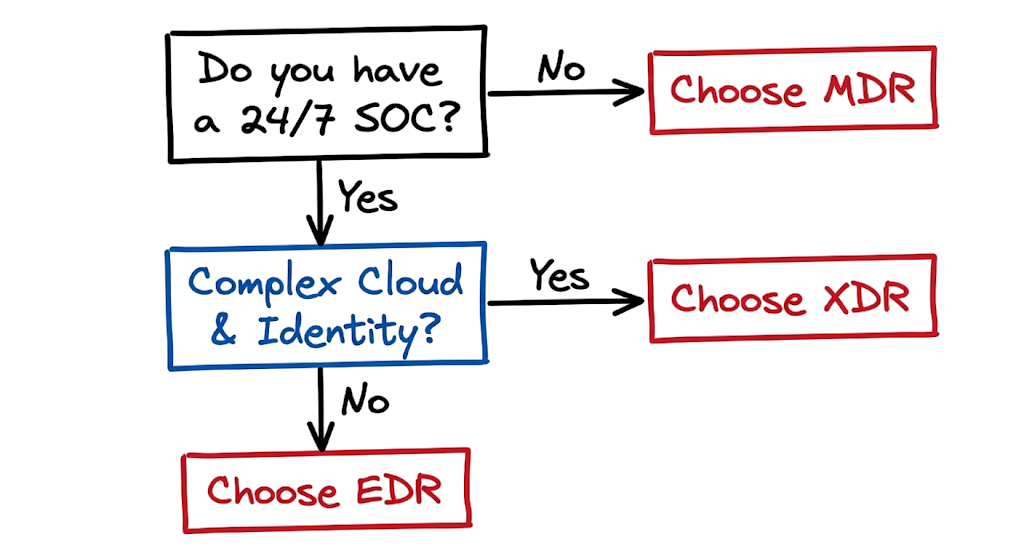
Your choice between EDR vs XDR vs MDR ultimately depends on your organization’s security maturity, internal engineering capacity, and operational budget. Each solution addresses different cybersecurity challenges and offers varying levels of visibility, detection, and response capabilities.
Endpoint Detection and Response (EDR) provides the endpoint visibility needed to detect and stop malware, ransomware, and suspicious activity on laptops, servers, and workstations. For organizations primarily focused on endpoint protection, EDR can be an effective starting point.
Extended Detection and Response (XDR) expands that visibility by correlating security events across endpoints, email systems, cloud environments, identity providers, and network infrastructure. This broader perspective helps security teams identify advanced persistent threats and complex attack chains that may go unnoticed when monitoring endpoints alone.
Managed Detection and Response (MDR) adds the human expertise required to continuously monitor alerts, investigate suspicious activity, hunt for threats, and make critical response decisions. MDR services are particularly valuable for organizations that lack a dedicated Security Operations Center (SOC) or experienced security analysts.
When evaluating EDR vs XDR vs MDR, start by assessing your current security team size, incident response capabilities, and monitoring requirements. Review your existing logging architecture and determine whether you have sufficient visibility across endpoints, networks, cloud platforms, and user identities.
The most effective cybersecurity strategy is the one that aligns with your organization’s actual risk profile. Whether you choose Endpoint Detection and Response, Extended Detection and Response, or Managed Detection and Response, ensure your security tooling can detect modern threats, support rapid response actions, and improve overall SOC efficiency.
As cyber threats continue to evolve, organizations that invest in the right combination of technology, visibility, and expertise will be better positioned to detect attacks early, reduce operational impact, and strengthen their overall security posture.
For a deeper understanding of cybersecurity, endpoint protection, identity security, and threat detection, explore these related guides:
- What Is Cybersecurity and Why It Is Important Today
https://technaga.com/what-is-cybersecurity-and-why-it-is-important-today/ - Complete Network Security Basics Guide for Beginners 2026
https://technaga.com/what-is-networks-and-network-security-basics-2026/ - Essential Endpoint Security Guide 2026 for Every Organization
https://technaga.com/endpoint-security-2026-guide/ - Security Information and Event Management: Complete SIEM Guide 2026
https://technaga.com/security-information-and-event-management-2026/ - Best SOC Analyst Roadmap 2026: Complete Guide to L1, L2, L3 Roles, Skills, and Tools
https://technaga.com/complete-soc-analyst-roadmap-2026/ - How to Identify Phishing Attacks in 2026 (Complete Guide)
https://technaga.com/how-to-identify-phishing-attacks-in-2026/ - Initial Access in Cybersecurity: Top 3 Attack Vectors You Must Know (2026)
https://technaga.com/initial-access-cybersecurity-attack-vectors-2026/ - Multi-Factor Authentication (MFA): Critical Guide to Secure Your Systems (2026)
https://technaga.com/multi-factor-authentication-mfa-guide-2026/ - Identity and Access Management in 2026: A Practical Guide for Cloud Security Professionals
https://technaga.com/identity-and-access-management-cloud-security-2026/ - Network Segmentation Explained with Real-World Example
https://technaga.com/network-segmentation-guide-ransomware-prevention/ - Cloud Security Basics 2026: Complete Beginner Guide
https://technaga.com/cloud-security-basics-2026/ - Top 10 Cybersecurity Best Practices for 2026
https://technaga.com/top-10-cybersecurity-best-practices-2026/ - Zero Trust Security in 2026: Architecture, Real Examples, and Implementation Guide
https://technaga.com/zero-trust-security-2026-guide/ - Forget the Perimeter: Zero Trust vs Traditional Security Technical Comparison 2026
- What is Firewall in Cybersecurity? Types, Examples and How it Works in 2026
https://technaga.com/firewall-in-cybersecurity-types-examples-explained/ - 10 Cybersecurity Tools for Beginners: Complete Guide 2026
https://technaga.com/tech-naga-com-free-cybersecurity-tools-2026/
Additional Resources
For further reading on EDR, XDR, MDR, threat detection, and security operations, explore these authoritative resources:
- Microsoft Defender for Endpoint
https://learn.microsoft.com/en-us/defender-endpoint/ - Microsoft Defender XDR Documentation
https://learn.microsoft.com/en-us/defender-xdr/ - CrowdStrike Falcon Platform
https://www.crowdstrike.com/platform/ - SentinelOne Singularity Platform
https://www.sentinelone.com/platform/ - Arctic Wolf Managed Detection and Response
https://arcticwolf.com/ - MITRE ATT&CK Framework
https://attack.mitre.org/ - NIST Cybersecurity Framework (CSF)
https://www.nist.gov/cyberframework - CISA Ransomware Guidance
https://www.cisa.gov/stopransomware - OWASP Security Resources
https://owasp.org/ - Microsoft Security Blog
https://www.microsoft.com/security/blog/ - Palo Alto Networks Cortex XDR Documentation
https://docs-cortex.paloaltonetworks.com/ - Cisco XDR Documentation
https://www.cisco.com/site/us/en/products/security/xdr/index.html - Trend Micro Vision One Platform
https://www.trendmicro.com/en_us/business/products/detection-response/xdr.html - Splunk Security Operations Center Resources
https://www.splunk.com/en_us/products/security.html - SANS Incident Response Resources
https://www.sans.org/white-papers/