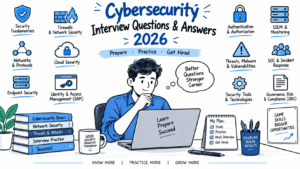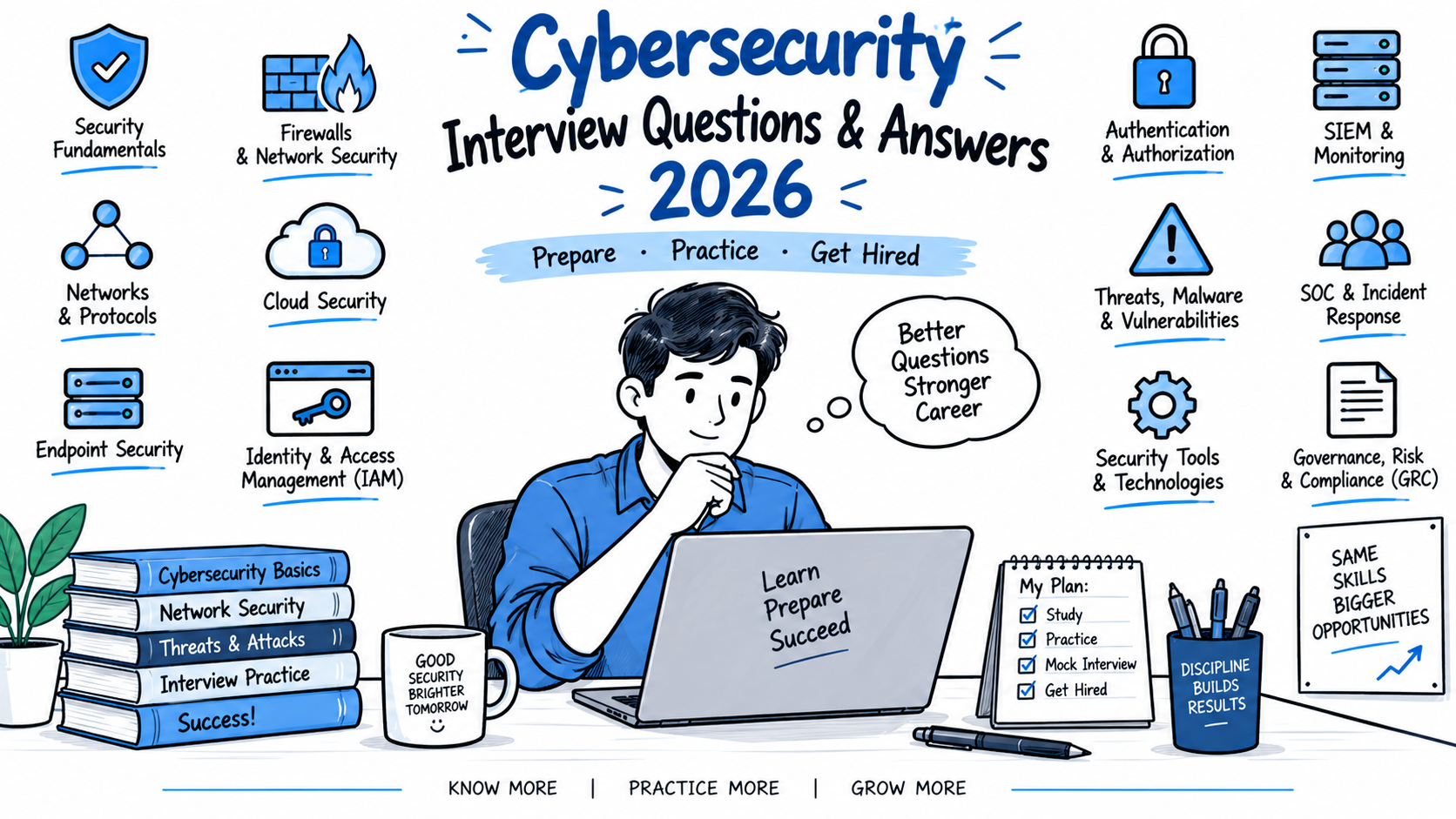
Cybersecurity has become an important part of almost every organization because businesses depend on networks, cloud platforms, applications, endpoints, and digital services. As cyber threats continue to evolve, organizations need security professionals who understand both cybersecurity fundamentals and practical security operations. This makes cybersecurity interview questions an important part of preparation for anyone looking to build or advance a career in information security.
If you are preparing for a cybersecurity interview in 2026, you should be comfortable answering questions about network security, authentication, firewalls, vulnerabilities, SIEM, incident response, endpoint security, cloud security, and common cyberattacks. Candidates preparing for cybersecurity interview questions for freshers should focus on security fundamentals, while experienced professionals should also prepare for troubleshooting and scenario-based questions.
This guide covers 40 Cybersecurity Interview Questions and Answers 2026 to help you prepare for technical interviews. These questions are useful for freshers, SOC analysts, cybersecurity analysts, network security engineers, and professionals preparing for L1 and L2 security roles. You will find questions covering cybersecurity interview questions for experienced professionals, along with practical explanations and real-world examples.
Whether you are starting your cybersecurity career or preparing for your next security role, these Cybersecurity Interview Questions and Answers 2026 cover fundamental concepts and practical security operations topics that you may encounter during an interview.
1. What is Cybersecurity?
Answer:
Cybersecurity is the practice of protecting systems, networks, applications, devices, and data from unauthorized access, attacks, damage, or disruption.
Cybersecurity includes several areas such as network security, endpoint security, application security, cloud security, identity and access management, vulnerability management, and incident response.
For example, an organization may use a firewall to control network traffic, EDR to monitor endpoints, MFA to protect user accounts, and SIEM to analyze security logs.
Before preparing for technical interviews, it is useful to understand the cybersecurity fundamentals that form the foundation of security operations.
2. What is the CIA Triad?
Answer:
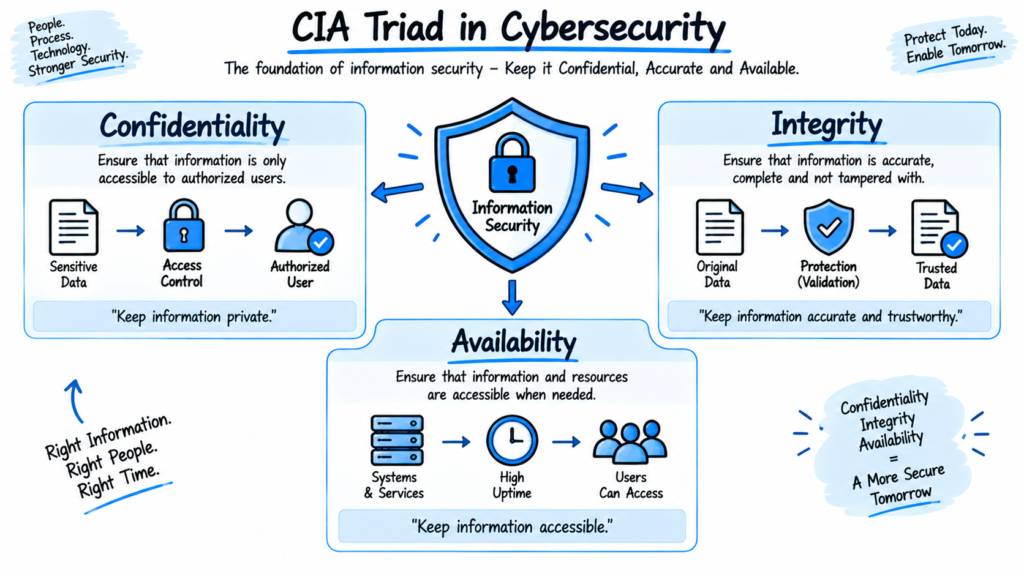
The CIA triad represents three fundamental cybersecurity principles:
- Confidentiality: Only authorized users should access information.
- Integrity: Data should remain accurate and should not be modified without authorization.
- Availability: Systems and information should be accessible when required.
For example, encryption helps protect confidentiality, file integrity monitoring can detect unauthorized changes, and backup systems help maintain availability.
3. What is the difference between a threat, vulnerability, risk, and attack?
Answer:
A threat is a potential cause of harm to a system.
A vulnerability is a weakness that can be exploited.
A risk represents the potential impact and likelihood of a threat exploiting a vulnerability.
An attack is an actual attempt to exploit a weakness.
For example, an outdated web server may contain a vulnerability. An attacker attempting to exploit that vulnerability is an attack, while the potential business impact represents the associated risk.
Cybersecurity Interview Questions and Answers 2026
4. What is the difference between vulnerability assessment and penetration testing?
Answer:
A vulnerability assessment identifies and reports security weaknesses in systems, applications, or networks.
Penetration testing goes further by attempting to exploit identified weaknesses to determine whether they can actually be abused.
For example, a vulnerability scanner may identify an outdated application version. During penetration testing, a security tester may attempt to exploit the vulnerability in an authorized environment.
Vulnerability assessment is generally broader, while penetration testing is focused on validating exploitability and security impact.
5. What is the difference between a security event, alert, and incident?
Answer:
A security event is an observable activity that may have security relevance.
A security alert is a notification generated when a security tool detects suspicious or potentially malicious activity.
A security incident is a confirmed or suspected security event that requires investigation and response.
For example, multiple failed login attempts may generate an alert. If investigation confirms that an attacker successfully compromised the account, it may become a security incident.
6. What are common types of cyberattacks?
Answer:
Common cyberattacks include:
- Phishing
- Ransomware
- Malware
- Denial-of-service attacks
- Credential attacks
- SQL injection
- Cross-site scripting
- Man-in-the-middle attacks
- Password attacks
- Supply-chain attacks
Attackers may combine multiple techniques during a real-world attack.
Cybersecurity Interview Questions and Answers 2026
7. What is the difference between malware, ransomware, spyware, and a virus?
Answer:
Malware is a general term for malicious software.
Ransomware encrypts or otherwise restricts access to data and demands payment from the victim.
Spyware is designed to secretly collect information from a system.
A virus is malware that can replicate by attaching itself to files or programs and spreading when those files are executed.
Malware is the broader category, while ransomware, spyware, and viruses are specific types or behaviors of malicious software.
8. What is social engineering?
Answer:
Social engineering involves manipulating people into revealing information, performing an action, or providing access.
Common examples include:
- Phishing emails
- Vishing calls
- Smishing messages
- Impersonation
- Pretexting
- Baiting
For example, an attacker may impersonate an IT administrator and ask an employee to provide a one-time authentication code.
Organizations can reduce these risks through security awareness training, MFA, email security, identity controls, and verification procedures.
9. What is phishing?
Answer:
Phishing is a social engineering technique where attackers use fraudulent emails, messages, websites, or other communication methods to trick users.
Attackers may attempt to steal:
- Usernames and passwords
- Banking information
- MFA codes
- Personal information
- Corporate credentials
Organizations can use email security gateways, URL filtering, phishing detection, MFA, user awareness training, and endpoint security to reduce phishing risk.
Cybersecurity Interview Questions and Answers 2026
10. What is the principle of least privilege?
Answer:
The principle of least privilege means giving users, applications, and systems only the permissions they need to perform their required tasks.
For example, a standard employee should not receive domain administrator privileges if their job only requires access to email and business applications.
Least privilege reduces the potential impact of compromised accounts and limits unauthorized access.
Network Security Interview Questions
These Cybersecurity Interview Questions and Answers 2026 are designed to cover fundamentals as well as practical security operations topics.
11. What is the difference between TCP and UDP?
Answer:
TCP is connection-oriented and provides reliable delivery, sequencing, and retransmission.
UDP is connectionless and does not guarantee delivery or ordering.
TCP is commonly used for applications such as HTTPS and SSH. UDP is commonly used for DNS, streaming, and certain real-time applications.
From a security perspective, understanding TCP and UDP helps analysts investigate network connections and firewall rules.
12. What is a firewall?
Answer:
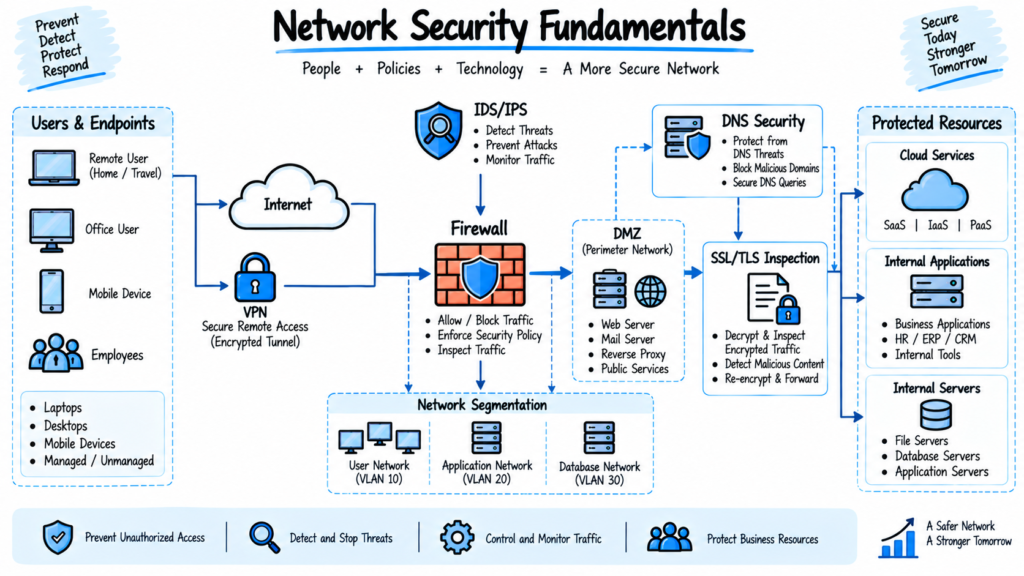
A firewall is a security control that monitors and controls network traffic according to configured rules.
A firewall can control traffic based on factors such as:
- Source IP
- Destination IP
- Port
- Protocol
- Application
- User or identity
- Security policies
For example, a firewall rule may allow HTTPS traffic to a web server while blocking unauthorized inbound connections.
Understanding how a firewall in cybersecurity works is essential for candidates preparing for network security and cybersecurity interview questions.
Firewall in Cybersecurity: Types, Examples and How It Works
13. What is the difference between IDS and IPS?
Answer:
An Intrusion Detection System (IDS) monitors network or system activity and generates alerts when suspicious activity is detected.
An Intrusion Prevention System (IPS) can detect suspicious activity and automatically block or prevent the traffic.
In simple terms:
IDS = Detect and alert
IPS = Detect and prevent
Both are important components of network security.
14. What is a Next-Generation Firewall?
Answer:
A Next-Generation Firewall, or NGFW, provides traditional firewall functionality along with additional security capabilities.
Depending on the platform, these may include:
- Application control
- Intrusion prevention
- URL filtering
- SSL inspection
- Malware protection
- User-based policies
- Threat intelligence
For example, instead of allowing traffic only based on TCP port 443, an NGFW can identify applications and apply more detailed security policies.
15. What is network segmentation?
Answer:
Network segmentation divides a network into separate logical or physical security zones.
For example, an organization may separate:
- User networks
- Server networks
- Database networks
- Guest networks
- Management networks
Segmentation can restrict communication between systems and reduce the potential spread of an attack.
A strong understanding of network security basics is important when preparing for cybersecurity interview questions because many security roles involve network traffic, segmentation, firewalls, and secure communication.
Complete Network Security Basics Guide for Beginners 2026
16. What is a DMZ?
Answer:
A DMZ, or demilitarized zone, is a network segment used to host services that need controlled exposure to external networks.
Examples include public-facing:
- Web servers
- Mail gateways
- DNS servers
- Reverse proxies
A DMZ helps separate externally accessible systems from internal corporate networks.
17. What is the difference between VPN and ZTNA?
Answer:
A VPN typically creates a secure connection between a user or device and a private network.
ZTNA, or Zero Trust Network Access, provides access to specific applications based on identity, device posture, policy, and other contextual factors.
A traditional VPN may provide network-level access after authentication, while ZTNA generally follows an application-specific access model.
18. What is SSL/TLS inspection?
Answer:
SSL/TLS inspection allows a security device or service to inspect encrypted traffic for security threats.
Without inspection, security controls may have limited visibility into encrypted HTTPS traffic.
A security solution can decrypt traffic, inspect it for threats or policy violations, and then establish a new encrypted connection.
Organizations must carefully configure certificates, privacy policies, exclusions, and applications because incorrect SSL inspection can cause application failures.
19. What is DNS security?
Answer:
DNS security protects the DNS resolution process and helps prevent users from reaching malicious domains.
Security controls can identify and block domains associated with:
- Malware
- Phishing
- Command-and-control infrastructure
- Botnets
DNS security can also provide visibility into suspicious domain requests.
20. What is a Man-in-the-Middle attack?
Answer:
A Man-in-the-Middle, or MITM, attack occurs when an attacker intercepts communication between two parties.
The attacker may attempt to read, modify, or redirect communication.
Security measures such as TLS, certificate validation, secure Wi-Fi configurations, VPNs, and strong authentication can help protect against MITM attacks.
Identity and Access Management Interview Questions
These Cybersecurity Interview Questions and Answers 2026 are designed to cover fundamentals as well as practical security operations topics.
21. What is IAM?
Answer:
Identity and Access Management, or IAM, controls who can access systems and what resources they are allowed to use.
IAM commonly includes:
- Authentication
- Authorization
- User provisioning
- Access policies
- Role management
- MFA
- Access reviews
For example, IAM can ensure that an employee receives access to applications required for their job while preventing access to restricted systems.
22. What is the difference between authentication and authorization?
Answer:
Authentication verifies who you are.
Authorization determines what you are allowed to access.
For example, entering a username, password, and MFA code authenticates you. After authentication, the system checks whether you have permission to access a particular application.
A simple way to remember it is:
Authentication = Who are you?
Authorization = What can you access?
23. What is MFA?
Answer:
Multi-Factor Authentication requires users to provide multiple authentication factors.
Common factors include:
- Something you know, such as a password.
- Something you have, such as a security key or authenticator device.
- Something you are, such as a biometric characteristic.
MFA provides additional protection when a password is compromised.
24. What is Single Sign-On?
Answer:
Single Sign-On, or SSO, allows users to authenticate once and access multiple authorized applications without entering separate credentials for every application.
SSO commonly uses technologies such as SAML, OpenID Connect, and OAuth-based identity flows.
For example, an employee can authenticate through the organization’s identity provider and then access multiple enterprise applications according to assigned permissions.
25. What is SAML?
Answer:
SAML, or Security Assertion Markup Language, is an XML-based standard commonly used for exchanging authentication and authorization information between an identity provider and a service provider.
For example:
User → Identity Provider → SAML Assertion → Application → Access
SAML is commonly used for enterprise SSO.
26. What is the difference between RBAC and ABAC?
Answer:
RBAC, or Role-Based Access Control, grants permissions based on a user’s role.
For example:
Security Analyst → SIEM access
Database Administrator → Database administration access
ABAC, or Attribute-Based Access Control, makes access decisions based on attributes such as user identity, device, location, resource, and security context.
ABAC can therefore support more detailed access policies.
27. What is PAM?
Answer:
Privileged Access Management, or PAM, protects and controls privileged accounts.
PAM solutions can provide:
- Credential protection
- Session monitoring
- Just-in-time access
- Privileged account management
- Password rotation
- Access auditing
For example, instead of allowing administrators to permanently use highly privileged accounts, PAM can provide controlled access for a limited period.
28. What is Zero Trust Architecture?
Answer:
Zero Trust is a security approach based on the principle that access should not be automatically trusted based only on network location.
Important principles include:
- Verify explicitly
- Apply least privilege
- Continuously evaluate access
- Monitor activity
- Protect resources rather than relying solely on network boundaries
For example, an employee working inside the corporate network should still be required to authenticate and meet access policies before accessing a sensitive application.
These Cybersecurity Interview Questions and Answers 2026 are designed to cover fundamentals as well as practical security operations topics.
SOC and Incident Response Interview Questions
These Cybersecurity Interview Questions and Answers 2026 are designed to cover fundamentals as well as practical security operations topics.
29. What is a SOC?
Answer:
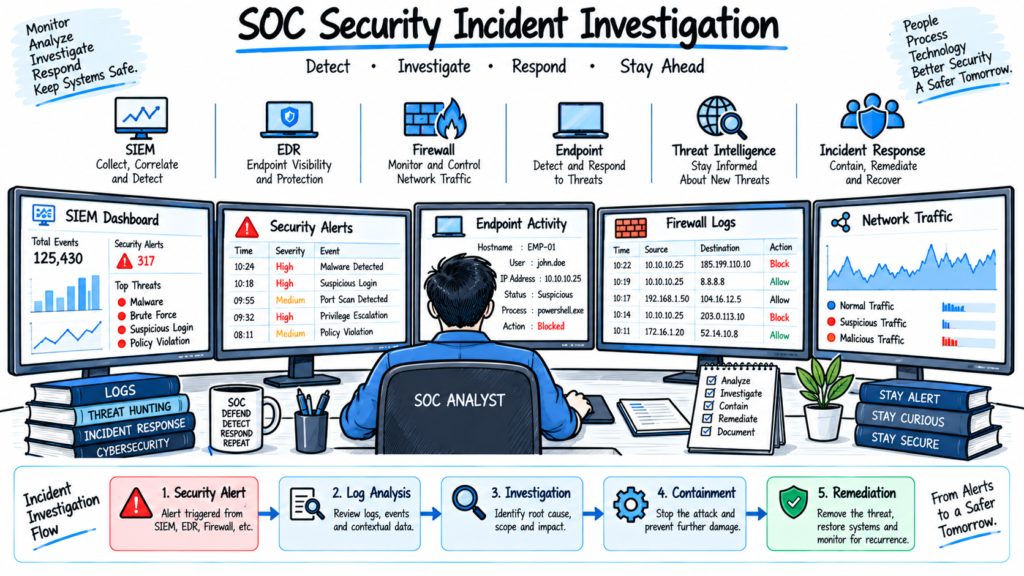
A Security Operations Center, or SOC, is responsible for monitoring, detecting, investigating, and responding to security threats.
SOC teams commonly work with:
- SIEM
- EDR
- Firewalls
- IDS/IPS
- Email security
- Threat intelligence
- Network monitoring tools
A SOC analyst may investigate alerts, collect evidence, determine severity, escalate incidents, and document the investigation.
30. What is SIEM?
Answer:
SIEM stands for Security Information and Event Management.
A SIEM collects and analyzes security logs from multiple sources.
Examples include:
- Firewalls
- Servers
- Endpoints
- Identity providers
- Applications
- Network devices
- Cloud platforms
SIEM can correlate events and generate alerts.
For example, a failed login followed by a successful login from an unusual location may trigger an investigation.
31. What is the difference between SIEM, SOAR, EDR, XDR, and MDR?
Answer:
SIEM: Collects and analyzes security logs and events.
SOAR: Automates security workflows and response actions.
EDR: Monitors endpoint activity and helps detect and respond to endpoint threats.
XDR: Correlates security telemetry across multiple security domains such as endpoints, email, identity, network, and cloud, depending on the product.
MDR: A managed security service where security professionals monitor and respond to threats on behalf of customers.
These technologies can work together in a modern security operations environment.
32. How would you investigate a suspicious login alert?
Answer:
I would follow a structured investigation process.
First, I would verify the alert details, including:
- Username
- Source IP
- Destination application
- Login time
- Authentication method
- Device information
- Geographic information
- Previous login activity
Then I would check whether the login is expected.
I would review related authentication logs and look for failed login attempts, unusual devices, impossible travel indicators, MFA activity, or other suspicious behavior.
If compromise is suspected, I would follow the organization’s incident response process, which may include disabling the account, revoking sessions, resetting credentials, and investigating the affected device.
33. How would you investigate a phishing email?
Answer:
I would first preserve the email and examine:
- Sender address
- Reply-to address
- Email headers
- URLs
- Attachments
- Domain information
- Authentication results such as SPF, DKIM, and DMARC
I would determine whether the URLs or attachments are malicious using approved security tools.
I would then check whether other employees received the same email and whether anyone clicked the link or opened the attachment.
If necessary, I would remove the malicious email from affected mailboxes and investigate compromised accounts or endpoints.
34. What steps would you follow after detecting malware on an endpoint?
Answer:
The response depends on the organization’s incident response procedures, but a typical process includes:
- Validate the alert.
- Identify the affected endpoint and user.
- Review the detection details.
- Isolate the endpoint if required.
- Collect relevant evidence.
- Identify the malware and its behavior.
- Search for indicators of compromise across the environment.
- Remove or remediate the threat.
- Reset credentials if compromise is suspected.
- Restore the system if necessary.
- Document the incident.
The goal is to contain the threat, investigate its scope, remediate the affected systems, and prevent recurrence.
35. What is incident response?
Answer:
Incident response is the structured process used to detect, investigate, contain, eradicate, and recover from security incidents.
Common phases include:
- Preparation
- Detection and analysis
- Containment
- Eradication
- Recovery
- Lessons learned
For example, during a ransomware incident, the security team may isolate affected systems, identify the attack path, remove malicious persistence, restore systems from clean backups, and review controls that could prevent similar incidents.
36. What is threat intelligence?
Answer:
Threat intelligence is information about threats, threat actors, attack techniques, indicators, and vulnerabilities that can help an organization make security decisions.
Threat intelligence may include:
- Malicious IP addresses
- Domains
- File hashes
- Attack techniques
- Vulnerability information
- Threat actor information
Security teams can use this information in SIEM, EDR, firewalls, email security, and other security controls.
Vulnerability, Cloud and Application Security Questions
These Cybersecurity Interview Questions and Answers 2026 are designed to cover fundamentals as well as practical security operations topics.
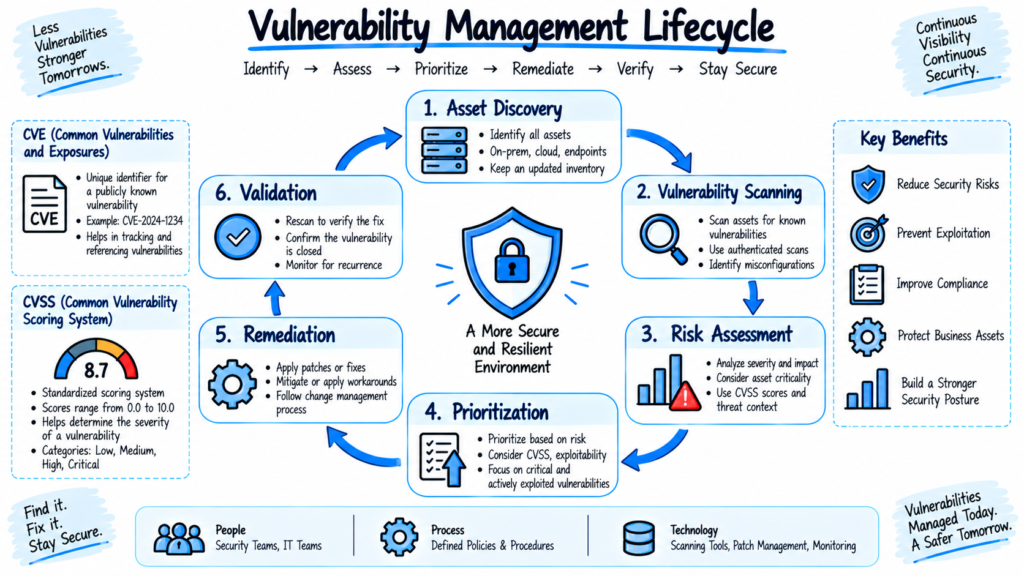
37. What is CVE and how is it different from CVSS?
Answer:
CVE, or Common Vulnerabilities and Exposures, provides standardized identifiers for publicly known cybersecurity vulnerabilities.
CVSS, or Common Vulnerability Scoring System, provides a standardized method for assessing the severity of vulnerabilities.
For example, a vulnerability can have a CVE identifier and receive a CVSS score based on characteristics such as attack complexity, privileges required, and potential impact.
CVE identifies the vulnerability, while CVSS helps describe its severity.
38. What is vulnerability management?
Answer:
Vulnerability management is the continuous process of identifying, assessing, prioritizing, remediating, and validating security vulnerabilities.
A typical lifecycle includes:
Asset Discovery → Vulnerability Scanning → Risk Assessment → Prioritization → Remediation → Validation → Reporting
Organizations should prioritize vulnerabilities based on factors such as severity, exploitability, asset importance, exposure, and business impact.
39. What is the difference between application security and network security?
Answer:
Application security focuses on protecting software and applications from vulnerabilities and attacks.
Examples include:
- Secure coding
- Input validation
- Authentication
- Authorization
- API security
- Dependency management
- Security testing
Network security focuses on protecting network infrastructure and communications.
Examples include:
- Firewalls
- IDS/IPS
- Network segmentation
- VPN
- Secure DNS
- Network monitoring
Both areas are important because an application can be vulnerable even when the underlying network is securely configured.
40. What are the major cybersecurity risks in cloud environments?
Answer:
Common cloud security risks include:
- Misconfigured storage
- Excessive permissions
- Weak identity controls
- Exposed credentials
- Insecure APIs
- Poor network configuration
- Inadequate logging and monitoring
- Vulnerable workloads
- Data exposure
A strong cloud security strategy should include IAM, MFA, least privilege, encryption, logging, vulnerability management, secure configurations, and continuous monitoring.
These Cybersecurity Interview Questions and Answers 2026 are designed to cover fundamentals as well as practical security operations topics.
Disclaimer
This Cybersecurity Interview Questions and Answers 2026 guide is provided for educational and interview preparation purposes. The cybersecurity interview questions, answers, examples, and explanations are intended to help students, freshers, SOC analysts, cybersecurity analysts, network security engineers, and experienced security professionals prepare for technical interviews.
Cybersecurity technologies, security practices, standards, and attack techniques can change over time. Always verify important technical information with current documentation from relevant vendors, standards organizations, and trusted cybersecurity authorities.
The information provided on TechNaga should not be considered professional cybersecurity, legal, compliance, or security consulting advice. Organizations should evaluate their own security requirements and follow their internal policies and applicable regulations.
External Cybersecurity Resources
These resources can help you continue your cybersecurity interview preparation and strengthen your understanding of cybersecurity fundamentals, network security, incident response, and application security.
- NIST Cybersecurity Framework (CSF) 2.0
Useful for understanding cybersecurity risk management and security practices.
NIST Cybersecurity Framework 2.0 - NIST Incident Response Guidance
Useful when preparing for cybersecurity interview questions related to incident response, detection, containment, and recovery. NIST SP 800-61 Rev. 3 was finalized in April 2025.
NIST SP 800-61 Rev. 3 Incident Response - CISA Cybersecurity Guidance
Useful for reviewing practical cybersecurity practices, including MFA, strong passwords, software updates, and incident preparation.
CISA Cybersecurity Guidance - OWASP Top 10:2025
Useful for application security interview questions and understanding major web application security risks.
OWASP Top 10:2025