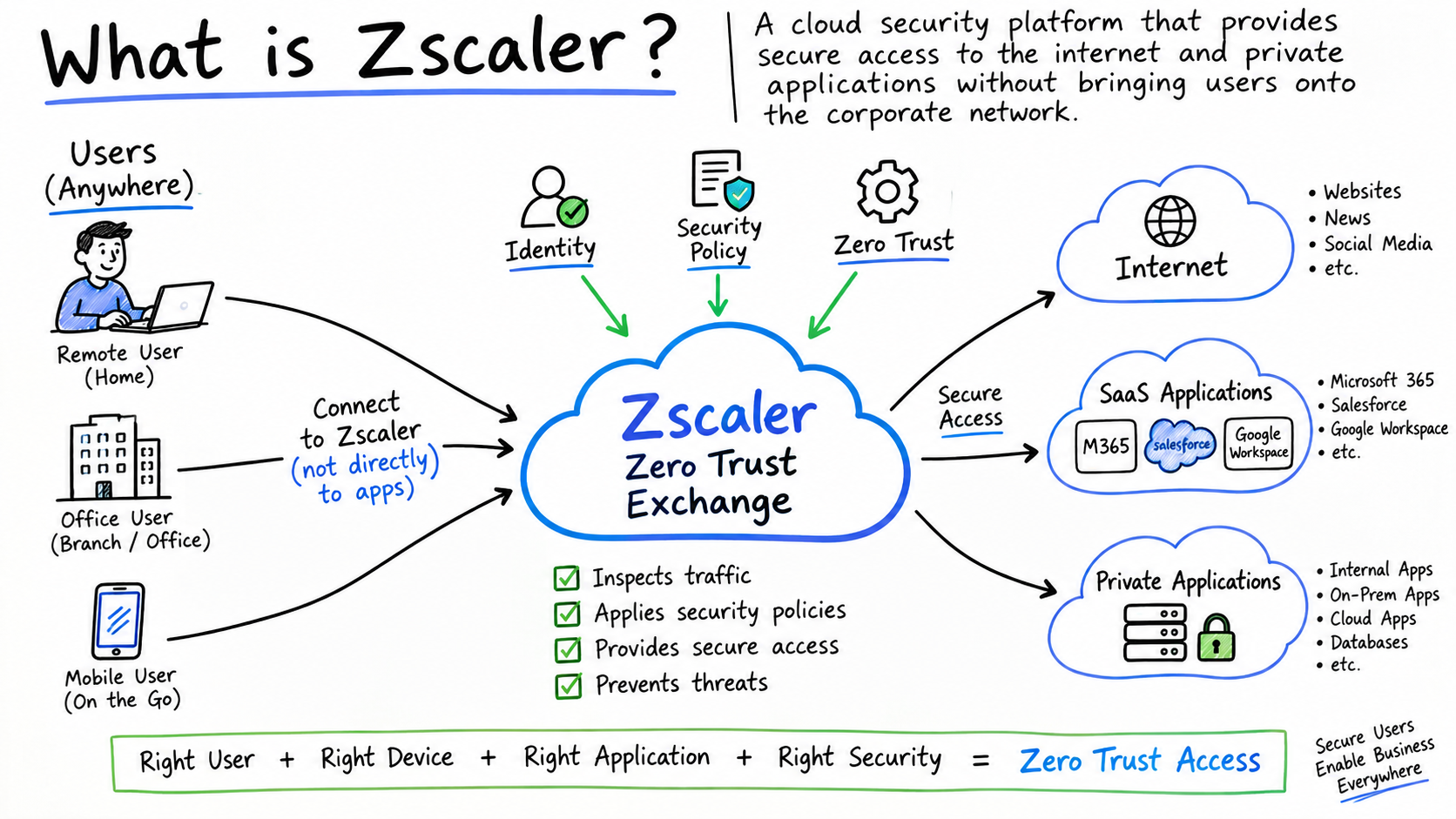
Zscaler interview questions often cover more than basic product definitions. For cybersecurity and network security roles, candidates may be asked about Zero Trust, the Zscaler Zero Trust Exchange, ZIA, ZPA, ZDX, Zscaler Client Connector, SSE, SASE, ZTNA, traffic forwarding, and Zscaler architecture.
This guide covers 25 Zscaler fundamentals interview questions and answers to help you understand the core concepts before moving into advanced ZIA, ZPA, ZDX, and Zscaler Client Connector topics.
Core Concepts
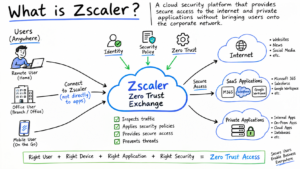
1. What is Zscaler?
Zscaler is a cloud-native security platform that protects users, devices, and applications by providing secure internet access, private application access, and digital experience monitoring without requiring users to connect directly to the corporate network.
2. Why is Zscaler used?
Organizations use Zscaler to secure users and applications, protect against cyber threats and data loss, and provide secure access from different locations and networks through cloud-delivered security services.
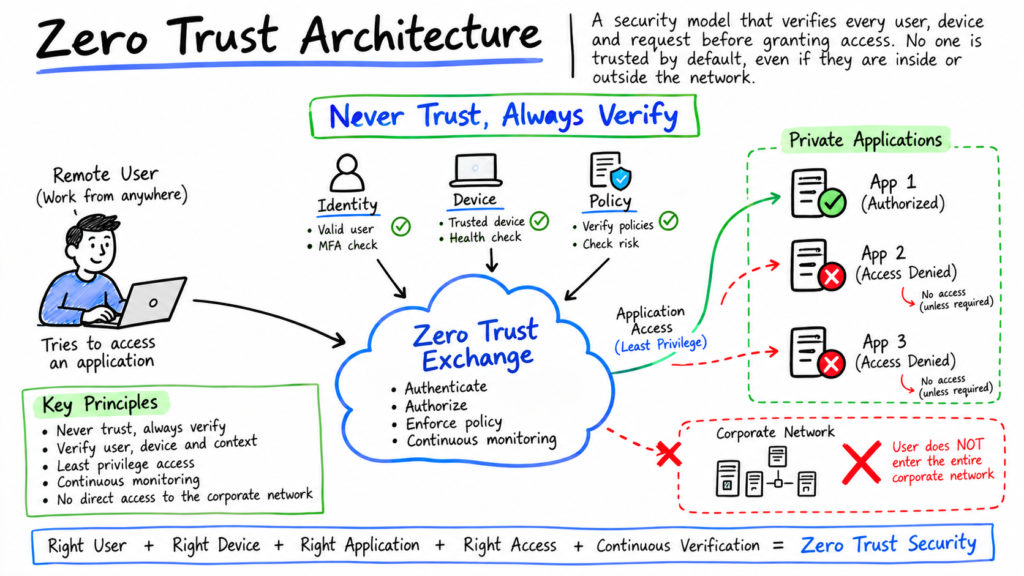
3. What is Zero Trust?
Zero Trust is a security model based on the principle of “never trust, always verify.” It does not automatically trust a user or device based on its network location. Access is granted only after evaluating factors such as identity, device context, application, and security policies.
4. What is Zero Trust Exchange?
The Zero Trust Exchange is Zscaler’s cloud-native security platform that connects users, devices, workloads, and applications based on identity, business policies, and security context rather than relying on traditional network-based trust.
5. What is SSE?
Security Service Edge (SSE) is a security architecture that brings cloud-delivered security services together to protect users accessing the internet, SaaS applications, and private applications.
Common SSE capabilities include:
- Secure Web Gateway (SWG)
- Cloud Access Security Broker (CASB)
- Data Loss Prevention (DLP)
- Zero Trust Network Access (ZTNA)
- Firewall capabilities
6. What is SASE?
Secure Access Service Edge (SASE) is an architectural model that combines networking capabilities, such as SD-WAN, with cloud-delivered security services such as SSE.
7. What is the difference between SASE and SSE?
SASE combines networking and security capabilities, while SSE focuses on the security component of that architecture.
For example:
SASE = Networking + SSE
SSE = Cloud-delivered Security Services
Zscaler Products & Components
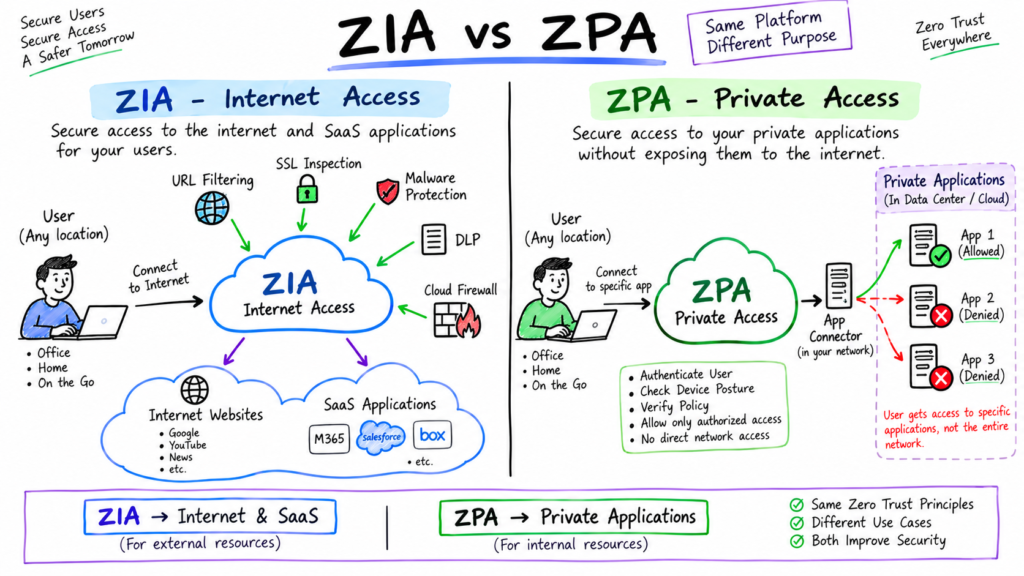
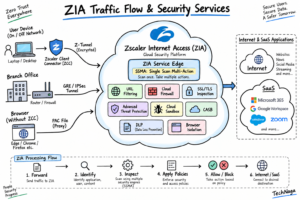
8. What is ZIA?
Zscaler Internet Access (ZIA) is a cloud-delivered security service that protects users and workloads accessing the public internet and SaaS applications.
ZIA provides security capabilities such as:
- URL Filtering
- SSL/TLS Inspection
- Cloud Firewall
- Cloud Application Control
- DLP
- Malware Protection
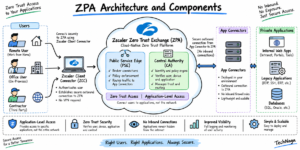
9. What is ZPA?
Zscaler Private Access (ZPA) is a Zero Trust Network Access (ZTNA) service that provides secure, application-specific access to private applications and workloads without placing users directly on the corporate network.
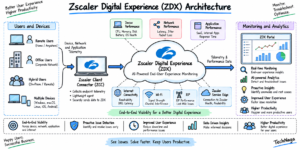
10. What is ZDX?
Zscaler Digital Experience (ZDX) is a Digital Experience Monitoring (DEM) solution that provides visibility into the performance of endpoints, networks, and applications to help identify connectivity and application-performance problems.
11. What is Zscaler Client Connector?
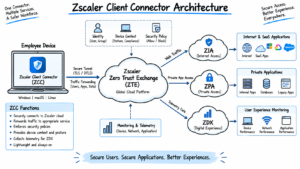
Zscaler Client Connector (ZCC) is an endpoint agent that securely connects user devices to Zscaler services.
Depending on the configuration, ZCC can provide connectivity for services such as ZIA and ZPA and provide endpoint information used by ZDX and device posture policies.
12. What is the difference between ZIA and ZPA?
ZIA primarily secures access to public internet and SaaS applications, while ZPA provides secure, identity-based access to private applications.
| ZIA | ZPA |
|---|---|
| Internet and SaaS access | Private application access |
| Secure Web Gateway | Zero Trust Network Access |
| Protects outbound internet traffic | Provides application-specific private access |
| URL filtering, SSL inspection, DLP, etc. | Application segmentation and access policies |
13. What is the Zscaler cloud?
The Zscaler cloud is a globally distributed cloud infrastructure that delivers Zscaler security and access services. It processes traffic and access requests through distributed service infrastructure rather than requiring organizations to deploy security appliances at every location.
14. What is a Zscaler Service Edge?
A Zscaler Service Edge is a distributed point in the Zscaler cloud infrastructure that provides security and access services for users and locations.
Depending on the service and deployment, it can process traffic, enforce security policies, and facilitate secure connections.
15. What is Zero Trust Network Access?
Zero Trust Network Access (ZTNA) is a security approach that provides users with controlled access to specific applications based on identity, device context, and security policies instead of giving users broad access to an internal network.
Architecture & Comparisons
16. What is Security Service Edge?
Security Service Edge (SSE) is a cloud-delivered security architecture that provides security controls such as SWG, CASB, DLP, ZTNA, and firewall capabilities without depending entirely on traditional network perimeter security.
17. Zscaler vs. Traditional VPN
A traditional VPN commonly provides network-level connectivity to remote users. Depending on the configuration, this can provide broader access to internal network resources.
ZPA follows a Zero Trust approach by providing access to specific authorized private applications rather than placing the user directly on the corporate network.
18. Zscaler vs. Traditional Proxy
Traditional proxy architectures may rely on centralized appliances or data centers through which user traffic is routed.
Zscaler provides cloud-delivered proxy and security capabilities through its distributed service infrastructure, allowing organizations to apply security policies without deploying traditional proxy appliances at every location.
19. How does Zscaler secure remote users?
Remote users can use Zscaler Client Connector to forward traffic to Zscaler cloud services. Zscaler then applies the organization’s configured security and access policies regardless of whether the user is working from an office, home, or another location.
20. How does Zscaler reduce the network attack surface?
For private applications, ZPA can use App Connectors that establish outbound connections to the Zscaler cloud. This allows private applications to remain inaccessible directly from the public internet.
ZPA also provides application-specific access instead of placing users on the entire internal network, reducing unnecessary network exposure.
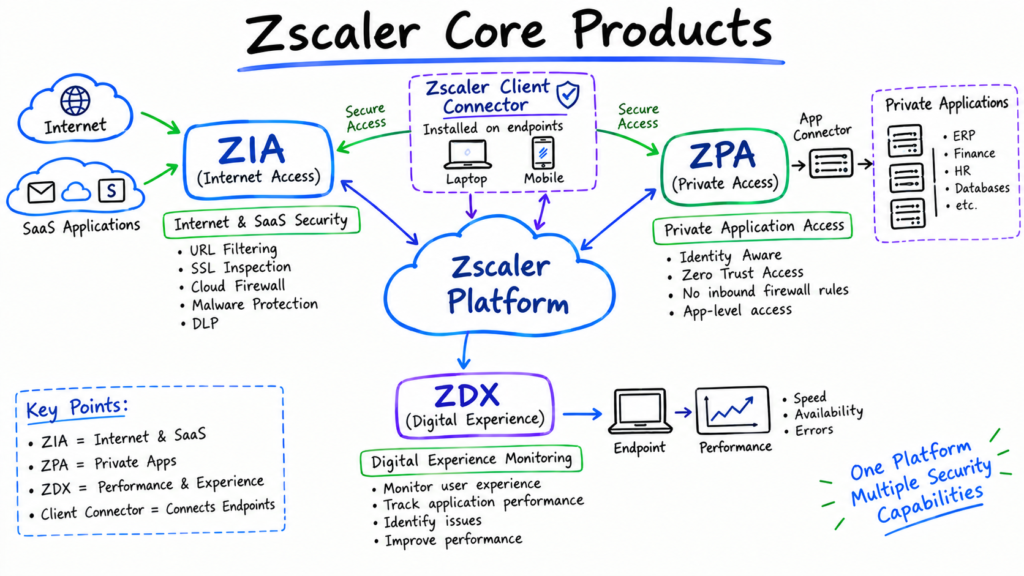
21. What are the main Zscaler products?
The major Zscaler products include:
- ZIA: Zscaler Internet Access
- ZPA: Zscaler Private Access
- ZDX: Zscaler Digital Experience
- Zscaler Client Connector: Endpoint agent used to connect devices to Zscaler services
Zscaler also provides additional security capabilities and services that integrate with these products.
22. What is Zscaler’s cloud architecture?
At a high level, Zscaler’s architecture separates management and enforcement functions.
The management side handles activities such as configuration and policy management, while distributed service infrastructure processes traffic and applies configured security policies.
The exact architecture and components can differ depending on the Zscaler service being discussed.
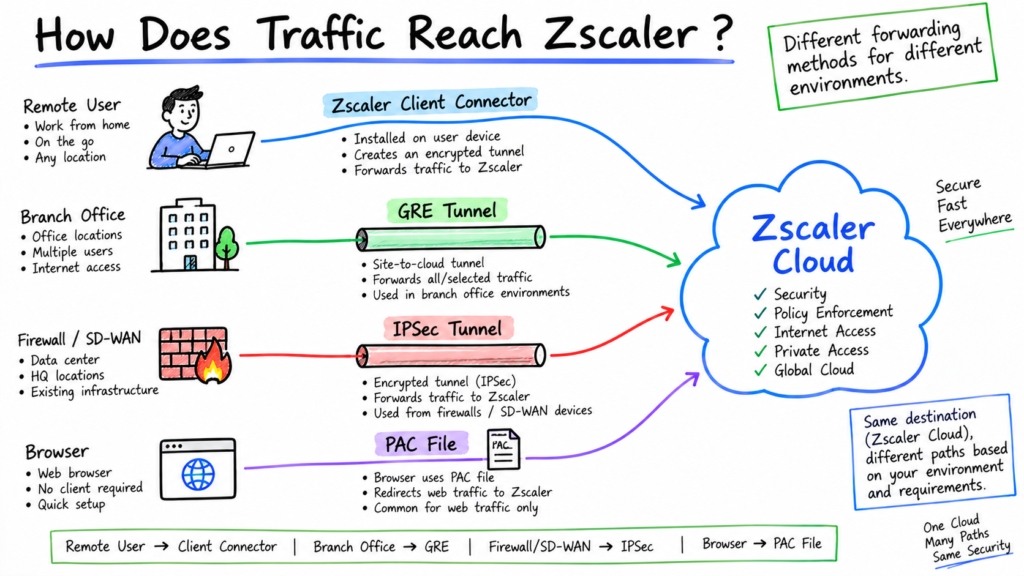
23. How does traffic reach Zscaler?
Traffic can be forwarded to Zscaler using different deployment methods depending on the user, device, and network architecture.
Common methods include:
- Zscaler Client Connector
- GRE tunnels
- IPSec tunnels
- PAC files
- Other supported forwarding mechanisms
The appropriate method depends on whether the traffic originates from a remote endpoint, branch office, data center, or another network environment.
24. What are common Zscaler deployment methods?
Common Zscaler deployment approaches include:
Endpoint-based deployment:
Zscaler Client Connector can be installed on managed endpoints to forward traffic to Zscaler services.
Branch-based deployment:
Organizations can use network devices such as routers, firewalls, or SD-WAN devices to establish GRE or IPSec connectivity to Zscaler.
PAC-based deployment:
PAC files can be used to direct supported browser traffic through a Zscaler proxy.
The selected deployment method depends on the organization’s network architecture, endpoint management, traffic requirements, and security policies.
25. What are the benefits and limitations of Zscaler?
Benefits:
- Cloud-delivered security
- Secure access for remote and branch users
- Reduced dependency on traditional security appliances
- Centralized policy management
- Application-specific access through Zero Trust
- Reduced network backhauling in suitable deployments
- Security inspection closer to users
Limitations and considerations:
- Requires reliable internet connectivity for cloud-delivered services
- Deployment and policy migration can require significant planning
- Existing applications may have dependencies that need to be identified before moving to Zero Trust access
- Some legacy applications or protocols may require additional configuration
- Organizations remain dependent on the availability of the cloud service and their network connectivity
Related TechNaga Articles
- Cybersecurity Fundamentals: What Is Cybersecurity and Why It Is Important Today
- Complete Network Security Basics Guide for Beginners 2026
- Firewall in Cybersecurity: Types, Examples and How It Works
2 thoughts on “25 Zscaler Fundamentals Interview Questions and Answers”