It started with a low-priority security alert at 3:00 AM. A single internal server was generating an unusually high number of TXT record queries to a newly registered and suspicious domain. At first glance, the activity appeared to be routine DNS traffic. However, by the time the incident response team investigated, gigabytes of sensitive customer data had already been stolen.
The attack was identified as a DNS Tunneling Attack, where cybercriminals abused trusted DNS (Domain Name System) traffic to secretly transfer confidential information outside the organization’s network. Because DNS is one of the most trusted internet protocols, many organizations allow outbound DNS traffic without performing deep inspection, making it an attractive channel for attackers.
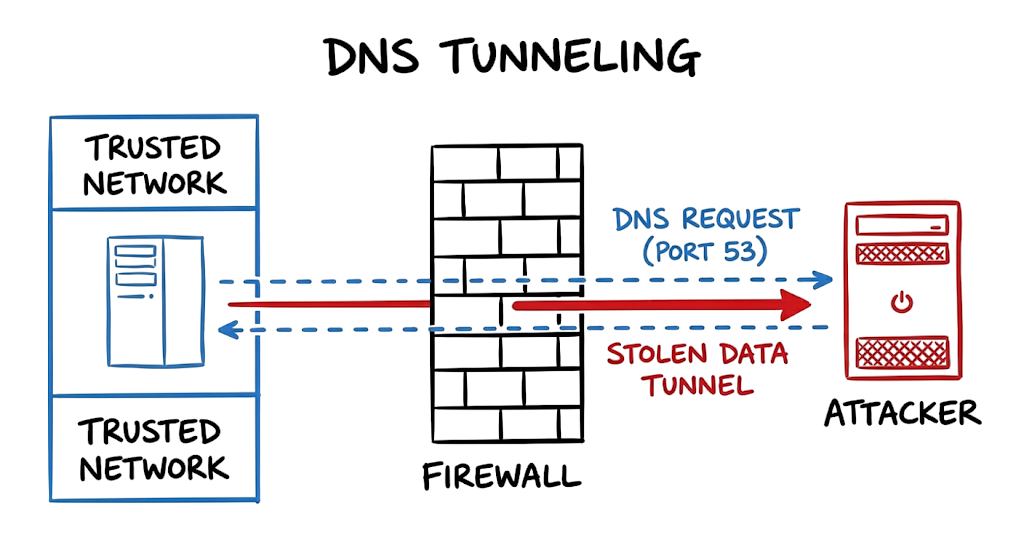
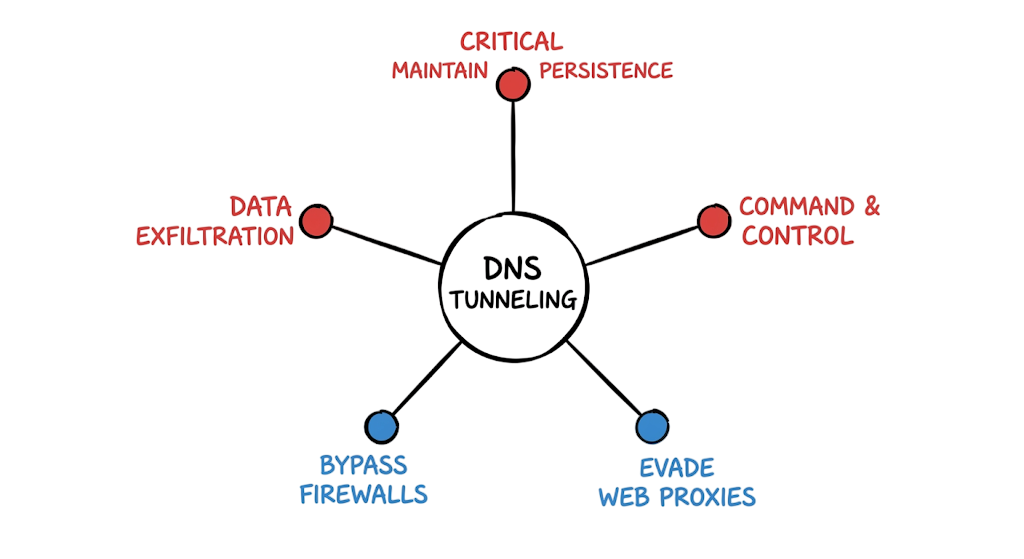
In modern enterprise environments, security teams carefully restrict outbound network traffic, yet Port 53 remains open because DNS is essential for resolving domain names and maintaining internet connectivity. Attackers understand this weakness and frequently use DNS Tunneling to bypass firewalls, evade security monitoring, establish covert command-and-control (C2) channels, and perform DNS Data Exfiltration without raising immediate suspicion.
In this guide, you’ll learn what DNS Tunneling is, how a DNS Tunneling Attack works, how attackers use DNS to bypass traditional security controls, and the best practices for detecting, preventing, and responding to DNS-based data exfiltration attacks.
What Is DNS Tunneling?
DNS Tunneling is a cyberattack technique in which attackers hide non-DNS traffic inside legitimate DNS queries and responses. Instead of using DNS solely for domain name resolution, attackers abuse the protocol to transport malicious commands, stolen credentials, or sensitive business data through trusted DNS communications.
The Domain Name System (DNS) functions as the internet’s phonebook by translating human-readable domain names into IP addresses. Since DNS is required for almost every online application and service, organizations typically allow DNS traffic through firewalls with minimal restrictions. This trust makes DNS an attractive target for cybercriminals.
During a DNS Tunneling Attack, attackers encode malicious payloads or confidential data into DNS requests, such as TXT, CNAME, or NULL record queries. To firewalls, proxies, and many traditional security devices, these packets appear to be legitimate DNS traffic. In reality, they create a hidden, bidirectional communication channel that allows attackers to bypass security controls, evade detection, establish command-and-control (C2) communications, and perform DNS Data Exfiltration from compromised systems.
Because DNS Tunneling blends malicious activity with normal DNS traffic, detecting this DNS Attack often requires advanced network monitoring, behavioral analytics, DNS logging, and anomaly detection rather than relying solely on traditional signature-based security tools.
How DNS Tunneling Works
The mechanism relies on the hierarchical nature of DNS resolution. When a device on your network wants to reach a specific domain, it sends a query to an internal DNS resolver. If the resolver does not already have the answer in its cache, it forwards the request to the public DNS infrastructure.
The resolver recursively queries root servers, top-level domain servers, and eventually the authoritative name server for the requested domain. If an attacker registers a malicious domain and controls its authoritative name server, they can use this process to receive DNS queries from your network and establish a covert communication channel.
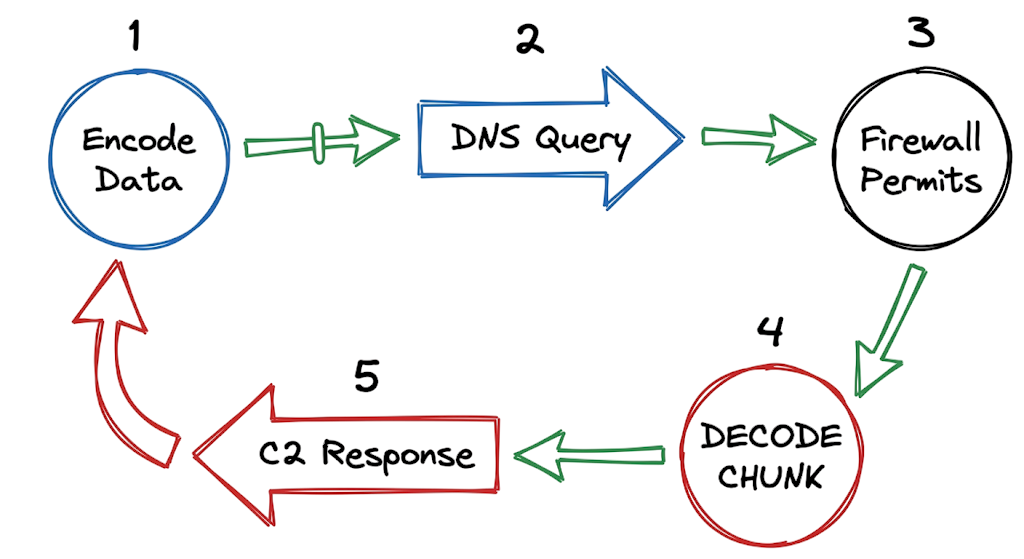
The attacker first infects a machine inside the network. The malware collects sensitive data, encodes it, and adds it as a subdomain to an attacker-controlled domain. It then generates a seemingly legitimate DNS query and sends it to the internal DNS resolver.
The local resolver treats the request as a normal DNS lookup. If the answer is not available in its cache, it forwards the query to the internet until it reaches the attacker’s authoritative DNS server. The attacker extracts the encoded data from the subdomain and stores the stolen information.
The attacker can also send commands back to the infected system through specially crafted DNS responses. To avoid caching, attackers generate unique subdomains for every query, forcing the resolver to contact the external server each time. This technique works because DNS was designed for fast and reliable name resolution rather than deep payload inspection.
DNS Data Exfiltration Through DNS Queries
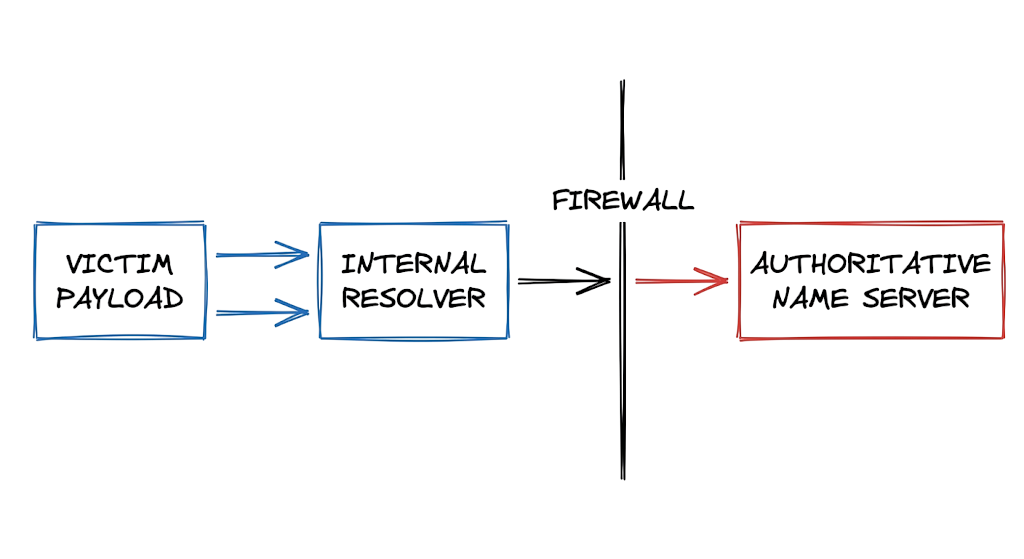
Let us walk through the exact sequence of an attack. The victim device first executes the malicious payload. This payload identifies a target file, compresses it, and encodes it into a format like Base64. The malware then chunks this string into smaller pieces because protocol limits restrict subdomain lengths to 63 characters. It appends the attacker’s domain to the chunk, creating a massive and random looking hostname. The victim device fires off a standard UDP packet on port 53 asking for the text record of this bizarre domain.
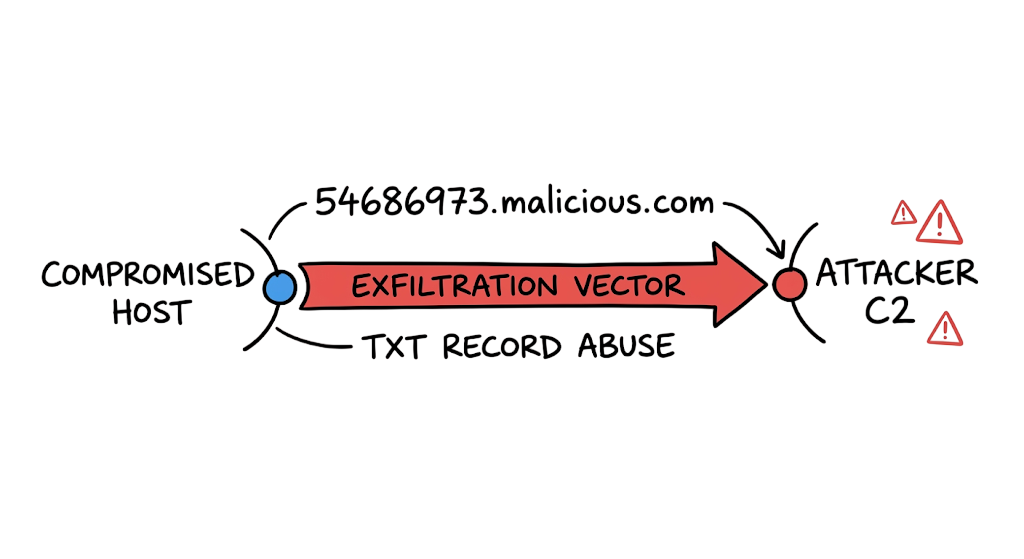
Your internal resolver receives the request, realizes it does not have the answer, and acts as a proxy by sending the request through the corporate firewall. The firewall permits it because it is standard port 53 traffic originating from an approved internal server. Now here’s where it gets interesting. The attacker’s authoritative name server receives the query, strips off the domain suffix, and decodes the Base64 chunk to reconstruct the stolen file on their end. To keep the connection alive, the attacker’s server sends a response back. This response contains an encoded string that the malware decodes into its next Command and Control instruction. The malware receives the instruction, executes it, and the cycle repeats.
Key Components of DNS Tunneling
- Victim payload: The malicious script executing on the internal host that encodes data and crafts the outgoing queries.
- Internal resolver: The legitimate corporate server that unwittingly acts as a smuggler by forwarding the malicious queries through the perimeter.
- Authoritative name server: The attacker controlled server sitting on the public internet configured to capture subdomains and issue commands.
- Encoded subdomains: The actual stolen data obfuscated as a string of random characters attached to the attacker’s root domain.
- Text records: The specific record types heavily abused by attackers to send large chunks of command data back into the network.
6. Real World Example
Plaintext
2026-06-11T03:14:22Z Query: 5468697349734154657374.maliciousdomain.com IN TXT
2026-06-11T03:14:23Z Query: 416e6f746865724368756e6b.maliciousdomain.com IN TXT
2026-06-11T03:14:24Z Query: 596574416e6f746865724f6e65.maliciousdomain.com IN TXT
2026-06-11T03:14:25Z Query: 4c61737450696563654f6644617461.maliciousdomain.com IN TXT
This log excerpt shows a classic exfiltration attempt. Notice the rapid succession of queries for text records all directed at the same base domain but with highly variable hex encoded subdomains. Each query represents a chunk of data leaving the network. The attacker is using hex encoding here instead of Base64 to avoid special characters that might break routing rules. When you see this pattern in your logs, the immediate next step is to block the base domain at the firewall, isolate the source IP making the requests, and decode the hex strings to determine exactly what data was compromised.
DNS Tunneling Detection and Prevention Implementation
- Review your perimeter firewall rules to ensure that only your designated internal resolvers can communicate externally on port 53.
- Block direct outbound queries from all user workstations and application servers to force them to use your monitored internal servers.
- Configure your logging infrastructure to capture full query logs rather than just connection events so you can inspect the actual requested hostnames.
- Ingest those logs into your SIEM platform to baseline normal behavior and identify deviations.
- Set up alerting rules for queries containing more than 50 characters in the subdomain or those utilizing high entropy character strings.
- Monitor for an abnormal ratio of text or null record queries compared to standard address record lookups.
- Implement a sinkhole for known malicious domains by feeding high quality Threat intelligence feeds directly into your internal resolvers.
Advantages and Limitations of DNS Tunneling
From an attacker’s perspective, DNS Tunneling is highly reliable because it can bypass many traditional perimeter defenses. It allows attackers to maintain communication with compromised systems even in heavily restricted environments. However, the technique is relatively slow because DNS packets carry limited amounts of data. As a result, transferring even a small file may require thousands of DNS queries.
For defenders, detecting DNS Tunneling is not always straightforward. Relying only on query length or traffic volume can lead to false positives. Content delivery networks (CDNs), anti-spam services, and legitimate endpoint security tools often generate long and complex subdomains for telemetry and tracking purposes. Blocking every suspicious-looking query can disrupt critical business applications and create unnecessary operational issues.
Common Mistakes
Many engineers review firewall logs, see allowed port 53 traffic, and assume the network is secure because the requests originate from internal DNS servers or domain controllers. This assumption often leads to missed indicators of DNS Tunneling activity.
The DNS server is only acting as a messenger. If you monitor only the network perimeter, you lose visibility into the original source IP address of the infected endpoint. The firewall sees only the DNS server communicating with external systems. To accurately trace an infection, analysts must collect and correlate logs from internal DNS resolvers, endpoints, and security monitoring tools.
Another common mistake is ignoring NXDOMAIN responses. Attackers frequently generate queries for non-existent domains to test defenses, evade caching, or support DNS Tunneling operations. Failing to investigate unusual NXDOMAIN activity can create a significant blind spot and delay threat detection.
Best Practices
Effective defense against DNS Tunneling requires complete visibility and strong architectural controls. Organizations must understand how DNS traffic flows through the network and ensure that all DNS requests pass through monitored and approved resolvers.
During a network hardening project at a large regional data center, we discovered that more than forty internal applications were configured to use public DNS resolvers directly. To address this risk, we implemented Zero Trust principles and forced all DNS traffic through dedicated inspection and monitoring points. This provided greater visibility and reduced the risk of unauthorized communication channels.
Organizations should enforce strict DNS resolution policies and use SIEM correlation to identify low-and-slow data exfiltration attempts. Do not rely solely on static blocklists, as attackers can register new domains within minutes. Strong DNS security controls should analyze query volume, payload entropy, and domain reputation. Security teams should also investigate systems that generate unusually high numbers of requests to a single domain within a short period.
Troubleshooting Scenario
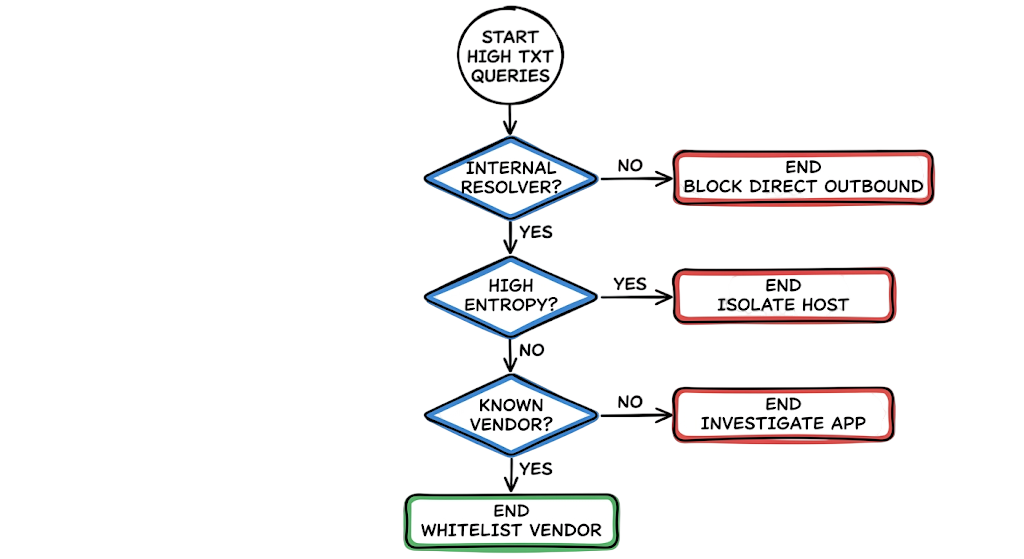
A high-severity alert is triggered for suspected data theft in a core banking environment. The SIEM identifies a database server sending thousands of TXT record queries to a domain with unusually long and random-looking subdomains. At first glance, the activity appears to be a DNS Tunneling attempt.
The junior analyst immediately assumes the database server has been compromised and recommends isolating the system from the network. However, experienced incident responders know that DNS-related alerts require careful validation before taking disruptive actions.
After analyzing the DNS queries and decoding the suspicious subdomains, the security team discovers that the strings contain encrypted license keys rather than stolen customer data. The investigation reveals that a newly installed third-party database monitoring agent is using TXT records to perform license validation and telemetry communication.
Instead of isolating the critical server, the team validates the vendor’s behavior, whitelists the approved telemetry domain, and continues monitoring the activity. This scenario demonstrates why analysts should verify evidence, review DNS logs, and complete a full investigation before classifying an event as a DNS Tunneling incident.
Interview Questions
Q: Why do attackers prefer this protocol for command communications?
A: Port 53 is rarely blocked or deeply inspected by corporate firewalls. It provides a highly reliable channel for bidirectional communication that easily evades traditional web proxies and perimeter defenses.
Q: What is the significance of the text record in an attack?
A: Text records allow for a larger payload size in the response compared to standard address records. Attackers use them to push larger scripts or complex commands from their authoritative server back down to the infected internal host.
Q: How does a recursive resolver unwittingly assist an attacker?
A: A recursive resolver is designed to fetch answers it does not have by querying external servers. When it receives a query for the attacker’s custom domain, it actively reaches out to the attacker’s server and bridges the gap between the isolated internal network and the public internet.
Q: Why is relying only on firewall logs insufficient for detecting this threat?
A: Perimeter firewalls typically only log the IP address of the internal server making the external request. They do not log the original internal workstation that initiated the query, making it impossible to identify the actual compromised host.
Q: How can entropy analysis help identify covert channels?
A: Legitimate domain names usually contain readable and predictable patterns of characters. Encoded data has high entropy and appears highly random. Analyzing the entropy of subdomains helps flag mathematically unusual queries for investigation.
Future Trends
As we move forward, adversaries are increasingly moving away from simple encoding and using AI to generate subdomains that mimic natural language, which severely degrades the effectiveness of entropy based detection. Threat actors are also starting to abuse encrypted resolution protocols to completely blind legacy network monitoring tools. This forces organizations to deploy endpoint level inspection rather than relying on network choke points. Regionally, strict frameworks like the Saudi SAMA Cyber Security Framework and the UAE NESA standards are updating their audit requirements to explicitly mandate that critical infrastructure providers implement deep packet inspection for all outbound name resolution traffic.
FAQ
Q: What is the difference between spoofing and DNS Tunneling?
A: Spoofing involves altering records to redirect users to a malicious site. Tunneling uses the protocol itself as a covert transport layer to sneak data in and out of a network.
Q: Can a standard firewall block this activity?
A: Most standard firewalls cannot block it because they only check the port and protocol rather than the payload of the query. You need an application aware firewall or a dedicated filtering solution to inspect the query contents.
Q: Why not just block all text records?
A: Blocking all text records will break legitimate internet functions. Anti spam mechanisms like SPF and DMARC rely heavily on text records to verify email authenticity.
Q: How do attackers get the malware onto the network initially?
A: The malware is typically delivered through traditional initial access vectors. This includes phishing emails, malicious downloads, or exploiting unpatched vulnerabilities on an internet facing system.
Q: Does using a public provider like Cloudflare protect me?
A: Public providers simply resolve domains and do not filter outbound Data exfiltration attempts for your specific network. You must implement filtering and monitoring before the query leaves your perimeter.
Conclusion: Protecting Your Organization from DNS Tunneling
DNS Tunneling proves that adversaries will always find the path of least resistance and turn your most trusted network protocols into weapons against you. By understanding how the protocol is abused, you can shift your defenses from blindly allowing port 53 to actively inspecting it. Go to your logging platform right now and run a search for the top ten internal hosts generating the highest volume of unique queries.
References and Further Reading
MITRE ATT&CK: DNS Protocol (T1071.004)
https://attack.mitre.org/techniques/T1071/004/
CISA Cybersecurity Resources
https://www.cisa.gov
Cloudflare Learning Center: What is DNS?
https://www.cloudflare.com/learning/dns/what-is-dns/
OWASP Security Guidance
https://owasp.org
SANS Institute DNS Security Resources
https://www.sans.org
Related Articles
- What Is Cybersecurity and Why It Is Important Today
https://technaga.com/what-is-cybersecurity-and-why-it-is-important-today/ - Complete Network Security Basics Guide for Beginners 2026
https://technaga.com/what-is-networks-and-network-security-basics-2026/ - What is Firewall in Cybersecurity? Types, Examples and How it Works in 2026
https://technaga.com/firewall-in-cybersecurity-types-examples-explained/ - Security Information and Event Management: Complete SIEM Guide 2026
https://technaga.com/security-information-and-event-management-2026/ - Zero Trust Security in 2026: Architecture, Real Examples, and Implementation Guide
https://technaga.com/zero-trust-security-2026-guide/