It is 2 AM, and the SOC dashboard suddenly lights up with a massive spike in unknown unicast traffic across the access layer switches. A junior analyst checks the bandwidth charts, assumes it is a broadcast storm, and attempts to reboot the switch without investigating the root cause.
This is where understanding a MAC Flooding Attack Explained becomes critical. A MAC flooding attack can overwhelm a switch’s forwarding table, forcing it to behave like a hub and exposing sensitive network traffic. As one of the most common Layer 2 attacks, it can create serious risks for network switch security and data confidentiality.
In this guide, you will learn how a CAM table overflow attack works, how attackers exploit MAC address table attacks to intercept traffic, and the most effective port security and switch hardening techniques to prevent a switch flooding attack before it impacts your organization.
MAC Flooding Attack Explained: What Is a MAC Flooding Attack?
A network switch operates by maintaining a dynamic hardware-level mapping table that links physical ports to connected devices. This table, often called the Content Addressable Memory (CAM) table, enables efficient traffic forwarding and plays a critical role in network switch security.
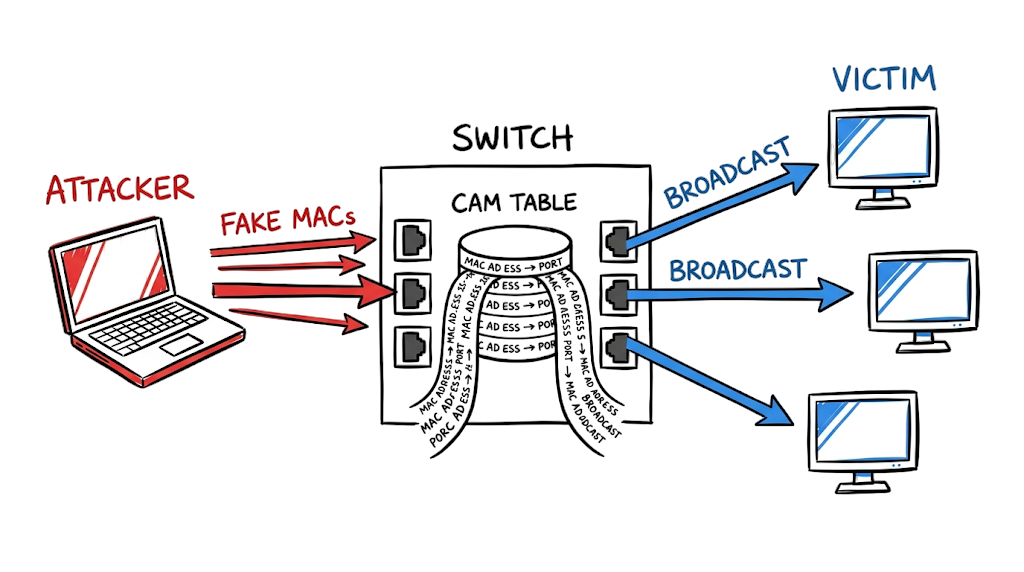
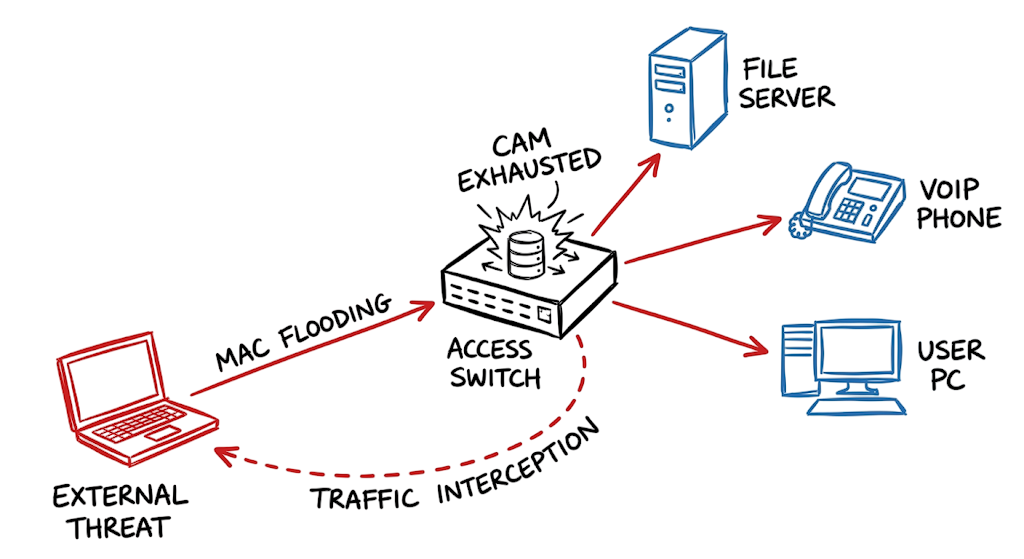
During a MAC Flooding Attack Explained scenario, an attacker overwhelms the switch with thousands of forged MAC addresses. This CAM table overflow attack rapidly consumes the switch’s available memory, preventing it from learning legitimate device locations.
Once the CAM table becomes full, the switch can no longer determine the correct destination port for incoming traffic. Instead, it floods frames across multiple ports within the VLAN, creating a switch flooding attack condition. This behavior allows attackers to capture network traffic that was never intended for their device.
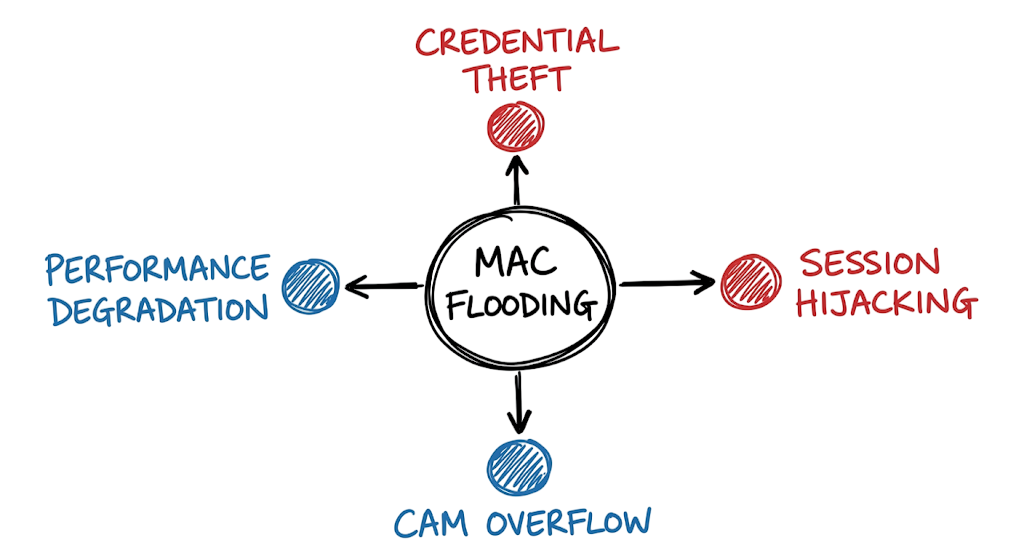
As a result, a successful MAC address table attack can effectively downgrade an intelligent Ethernet switch into a hub-like device. This makes Layer 2 attacks particularly dangerous because sensitive corporate data, credentials, and application traffic may become visible to unauthorized users connected to the same network segment.
MAC Flooding Attack Explained: How the Attack Mechanics Work
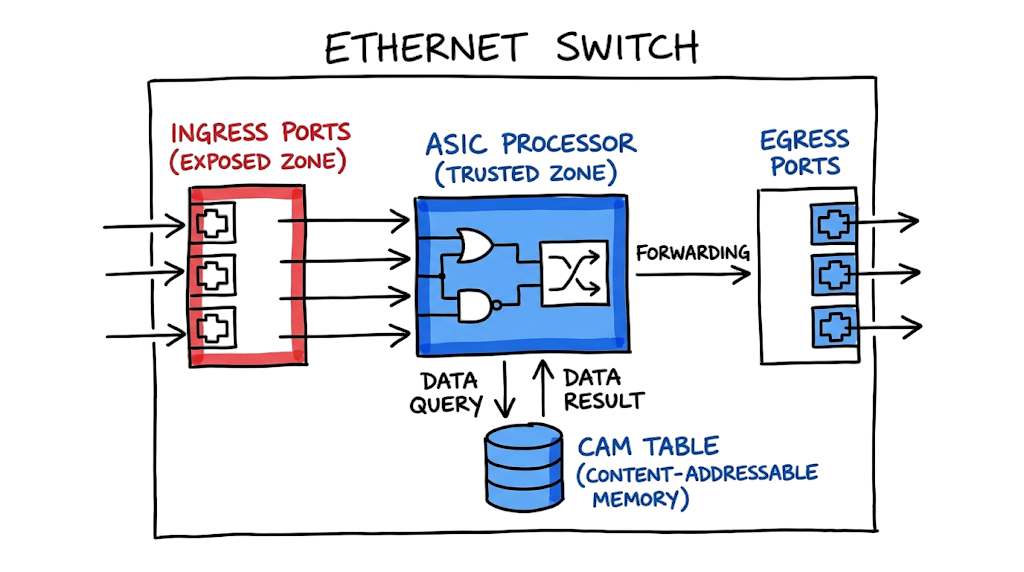
Switches use Application-Specific Integrated Circuits (ASICs) and Content Addressable Memory (CAM) to perform wire-speed lookups. This specialized hardware allows Ethernet switches to forward traffic efficiently while maintaining high performance across the network.
As part of a MAC Flooding Attack Explained, switches dynamically learn device locations by examining the source MAC address of every incoming Ethernet frame. When an attacker connects to a network port and launches a tool that generates thousands of random MAC addresses, the switch treats each address as a legitimate new device and stores it in the CAM table.
The problem occurs when the CAM table overflow attack reaches the hardware’s storage limit. Within seconds, the switch exhausts its available memory and can no longer learn or maintain legitimate MAC address mappings. This creates a serious network switch security issue because normal traffic forwarding begins to fail.
When the switch cannot determine the correct destination port, it follows standard Ethernet behavior and floods the frame across all ports within the VLAN. This switch flooding attack causes unknown unicast traffic to spread throughout the broadcast domain, allowing the attacker’s device to receive copies of traffic intended for other users.
As a result, a successful MAC address table attack may expose unencrypted credentials, VoIP conversations, application data, and other sensitive information. This is why Layer 2 attacks such as MAC flooding remain a significant threat in enterprise environments. Rather than exploiting software vulnerabilities, attackers abuse the fundamental learning process built into Ethernet switching technology.
MAC Flooding Attack Explained: The Technical Flow
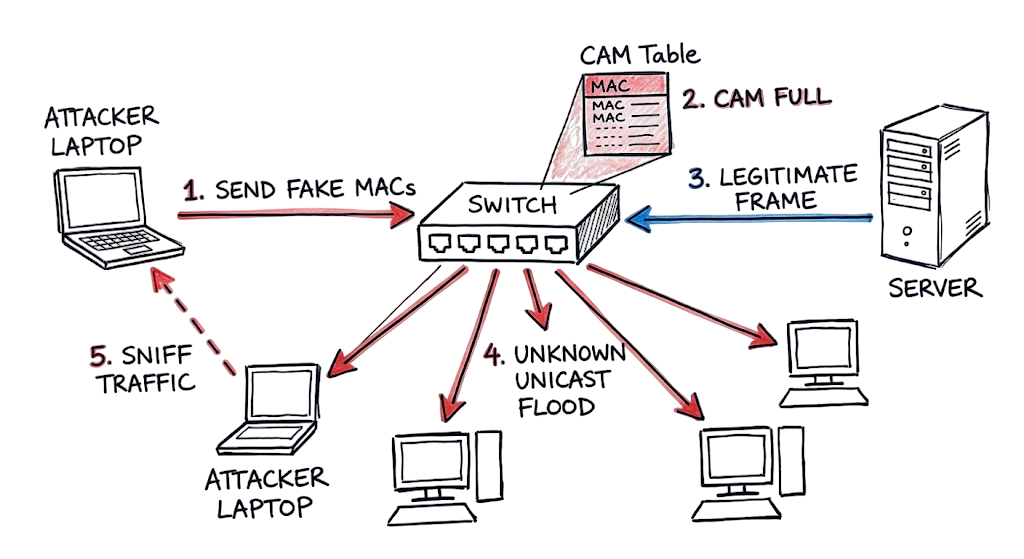
The sequence of a MAC Flooding Attack Explained begins when an unauthorized device or compromised endpoint starts transmitting thousands of crafted Ethernet frames onto the local network segment. The attacker uses specialized tools to generate random source MAC addresses, making the switch believe that numerous new devices are connecting simultaneously.
As the attack progresses, the access switch continuously updates its forwarding database, also known as the CAM table. Each newly generated MAC address consumes valuable memory resources, forcing older and legitimate entries to be removed. This behavior is the foundation of a CAM table overflow attack and represents a serious network switch security concern.
The attacker is not attempting to communicate with other systems directly. Instead, the goal is to overwhelm the switch’s lookup capacity by flooding it with fake MAC addresses. Within seconds, the switch reaches its storage limit and can no longer maintain accurate forwarding information for legitimate devices.
Once the CAM table becomes full, normal network traffic is treated as unknown unicast traffic. The switch responds by flooding frames across all ports within the VLAN, creating a switch flooding attack condition. This allows traffic intended for legitimate users to be copied and transmitted to multiple devices, including the attacker’s system.
To capture the exposed traffic, the attacker typically runs a packet sniffer in promiscuous mode. As a result, a successful MAC address table attack can expose credentials, application data, VoIP traffic, and other sensitive information. This is why Layer 2 attacks remain a significant threat to enterprise networks, even when perimeter firewalls and endpoint security solutions are properly configured.
MAC Flooding Attack Explained: Key Components
- Target Switch — The physical or virtual network hardware responsible for forwarding frames, which gets forced into a fail-open broadcast state.
- Forwarding Database — The limited memory space, commonly called the CAM table, that maps hardware addresses to physical switch ports.
- Generation Tool — A script or utility, such as Macof, that rapidly outputs thousands of randomized source addresses per second to exhaust the switch memory.
- Packet Sniffer — Software running in promiscuous mode to silently capture the leaked broadcast traffic leaving the compromised switch.
- Victim Endpoints — Legitimate corporate devices whose private network communications are unintentionally exposed to the attacker during the flood.
REAL-WORLD ENTERPRISE EXAMPLE
Plaintext
%PORT_SECURITY-2-PSECURE_VIOLATION: Security violation occurred, caused by MAC address 0011.2233.4455 on port FastEthernet0/12.
%PM-4-ERR_DISABLE: psecure-violation error detected on Fa0/12, putting Fa0/12 in err-disable state
%SYS-5-CONFIG_I: Configured from console by vty0 (10.0.5.50)
When an attacker targets a financial institution, the impact of a MAC Flooding Attack Explained becomes immediately visible in the logging systems. In one banking environment, a contractor connected a rogue device to a meeting room network port, causing the core distribution switches to generate multiple security alerts within seconds.
The switch detected an unusually high number of MAC addresses originating from a single interface. This behavior is a common indicator of a CAM table overflow attack and should trigger an immediate investigation by the network and security teams.
Because port security was properly configured, the switch automatically placed the affected interface into an error-disabled state. This action isolated the threat and prevented the attacker from continuing the switch flooding attack against the network infrastructure.
Without these protections, the attack could have exposed sensitive traffic flowing through the affected VLAN. A successful MAC address table attack may allow attackers to capture unencrypted credentials, internal application traffic, and legacy system communications, creating a serious network switch security risk.
In highly regulated industries such as banking and healthcare, data exposure can result in significant compliance violations. Frameworks such as Singapore’s MAS TRM require organizations to implement strong controls that protect sensitive information from unauthorized access.
When a port security violation occurs, security engineers should immediately identify the physical location of the affected switch port, locate the connected device, and collect relevant logs for forensic analysis. This helps determine whether the incident was caused by an insider threat, a compromised endpoint, or an intentional Layer 2 attack designed to intercept network traffic.
MAC Flooding Attack Explained: Practical Implementation and Prevention
- Access the switch command line interface and navigate to the specific user-facing interface you want to secure, rather than applying sweeping changes globally that might inadvertently break your critical uplink ports.
- Force the interface into a static access mode, because dynamic trunking protocols will easily bypass your basic port security rules if the attacker manages to negotiate a trunk link.
- Enable the port security feature on the interface, ensuring you explicitly define the maximum number of allowed hardware addresses.
- Adjust the maximum address limit to account for legitimate daisy-chained devices; leaving this at the default of one will break setups where a user’s PC plugs into their VoIP phone.
- Set the violation mode to shutdown so the port completely disables itself upon detecting an attack, rather than just silently dropping packets and burning CPU cycles processing the malicious traffic.
- Define a recovery timer so that the interface eventually brings itself back online after a set period, saving you from manually bouncing ports at 3 AM when an employee accidentally triggers a violation with an unapproved desktop switch.
MAC Flooding Attack Explained: Advantages and Limitations of Defenses
Securing enterprise networks against Layer 2 attacks requires a realistic understanding of both the strengths and limitations of security controls. One of the most effective defenses against a MAC Flooding Attack Explained is the implementation of strict port security policies on access switches.
Port security helps prevent a CAM table overflow attack by limiting the number of MAC addresses that can be learned on a switch interface. If the configured threshold is exceeded, the switch can automatically shut down the port, effectively stopping the attack before the forwarding table becomes exhausted.
This approach creates a strong security boundary and significantly improves network switch security. By preventing unauthorized devices from introducing thousands of fake MAC addresses, organizations can reduce the risk of a successful switch flooding attack.
However, strict port security can introduce operational challenges in modern enterprise environments. Employees frequently move between desks, connect different docking stations, or use virtual machines that generate additional MAC addresses. These legitimate activities may trigger security violations and cause users to lose network connectivity.
Another limitation is that basic port security does not completely prevent a MAC spoofing attack. A skilled attacker may clone the MAC address of a trusted device, such as a printer, VoIP phone, or workstation, to bypass simple address-based restrictions.
For this reason, organizations should combine port security with additional controls such as 802.1X authentication, VLAN segmentation, endpoint security, and continuous monitoring. The goal is to balance strong protection against MAC address table attacks while maintaining a smooth user experience and minimizing helpdesk disruptions.
MAC Flooding Attack Explained: Common Architecture Mistakes
This is where most people get confused: they assume that putting a next-generation firewall at the perimeter automatically protects the internal switching infrastructure. I constantly see engineers leaving unused wall jacks patched directly into active switch ports with no restrictions whatsoever. They rely entirely on endpoint agents and perimeter firewalls, completely forgetting that a network switch security strategy is strictly necessary to protect internal east-west traffic.
Another major error is ignoring the syslog server until something physically breaks. Switches will scream about memory exhaustion and unusual broadcast levels for hours before totally failing, but if nobody is actively monitoring the SIEM, the attacker gets all the time they need to capture sensitive data. Finally, engineers often apply port limits but leave the violation mode set to restrict rather than shutdown. This stops the memory from filling up, but it drives the switch CPU to 100% as it struggles to inspect and drop thousands of malicious frames per second, ultimately causing a denial of service anyway.
MAC Flooding Attack Explained: Best Practices for Switch Hardening
When I was working on an infrastructure overhaul for a major healthcare provider, the biggest operational win came from simply shutting down every single unpatched port across the campus. You must build a habit of administratively disabling any interface that is not actively providing service to a known endpoint. Segment your network heavily using VLANs to ensure that even if an attacker successfully executes a MAC address table attack, they only expose the traffic of that specific isolated subnet rather than the entire corporate routing table.
Move your architecture toward implementing 802.1X authentication so that the switch will not even pass DHCP traffic until the endpoint provides a valid cryptographic certificate or user credential. Finally, forward all your spanning tree, interface state, and port violation logs directly into a centralized SIEM, and set up hard alerts for any interface that attempts to register more than five new hardware addresses within a one-minute window.
MAC Flooding Attack Explained: Troubleshooting Scenario
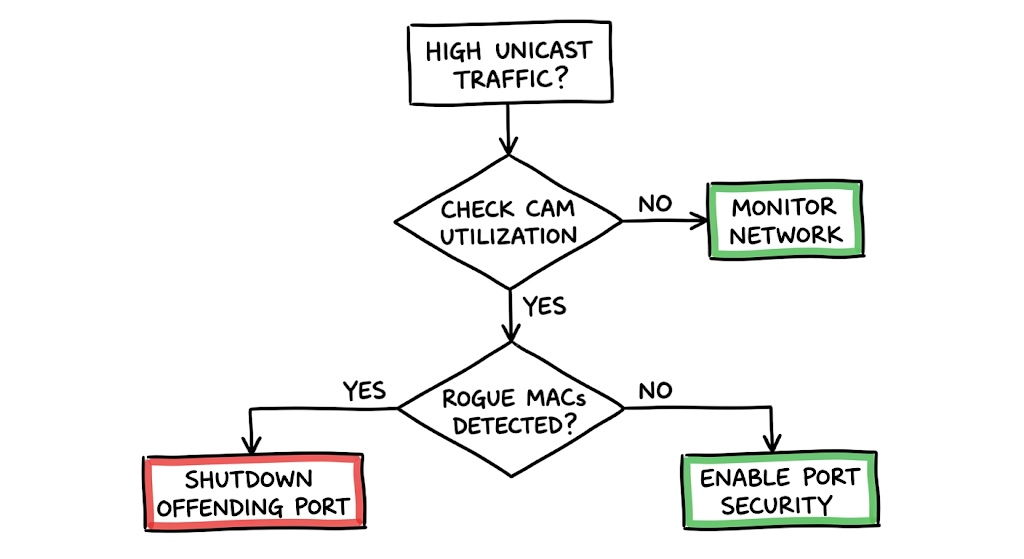
Users on the third floor suddenly report that their VoIP calls are dropping, and internal database queries are timing out intermittently. The junior engineer looks at the monitoring dashboard, sees high bandwidth utilization across the uplinks, and assumes there is a routing loop or a spanning tree failure. In real environments, it doesn’t work this cleanly.
The engineer wastes an hour tracing BPDU packets when the actual root cause is a compromised IoT smart TV in the lobby executing a localized flood. Because the switch memory is completely exhausted, all unicast traffic is being broadcast to every port on that switch, saturating the gigabit links with duplicate packets and causing the VoIP phones to drop frames. To fix this, you must log into the affected switch, run the command to view the forwarding table capacity, and identify the specific interface contributing thousands of entries. Once you administratively shut down the lobby port, you clear the dynamic address table, allowing the switch to relearn the legitimate paths and instantly restoring normal network performance.
MAC Flooding Attack Explained: Interview Questions for Security Engineers
Q: What exactly is happening under the hood during a CAM table exhaustion?
A: The switch receives a massive volume of frames with randomized source hardware addresses. It fills its limited physical memory trying to map all these new addresses to the ingress port, leaving no space for legitimate mappings.
Q: Why does the switch flood traffic instead of just dropping it when the memory is full?
A: Ethernet switching rules dictate that if a switch does not have a specific port mapping for a destination address, it must flood the frame to all ports within the VLAN to ensure delivery. Attackers exploit this exact standard to capture traffic.
Q: How does this differ from an ARP spoofing attack?
A: A flooding attack targets the switch’s internal memory to force a broadcast state, whereas ARP spoofing targets the individual ARP caches of endpoint devices to quietly redirect traffic flow for a man-in-the-middle interception.
Q: If you only have five minutes to secure a remote branch switch, what is the most effective command sequence?
A: Implementing basic port security with a strict maximum address limit and a shutdown violation mode. This instantly neutralizes any script attempting to generate thousands of fake addresses from a single access port.
Q: Can an attacker execute this remotely over the public internet?
A: No, this attack requires local Layer 2 connectivity. The attacker must be physically plugged into a switch port or connected to a poorly secured wireless network bridged to the target VLAN.
MAC Flooding Attack Explained: Future Trends (2026 and Beyond)
The reliance on static port configurations is rapidly shifting toward identity-driven access layers. We are seeing heavy adoption of Zero Trust architectures where the switch port itself remains essentially dead until a dynamic policy engine, like Cisco ISE or Aruba ClearPass, authenticates the device hardware and user identity simultaneously.
Furthermore, driven by strict regulatory frameworks like India’s DPDP Act, organizations are enforcing automated quarantine workflows to protect user data from internal exposure. If a switch detects anomalous learning behavior, the SIEM now uses API calls to instantly isolate the offending port and revoke the endpoint’s network access, entirely removing the human response delay.
MAC Flooding Attack Explained: Frequently Asked Questions
Q: Can this attack bypass modern enterprise firewalls?
A: Yes, because it operates entirely at the data link layer within the local subnet. The perimeter firewall never sees the traffic being leaked laterally between two endpoints connected to the same switch.
Q: Will dividing the network into multiple VLANs stop the attack?
A: It will not prevent the attack itself, but it significantly contains the blast radius. The flooding behavior is restricted to the specific broadcast domain where the attacker is connected.
Q: Why do hardware vendors not just increase their memory capacity?
A: Hardware memory for wire-speed lookups (TCAM) is extremely expensive and power-hungry. Even if a switch had infinite memory, an attacker could simply run the generation script longer to eventually fill it up.
Q: Is there any legitimate reason for a switch port to learn hundreds of addresses?
A: Yes, if that port is an uplink to another switch, or if it connects to a hypervisor hosting multiple virtual machines. This is why you must never apply strict limits blindly across all interfaces.
Q: Can wireless networks suffer from this exact same vulnerability?
A: Enterprise wireless access points handle client associations differently and do not learn addresses in the same way a physical switch does, making them largely immune to this specific flooding technique.
MAC Flooding Attack Explained: Conclusion
This MAC Flooding Attack Explained guide demonstrates that major security incidents do not always require sophisticated malware or zero-day exploits. In many cases, a simple CAM table overflow attack launched from an unprotected network port can expose sensitive traffic and create significant network switch security risks. By exploiting the fundamental learning process of Ethernet switching, attackers can turn a localized Layer 2 attack into a serious data exposure event.
To reduce the risk of a MAC address table attack, organizations should implement port security, disable unused switch ports, enforce 802.1X authentication, and continuously monitor for unusual MAC learning activity. Take a few minutes to review your access switches today and verify that proper controls are in place. A single unsecured network port can be enough to trigger a switch flooding attack and expose critical business data.
References and Further Reading
- Cisco Port Security Documentation
- NIST Cybersecurity Framework
- IEEE Standards Association
- OWASP Foundation
- MITRE ATT&CK Framework
Related Articles
- What Is Cybersecurity and Why It Is Important Today
https://technaga.com/what-is-cybersecurity-and-why-it-is-important-today/ - Complete Network Security Basics Guide for Beginners 2026
https://technaga.com/what-is-networks-and-network-security-basics-2026/ - OSI Model Guide: 7 Powerful Layers Every Engineer Must Know
https://technaga.com/osi-model-7-layers-troubleshooting-guide/ - 4 Secrets of the TCP IP Model for Security Analysts
https://technaga.com/tcp-ip-model-security-guide/ - Network Segmentation Explained with Real-World Example
https://technaga.com/network-segmentation-guide-ransomware-prevention/ - What is Firewall in Cybersecurity? Types, Examples and How it Works in 2026
https://technaga.com/firewall-in-cybersecurity-types-examples-explained/ - Zero Trust Security in 2026: Architecture, Real Examples, and Implementation Guide
https://technaga.com/zero-trust-security-2026-guide/ - Security Information and Event Management: Complete SIEM Guide 2026
https://technaga.com/security-information-and-event-management-2026/