BGP Hijacking How Internet Routes Get Stolen is a growing concern for organizations that depend on internet connectivity, cloud services, and online applications. A single malicious route announcement can redirect traffic, cause outages, and expose sensitive data without directly attacking the target network.
Three hours into a critical outage, monitoring alerts finally pointed away from the internal firewalls and toward the public internet. A third party had falsely claimed ownership of our public IP space, blackholing traffic meant for our payment gateway.
This is the reality of BGP hijacking, one of the most dangerous internet routing attacks affecting organizations today. A successful route hijacking attack can redirect legitimate traffic to unauthorized networks, causing service disruption, data interception, and business impact.
In this guide, you will learn how internet routes get stolen, how attackers manipulate the Border Gateway Protocol (BGP), and why BGP security best practices are essential for modern networks.
We will explore the technical flow of a BGP hijacking attack, examine the role of RPKI security in preventing unauthorized route announcements, and discuss practical detection and mitigation techniques.
By the end of this article, you will understand how to identify suspicious routing behavior, investigate network route manipulation, and protect your infrastructure from future routing attacks.
What Is BGP Hijacking and Why Does It Matter?
Border Gateway Protocol (BGP) security relies heavily on trust between network operators. A BGP hijacking attack occurs when a network intentionally or accidentally announces ownership of an IP address range that actually belongs to another organization.
Internet routers are designed to select the best route to a destination. When a malicious or incorrect route advertisement appears, routers may accept it and update their routing tables. As a result, traffic destined for the legitimate network gets redirected to an unauthorized destination.
This type of route hijacking attack can allow attackers to drop packets, inspect traffic, intercept sensitive data, or even modify communications in transit. In severe cases, internet routing attacks can cause widespread outages affecting websites, cloud services, and enterprise applications.
You can think of BGP hijacking as manipulating the routing map of the internet. When an attacker advertises false routing information, data packets simply follow the advertised path without verifying whether the route is legitimate.
Understanding how internet routes get stolen requires recognizing a key limitation of early internet protocols. The Border Gateway Protocol was designed to prioritize connectivity and scalability rather than strong authentication. Because of this design, routers generally trust routing updates received from neighboring networks unless additional security controls such as RPKI security and route validation are implemented.
How BGP Hijacking Works on the Internet
To understand how BGP hijacking works, you first need to understand how routers communicate. The Border Gateway Protocol (BGP) uses TCP port 179 to exchange routing information between Autonomous Systems (AS). Networks advertise the IP prefixes they own, and neighboring routers share those routes across the internet.
When a network announces a route, routers evaluate multiple attributes to determine the best path. One of the most important factors is prefix specificity. A more specific route is usually preferred over a broader route because it provides a more precise destination.
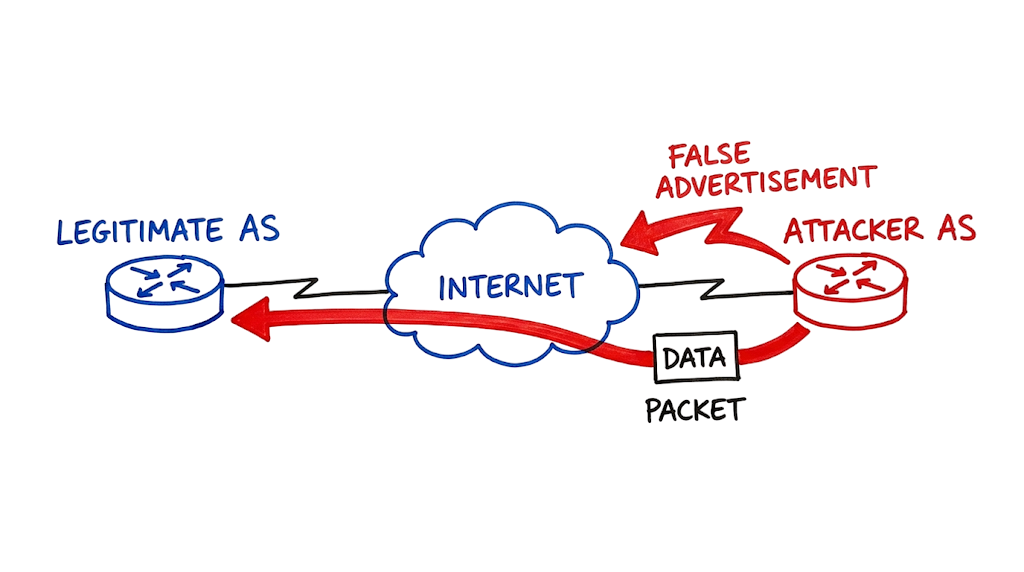
This is where a BGP hijacking attack becomes dangerous. If an attacker advertises a more specific IP prefix than the legitimate owner, routers may automatically update their routing tables and begin sending traffic to the attacker’s network instead.
If two routes have the same prefix length, routers evaluate additional factors such as AS path length and routing policies. Attackers often exploit these routing behaviors to make their malicious route appear more attractive than the legitimate one.
Unlike many cyberattacks, a route hijacking attack does not require direct access to the victim’s systems. The attacker only needs to convince an upstream provider or connected network to accept and propagate a false route advertisement.
Once accepted, the malicious route can spread rapidly through the global routing infrastructure. Within minutes, internet routers around the world may update their tables, redirecting traffic to the unauthorized network. This is one of the primary reasons internet routing attacks can have a global impact in a very short period.
Understanding how internet routes get stolen helps security and network engineers recognize why BGP security best practices and RPKI security are becoming essential for protecting modern internet infrastructure.
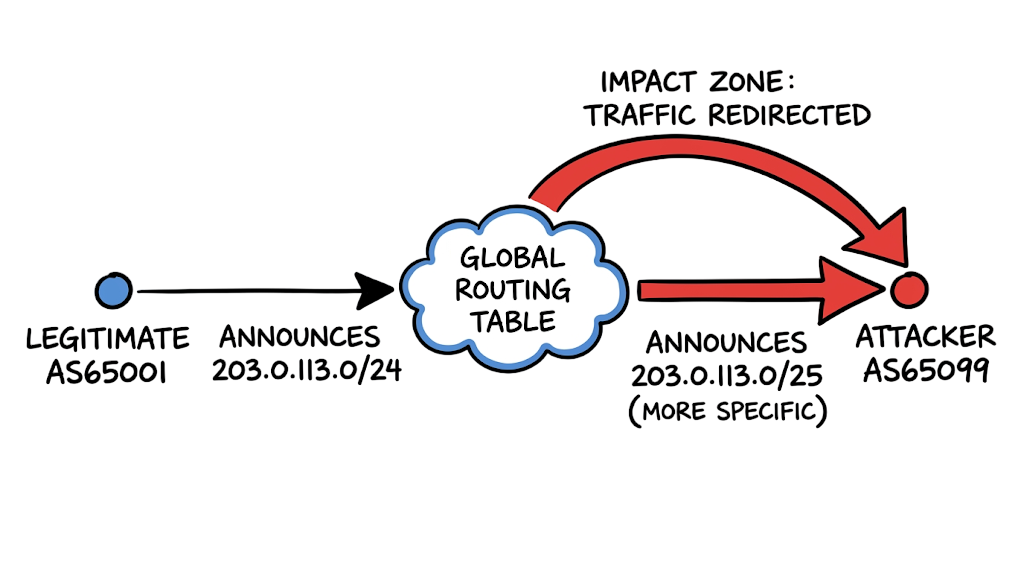
BGP Hijacking Technical Flow and Attack Architecture
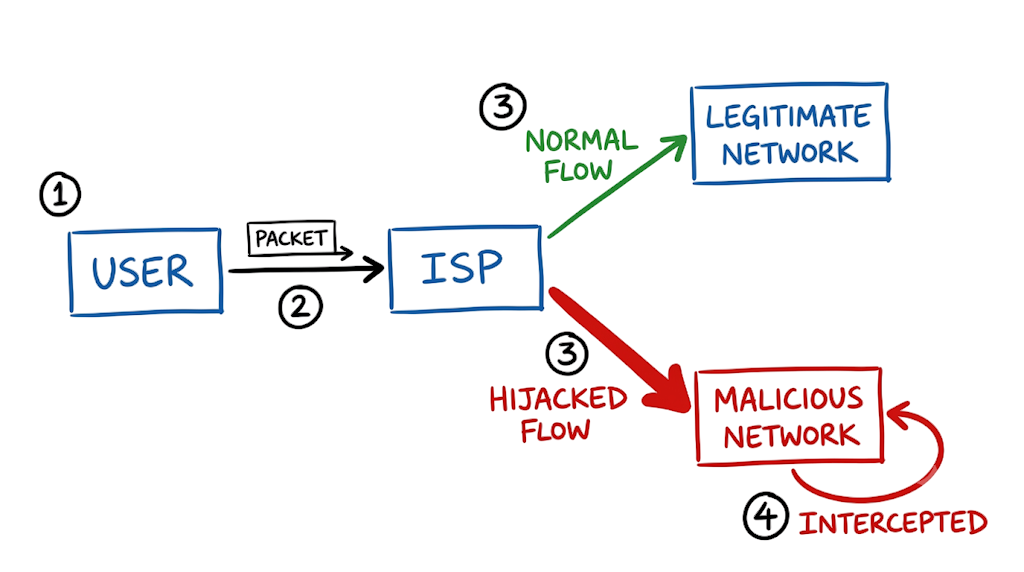
The BGP hijacking attack begins when a legitimate organization advertises its IP prefix to an upstream Internet Service Provider (ISP). The route is then propagated across the internet, and the global routing table recognizes the network as the correct destination for that IP range.
Next, an attacker configures a router to advertise a more specific portion of the same IP prefix. This malicious route advertisement is sent through the attacker’s provider using a BGP UPDATE message.
Once accepted, the false route spreads across the internet backbone. Routers worldwide receive both the legitimate and malicious route advertisements. Because the Border Gateway Protocol (BGP) typically prefers the most specific route, many routers select the attacker’s announcement as the preferred path.
As a result, traffic that should reach the legitimate network is redirected to the attacker’s infrastructure. This is the core mechanism behind how internet routes get stolen during a route hijacking attack.
The attacker can then choose from several options. They may drop the traffic completely to create a denial-of-service condition, inspect packets to collect information, or forward traffic to the real destination while secretly monitoring communications.
In advanced internet routing attacks, attackers often target dormant or poorly monitored IP address ranges. These prefixes may not generate immediate alerts, allowing the malicious route to remain active for a longer period.
This is why traditional security controls alone are not enough. Even strong firewall policies cannot protect traffic that never reaches the intended network perimeter. Effective BGP security best practices, including RPKI security, route validation, and continuous monitoring, are essential for detecting and preventing unauthorized route announcements.
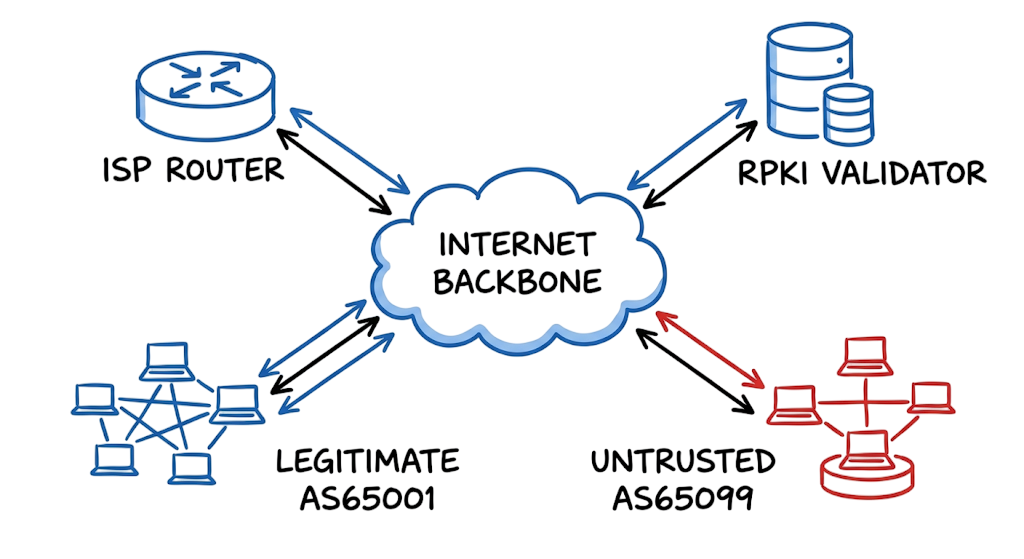
Key Components Behind Border Gateway Protocol Security
- Autonomous System (AS): A distinct network or group of networks managed by a single organization with a unified routing policy.
- AS Number: A unique numerical identifier assigned to an organization to represent its network on the public internet.
- IP Prefix: A specific block of internet protocol addresses that a network advertises to signal where traffic should go.
- Route Advertisement: A message sent between routers to declare reachability to specific IP ranges.
- Resource Public Key Infrastructure: A cryptographic framework that associates a route with its authorized origin to prevent unauthorized announcements.
Real World Example: Detecting BGP Hijacking How Internet Routes Get Stolen
Plaintext
BGP ROUTING ALERT: Prefix 203.0.113.0/24 (AS65001)
DETECTED NEW ORIGIN: AS65099
ANNOUNCED PREFIX: 203.0.113.0/25
STATUS: HIJACK SUSPECTED
PATH: 64496 64511 65099
During a routing security audit, we encountered a real-world example of BGP hijacking that highlighted how quickly internet routing can be manipulated. Our monitoring platform generated an alert indicating that one of our public IP prefixes was suddenly being advertised by an unknown Autonomous System (AS).
The alert showed that the prefix was being announced as a more specific subnet. Because the Border Gateway Protocol (BGP) prefers the most specific route, routers across the internet automatically selected the unauthorized advertisement over our legitimate route.
As the malicious route propagated, traffic intended for our infrastructure began flowing through a foreign network provider. This type of route hijacking attack can redirect sensitive business traffic without triggering traditional security controls.
To contain the incident, we immediately advertised a matching specific prefix and coordinated with our upstream providers to block the unauthorized route announcement. The response required close collaboration between network operations and security teams to restore normal traffic flow.
This experience reinforced an important lesson about how internet routes get stolen. Even a short-lived internet routing attack can disrupt services, impact customer transactions, and expose sensitive data if it is not detected quickly.
If you detect unexpected route advertisements, unfamiliar AS numbers, or sudden changes in traffic paths, treat the event as a potential security incident. Fast detection, proper BGP security best practices, and continuous route monitoring are critical to minimizing the impact of a BGP hijacking attack.
Practical Implementation of BGP Security Controls
- Generate cryptographic material for your IP prefixes using your regional internet registry portal to prove ownership conclusively to the rest of the world.
- Configure your edge routers to validate inbound routing updates against the cryptographic records to reject unauthorized origins automatically.
- Apply strict prefix filters on all peer connections to ensure you only accept routes that the neighbor is explicitly authorized to send.
- Establish continuous monitoring on your advertised subnets using public observation tools to detect unauthorized announcements immediately upon broadcast.
- Document emergency contact procedures for your upstream internet service providers so you can escalate unauthorized advertisements without delay.
- Implement automated alerting mechanisms that trigger incidents in your security operations center whenever route paths change unexpectedly.
- Conduct regular audits of your routing tables to confirm that no stale entries exist which could be exploited by an adversary later.
- Deploy route origin validation across all core routers to ensure consistency in how invalid routes are dropped throughout your network topology.
Advantages and Limitations of BGP Security Mechanisms
Implementing BGP security best practices provides a strong defense against unauthorized route announcements and many forms of BGP hijacking. Technologies such as RPKI security and Route Origin Validation (ROV) help organizations verify whether a network is authorized to advertise a specific IP prefix.
Advantages of BGP Security Controls
Automatic Route Validation
Routers can automatically reject invalid route advertisements before they affect network traffic. This reduces the risk of successful route hijacking attacks.
Improved Routing Visibility
Network administrators gain better visibility into which Autonomous Systems (AS) are authorized to announce their IP prefixes.
Stronger Protection Against BGP Hijacking
RPKI and route validation make it significantly harder for attackers to redirect traffic using unauthorized route advertisements.
Enhanced Internet Routing Security
Organizations can improve the reliability and trustworthiness of their internet routing infrastructure by validating route origins.
Limitations of BGP Security Controls
Limited Global Adoption
The effectiveness of RPKI security depends on widespread adoption. If intermediate networks do not perform route validation, traffic may still be vulnerable to internet routing attacks.
Does Not Fully Prevent Route Leaks
Route Origin Validation verifies who owns a prefix, but it does not completely stop BGP route leaks, where an authorized network accidentally advertises routes to the wrong peers.
Operational Complexity
Deploying and maintaining routing security controls requires careful planning, documentation, and ongoing management.
Risk of Self-Inflicted Outages
If routing changes are made without updating the corresponding RPKI records, legitimate route announcements may be marked as invalid and dropped by secure networks. This can result in service disruptions and connectivity issues.
While BGP security best practices significantly reduce the risk of BGP hijacking, organizations should understand that no single control provides complete protection. A combination of route validation, monitoring, filtering, and operational discipline is required to secure modern internet routing infrastructure.
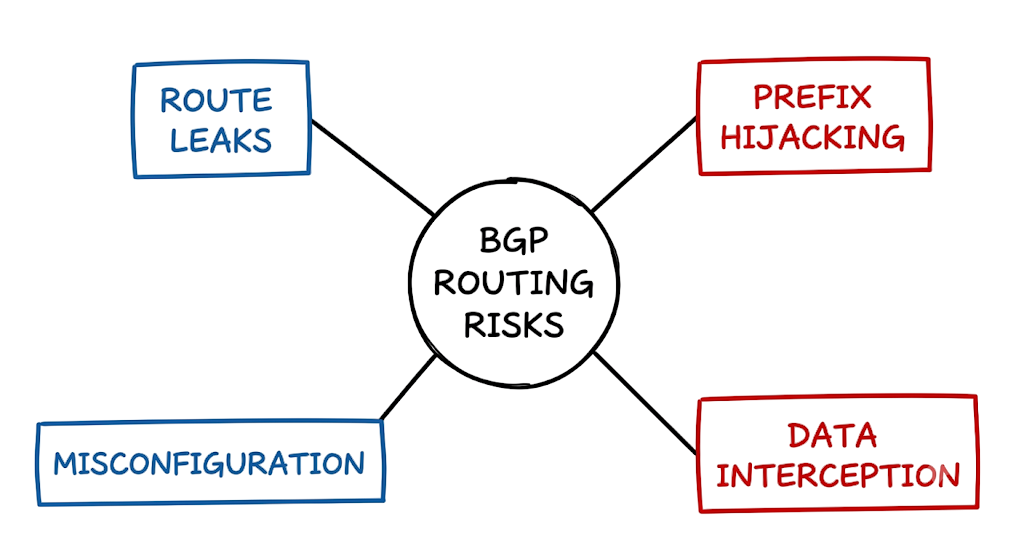
| Threat Type | Primary Mechanism | Intent | Cryptographic Defense |
| BGP Hijacking How Internet Routes Get Stolen | Unauthorized prefix announcement | Usually malicious | Effective with origin validation |
| Route Leak | Accidental route propagation | Usually accidental | Partially effective |
| DNS Hijacking | Modifying domain name resolution | Malicious | Domain Name System Security Extensions |
Common BGP Hijacking Mistakes That Engineers Make
Even experienced network engineers can make mistakes that increase the risk of BGP hijacking and other internet routing attacks. Most incidents are not caused by sophisticated attackers but by weak routing policies, poor monitoring, or incorrect assumptions.
1. Trusting Default Routing Configurations
One of the most common mistakes is accepting all route advertisements from an Internet Service Provider (ISP) without proper validation.
Many organizations assume their provider automatically filters malicious routes. In reality, some providers prioritize connectivity over security and may pass along unauthorized route announcements.
2. Failing to Validate BGP Routes
Organizations often rely solely on trust rather than implementing RPKI security and Route Origin Validation (ROV).
Without route validation, routers may accept malicious or incorrect route advertisements, increasing the risk of a successful route hijacking attack.
3. Ignoring Unused IP Address Space
Many companies only monitor active IP prefixes and forget about dormant address ranges.
Attackers frequently target unused IP blocks because unauthorized announcements involving them are less likely to generate alerts. These stolen routes can be used for spam campaigns, phishing infrastructure, or malware distribution.
4. Lack of Route Monitoring
Some organizations only discover routing issues after users begin reporting outages.
Continuous monitoring is essential for detecting suspicious route advertisements, unfamiliar Autonomous Systems (AS), and unexpected path changes before they impact business operations.
5. Overreliance on Perimeter Security
Traditional security controls such as firewalls, IDS, and web gateways cannot protect traffic that never reaches the intended network.
A BGP hijacking attack occurs at the internet routing layer, making BGP security best practices just as important as firewall and endpoint security controls.
6. Poor Coordination Between Network and Security Teams
Routing changes are sometimes implemented without notifying security teams.
This can result in outdated route validation records, incorrect filtering policies, and troubleshooting delays during routing incidents.
7. Not Auditing Routing Policies Regularly
Routing environments change over time. New providers, new prefixes, and updated network architectures can create security gaps if policies are not reviewed regularly.
Periodic audits help identify outdated configurations and reduce the risk of network route manipulation.
Avoiding these mistakes can significantly improve Border Gateway Protocol security and reduce the likelihood of a successful BGP hijacking incident.
BGP Security Best Practices to Prevent Route Hijacking Attacks
Protecting against BGP hijacking requires more than basic routing configurations. Organizations should combine route validation, monitoring, filtering, and operational procedures to strengthen Border Gateway Protocol security.
1. Implement RPKI Security
The first step is to deploy RPKI security and create Route Origin Authorizations (ROAs) for your public IP prefixes.
RPKI provides cryptographic proof that your organization is authorized to advertise specific routes, helping prevent unauthorized route announcements.
2. Configure Strict Prefix Filtering
Apply precise prefix filters on all BGP peer connections.
If a customer, partner, or service provider is authorized to advertise only a specific subnet, your routers should reject anything outside that approved range. This reduces the risk of route hijacking attacks and accidental route leaks.
3. Enable Continuous Route Monitoring
Monitor your public IP prefixes and routing paths continuously.
Unexpected route changes, new origin AS numbers, or unusual path modifications can be early indicators of internet routing attacks or network misconfigurations.
4. Integrate Routing Alerts with Your SIEM
Routing events should be treated as security events.
Forward BGP-related alerts to platforms such as Microsoft Sentinel, Splunk, QRadar, or other SIEM solutions so security teams can investigate suspicious activity quickly.
5. Establish Strong ISP Communication Channels
Maintain up-to-date contact information for upstream providers and network peers.
During a BGP hijacking incident, rapid communication with service providers can significantly reduce downtime and limit the impact of unauthorized route advertisements.
6. Follow Industry Routing Security Standards
Review guidance from industry initiatives such as MANRS (Mutually Agreed Norms for Routing Security).
Following recognized routing security standards helps improve resilience against network route manipulation and strengthens overall internet routing security.
7. Audit Routing Policies Regularly
Conduct periodic reviews of routing policies, prefix filters, and RPKI records.
Regular audits help identify outdated configurations and ensure that routing security controls remain effective as the network grows.
8. Treat Routing Anomalies as Security Incidents
Sudden traffic shifts, unexpected latency increases, or unusual route changes should never be ignored.
These symptoms may indicate a BGP hijacking attack, route leak, or other routing-related security issue. Early investigation can prevent major service disruptions.
By implementing these BGP security best practices, organizations can significantly reduce the risk of how internet routes get stolen, improve routing resilience, and strengthen the security of their internet-facing infrastructure.
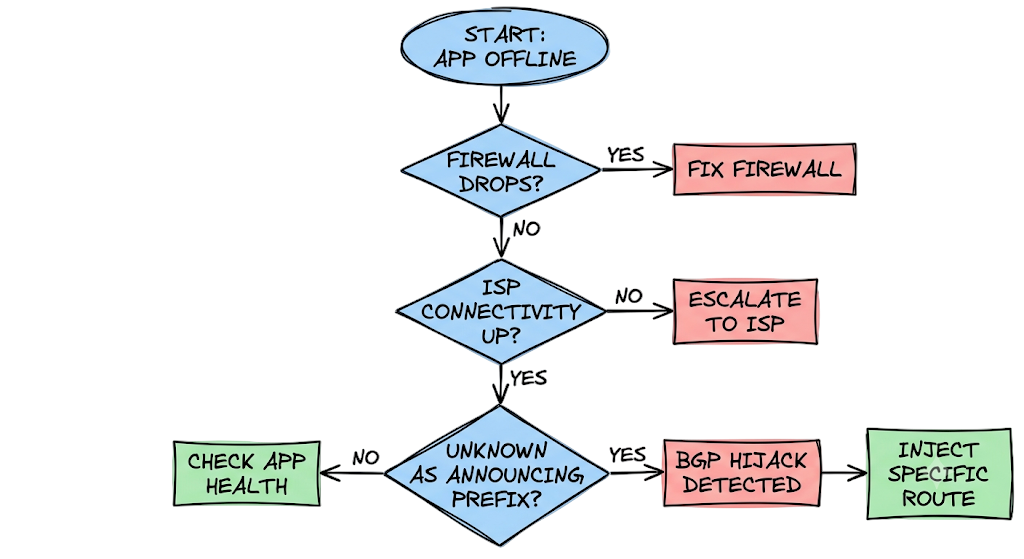
Troubleshooting a BGP Hijacking Incident in Enterprise Networks
Problem
Users in Europe suddenly report that they cannot access the organization’s online banking application. However, users in Asia and North America can access the service without any issues.
At first glance, the issue appears to be related to a failed load balancer, firewall policy, or application outage.
Initial Investigation
The operations team begins troubleshooting the application infrastructure by checking:
- Load balancer health
- Firewall logs
- Server availability
- Application performance metrics
All systems appear healthy, but European users continue to experience connectivity problems.
Network Analysis
The network team performs additional checks and collects:
- Traceroute results from affected regions
- BGP route advertisements
- Routing table outputs
- ISP connectivity information
During the investigation, engineers discover that traffic from Europe is following an unexpected routing path.
Root Cause
A regional Internet Service Provider (ISP) is incorrectly advertising a route to the banking application’s IP subnet.
Because the Border Gateway Protocol (BGP) selected the incorrect route, traffic from European users is being redirected and dropped before reaching the legitimate infrastructure.
This type of BGP hijacking or routing misconfiguration is a common cause of regional connectivity outages.
Verification
To confirm the issue, engineers collect evidence including:
show ip bgp
traceroute
show bgp ipv4 unicast
The routing data confirms that an unauthorized or incorrect route advertisement is influencing traffic flow.
Resolution
The network team immediately contacts its upstream providers and shares the routing evidence.
To restore connectivity quickly, the organization advertises a more specific route to reclaim traffic and ensure routers prefer the legitimate path.
At the same time, the offending provider updates its routing tables and withdraws the incorrect advertisement.
Result
Traffic gradually returns to the correct network path, and European users regain access to the banking application.
This scenario demonstrates how BGP hijacking attacks, internet routing attacks, and route misconfigurations can cause service disruptions even when applications, servers, and firewalls are functioning normally.
The key lesson is that not every outage originates inside your network. Sometimes the problem exists within the global internet routing infrastructure itself.
BGP Hijacking Interview Questions and Answers
Q: What is the primary difference between a route leak and a hijack?
A: A route leak is typically an accidental misconfiguration where legitimate routes are forwarded to unintended peers, violating established routing policies. A hijack is a deliberate and unauthorized claim of ownership over an IP prefix to steal or disrupt traffic. Leaks often result in poor performance or latency, while hijacks result in complete traffic redirection. Both require strict filtering to prevent, but they originate from entirely different intentions.
Q: How does the routing algorithm decide which path to take during an attack?
A: The protocol will always prefer the most specific IP prefix available in the routing table. If an attacker advertises a smaller subnet than the legitimate owner, all traffic for that specific subnet will route to the attacker. When specificity is identical, the router will evaluate the path length and prefer the shortest distance. Attackers know this and purposely craft announcements that exploit these fundamental mathematical rules.
Q: Why is origin validation insufficient to stop all routing attacks?
A: Origin validation only verifies the network originating the prefix against cryptographic records. It does not validate the entire path that the route traveled. This leaves the network vulnerable to attacks where the adversary fakes the path but presents a valid origin. True security requires full path validation, which is currently seeing limited adoption globally.
Q: How should an organization monitor for unauthorized route changes?
A: Engineers should use public routing observation data feeds to watch their owned IP blocks continuously. These feeds collect routing data from hundreds of vantage points globally. They can generate instant alerts if an unauthorized AS number suddenly begins advertising the organization prefixes. Relying solely on internal logs will not show you how the rest of the internet views your network.
Q: What immediate action should you take if your route is stolen?
A: You must immediately advertise a more specific prefix from your own infrastructure to reclaim the traffic mathematically. Then, you must contact your upstream internet providers to block the offending autonomous system at the perimeter. Speed is critical during this phase, as every second the attacker holds the route allows them to intercept sensitive communications. You must act before attempting to investigate the attacker identity.
Future Trends in BGP Security and Internet Routing Protection (2026)
The future of BGP security is moving toward stronger validation, greater automation, and stricter regulatory requirements. As internet routing attacks continue to impact critical infrastructure, governments, regulators, and service providers are investing more resources in securing the global routing ecosystem.
Increased Adoption of RPKI Security
More Internet Service Providers (ISPs), cloud providers, and enterprise networks are implementing RPKI security and Route Origin Validation (ROV).
As adoption grows, unauthorized route announcements and many forms of BGP hijacking will become more difficult to execute successfully.
Automated Route Validation
Large internet exchanges and backbone providers are increasingly deploying automated validation systems.
These systems can reject invalid route advertisements automatically, reducing the risk of route hijacking attacks and accidental routing misconfigurations.
Stronger Regulatory Requirements
Financial institutions, telecom providers, and critical infrastructure organizations are facing greater scrutiny from regulators.
Many cybersecurity frameworks now expect organizations to demonstrate resilience against network route manipulation, routing outages, and external routing threats.
Path Validation Technologies
The industry is gradually moving beyond origin validation toward full path validation mechanisms.
Future technologies aim to verify not only who owns a route but also every network that traffic passes through. This could significantly reduce opportunities for attackers to manipulate internet routing paths.
AI-Powered Routing Security Monitoring
Security teams are beginning to use AI and machine learning to detect unusual routing behavior.
Advanced analytics can identify suspicious route changes, unauthorized AS announcements, and emerging internet routing attacks much faster than traditional monitoring methods.
Preparing for the Future
Organizations should begin evaluating whether their routers, network infrastructure, and security tools support modern routing security standards.
Investing in BGP security best practices, route validation, and continuous monitoring today will help organizations stay ahead of future compliance requirements and evolving routing threats.
As internet infrastructure becomes more interconnected, securing how internet routes get stolen will remain a top priority for network and cybersecurity professionals worldwide.
Frequently Asked Questions About BGP Hijacking
Are internet routing attacks illegal?
Yes. Deliberately manipulating routing infrastructure to intercept traffic or cause outages violates cybercrime laws in most jurisdictions. Law enforcement agencies treat these incidents as serious attacks on critical infrastructure.
Can an attacker steal data during a routing hijack?
Yes. If the attacker chooses to intercept and forward the traffic, they can analyze the unencrypted payloads. This allows them to capture plaintext credentials and session data before routing the victim to the real destination.
Does encryption prevent traffic redirection?
No. Transport layer security encrypts the data payload, but it does not dictate how the packets travel across the physical network. The attacker will still receive the encrypted packets, even if they cannot easily read the contents.
How long does an unauthorized route announcement last?
It lasts until the legitimate owner detects the issue and takes corrective action. Some attacks last only minutes to steal specific data, while others persist for hours if the victim lacks proper monitoring.
Why do internet service providers accept false routes?
The protocol was built decades ago on a foundation of implicit trust. Many older network infrastructures lack the processing power or administrative configuration to cryptographically verify every single route update they receive.
What is the most effective immediate defense?
The most effective defense combines cryptographic origin validation with strict prefix filtering on all network borders. You must deploy both controls to secure your infrastructure against unauthorized routing claims.
Conclusion: Protecting Networks Against BGP Hijacking
Understanding BGP Hijacking How Internet Routes Get Stolen is essential for every network engineer, ISP, cloud provider, and cybersecurity professional. This route hijacking attack demonstrates that the global internet still depends heavily on trust between autonomous systems. A single unauthorized BGP route advertisement can redirect legitimate traffic, interrupt critical business services, and expose sensitive information through network route manipulation.
Improving Border Gateway Protocol security requires more than simply deploying routing hardware. Organizations should implement RPKI security, enable Route Origin Validation (ROV), apply strict prefix filtering, and continuously monitor BGP announcements for unexpected routing changes. These controls significantly reduce the risk of BGP Hijacking How Internet Routes Get Stolen, but they are effective only when properly configured, regularly audited, and consistently maintained.
Organizations should never assume that an ISP or cloud provider will automatically prevent every route hijacking attack. Security and network operations teams must actively verify route ownership, monitor for suspicious path changes, and treat any unexpected network route manipulation as a potential security incident requiring immediate investigation.
If your organization owns public IP address space, now is the time to strengthen your Border Gateway Protocol security posture. Review your RPKI security records, validate all route advertisements, enable Route Origin Validation wherever possible, and ensure your monitoring tools can quickly detect indicators of BGP Hijacking How Internet Routes Get Stolen before attackers can disrupt services or intercept traffic.
The internet continues to rely on trust between networks. Modern Border Gateway Protocol security relies on continuously verifying that trust through RPKI security, proactive monitoring, and rapid detection of network route manipulation and every potential route hijacking attack. By understanding BGP Hijacking How Internet Routes Get Stolen, organizations can build more resilient routing infrastructures and better defend the integrity of the global internet.
Top 5 Internal Links
- OSI Model Guide: 7 Powerful Layers Every Engineer Must Know
- 4 Secrets of the TCP IP Model for Security Analysts
- Complete Network Security Basics Guide for Beginners 2026
- What is Firewall in Cybersecurity? Types, Examples and How it Works in 2026
- Zero Trust Security in 2026: Architecture, Real Examples, and Implementation Guide
If you want more cybersecurity-focused links instead of networking-focused links:
- What Is Cybersecurity and Why It Is Important Today
- Security Information and Event Management: Complete SIEM Guide 2026
For a BGP Hijacking article, use authoritative networking and security sources. Limit it to these external links:
- MANRS (Mutually Agreed Norms for Routing Security)
- Cloudflare Learning Center: BGP Hijacking
- Internet Society Resource Public Key Infrastructure (RPKI)
- RIPE NCC RPKI Documentation
- IETF BGP Security Working Group