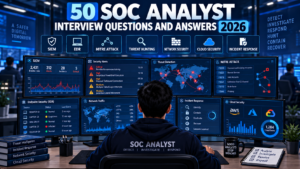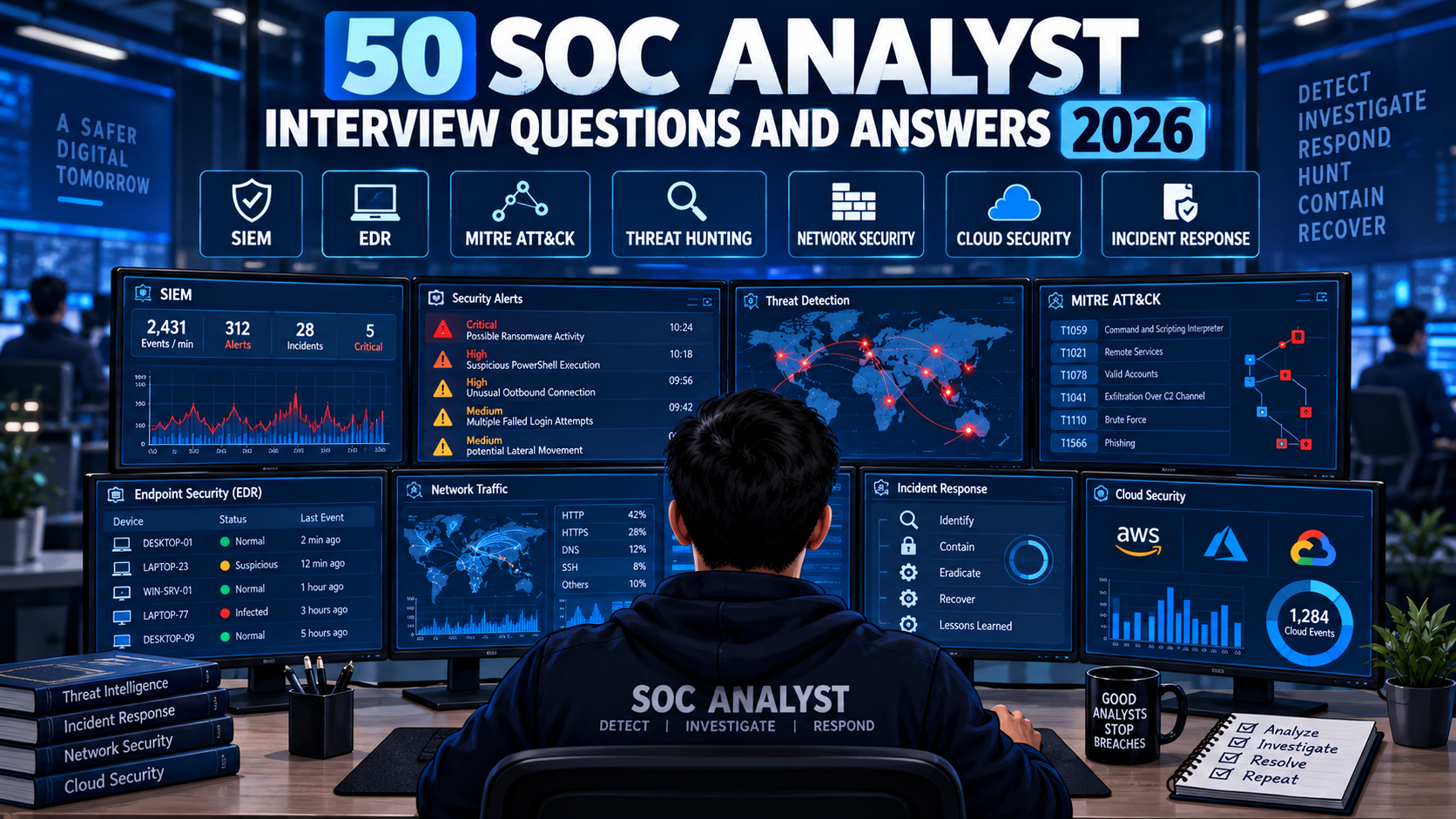
Preparing for a SOC Analyst interview requires a strong understanding of security monitoring, SIEM, incident response, threat hunting, network security, endpoint security, and cloud security. These SOC Analyst Interview Questions and Answers 2026 cover fundamental concepts, technical questions, troubleshooting scenarios, and modern security operations topics to help you prepare for your next cybersecurity interview.
1. What is a SOC?
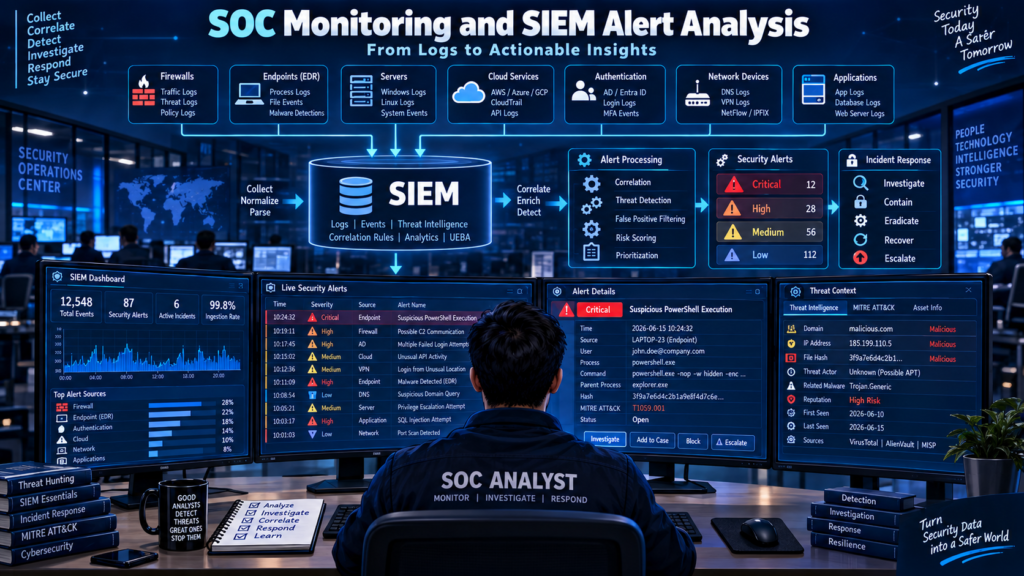
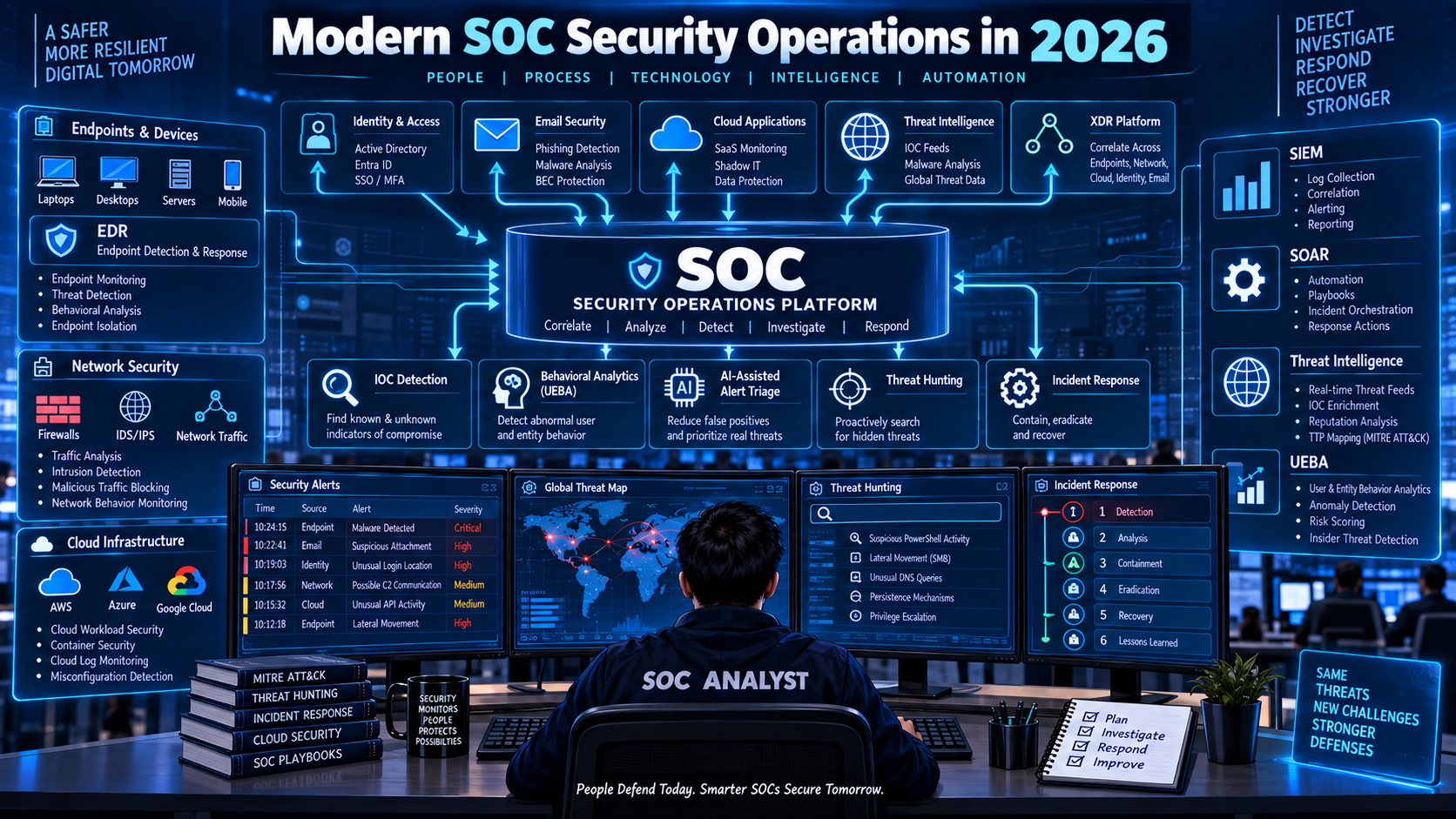
A Security Operations Center (SOC) is a centralized security function that monitors, detects, investigates, and responds to cybersecurity threats. SOC analysts use tools such as SIEM, EDR, firewalls, IDS/IPS, and threat intelligence platforms to identify and respond to suspicious activity.
2. What does a SOC Analyst do?
A SOC Analyst monitors security alerts, investigates suspicious activity, analyzes logs, identifies true and false positives, responds to incidents, documents findings, and escalates serious threats to the appropriate security team.
3. What is the difference between a False Positive and a False Negative?
A False Positive occurs when legitimate activity is incorrectly identified as malicious. A False Negative occurs when malicious activity is missed by a security system. False negatives can be dangerous because an actual attack may remain undetected.
SOC Analyst Interview Questions and Answers 2026
4. What is the Cyber Kill Chain?
The Cyber Kill Chain is a model developed by Lockheed Martin that describes seven stages of a cyberattack: Reconnaissance, Weaponization, Delivery, Exploitation, Installation, Command and Control, and Actions on Objectives.
5. What is MITRE ATT&CK?
MITRE ATT&CK is a knowledge base that documents real-world adversary tactics and techniques. SOC teams use it to understand attacker behavior, map alerts to techniques, develop detection rules, and identify gaps in security coverage.
6. What are the different SOC Analyst tiers?
Tier 1 focuses on alert monitoring, initial investigation, triage, and escalation. Tier 2 performs detailed investigations, containment, and incident response. Tier 3 handles advanced threat hunting, detection engineering, malware analysis, and forensic investigations.
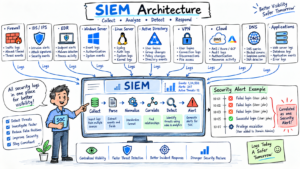
7. What is a SIEM?
A Security Information and Event Management (SIEM) platform collects and analyzes security logs from different sources. It normalizes and correlates events to identify suspicious activity and generate security alerts.
SOC Analyst Interview Questions and Answers 2026
8. What is Defense in Depth?
Defense in Depth is a security strategy that uses multiple security controls, such as firewalls, EDR, MFA, network segmentation, and monitoring. If one control fails, other controls provide additional protection.
9. What is Zero Trust?
Zero Trust is a security model based on continuously verifying users, devices, applications, and access requests instead of automatically trusting traffic because it originates from an internal network.
10. What is the difference between IDS and IPS?
An IDS monitors network traffic and generates alerts when it detects suspicious activity. An IPS operates inline and can actively block or drop malicious traffic.
11. What is alert triage?
Alert triage is the process of reviewing a security alert, determining its severity and validity, gathering context, and deciding whether it should be closed, investigated further, or escalated.
12. How do you investigate a high-severity alert?
First, identify the affected user and asset. Review the alert details, search for related events, check SIEM and EDR telemetry, investigate IP addresses, domains, hashes, and processes, determine whether it is a true positive, and contain or escalate the incident when necessary.
13. What is log correlation?
Log correlation means connecting events from multiple sources to identify a larger security incident. For example, a VPN login, suspicious PowerShell execution, and unusual network traffic from the same endpoint may indicate a compromised system.
SOC Analyst Interview Questions and Answers 2026
14. What logs are commonly collected in a SOC?
Common log sources include Windows Event Logs, Linux logs, firewall logs, proxy logs, DNS logs, VPN logs, authentication logs, EDR telemetry, cloud audit logs, email security logs, and application logs.
15. What is a security event?
A security event is an observable activity that may have security relevance, such as a failed login, firewall connection, process execution, or authentication attempt. A security event does not automatically mean a security incident occurred.
16. What is a security alert?
A security alert is a notification generated when a security tool detects activity that matches a defined rule, threshold, behavioral pattern, or threat indicator.
17. What is alert fatigue?
Alert fatigue occurs when analysts receive a large number of alerts, many of which are low-risk or false positives. Excessive alerts can make it harder to identify genuine threats. Detection tuning and alert prioritization can help reduce alert fatigue.
SOC Analyst Interview Questions and Answers 2026
18. Hash vs. IP address: Which is useful in threat hunting?
A file hash provides a fingerprint for a specific file, while an IP address identifies network infrastructure. Hashes can change when a file is modified, while IP addresses may be shared, reassigned, or associated with multiple services.
19. What is a malware beacon?
A malware beacon is periodic communication from a compromised system to attacker-controlled Command and Control infrastructure. Regular communication intervals can sometimes indicate automated C2 activity.
20. What would you do if a successful login alert is denied by the user?
Treat the activity as potentially unauthorized. Verify the source IP and location, review authentication and MFA logs, investigate session activity, check endpoint activity, look for lateral movement, and follow the organization’s account-compromise procedure.
21. Explain the TCP three-way handshake.
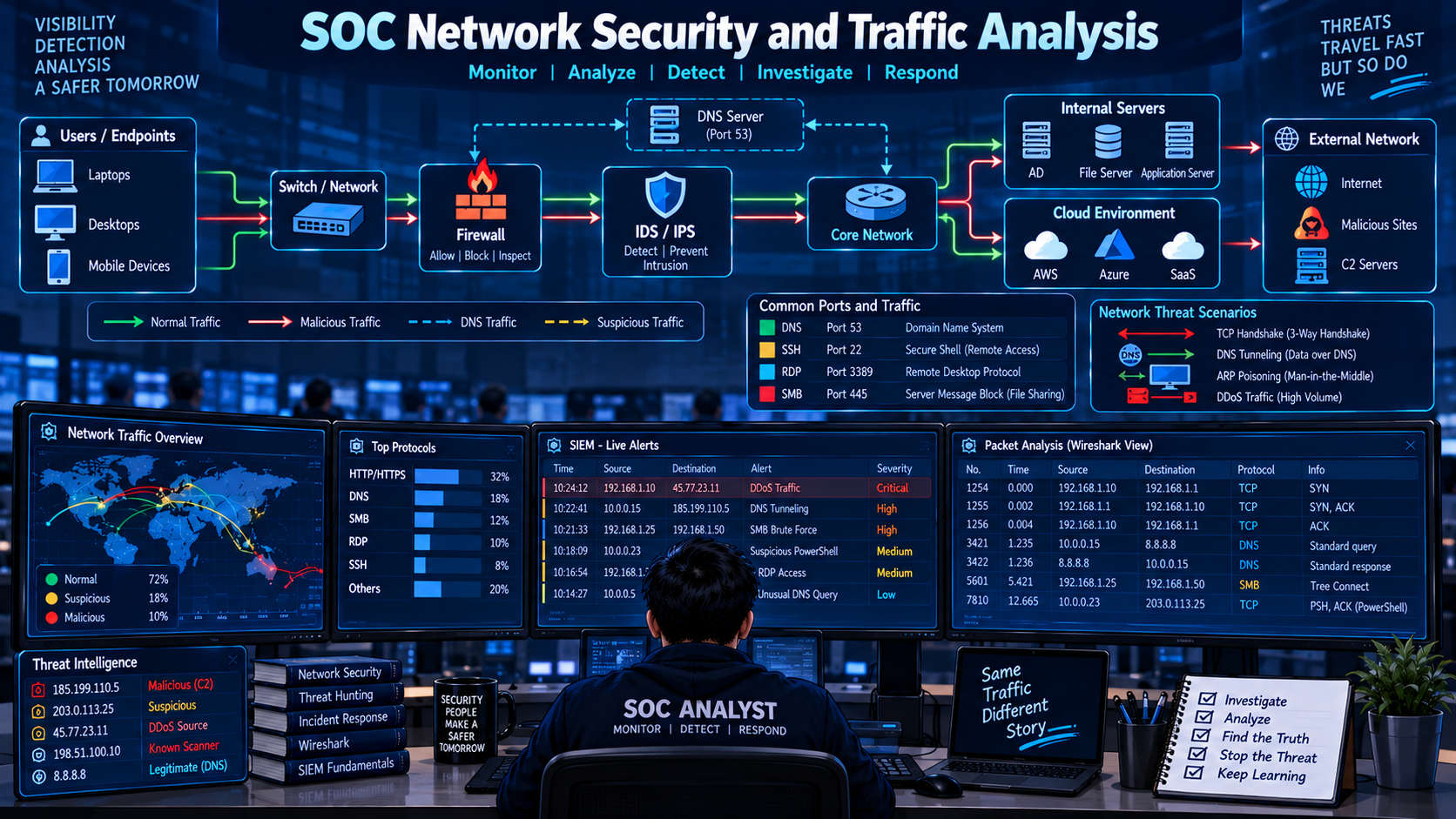
The TCP three-way handshake consists of three steps:
- SYN: The client requests a connection.
- SYN-ACK: The server acknowledges the request.
- ACK: The client confirms the connection.
This establishes a TCP connection between the systems.
22. What is ARP poisoning?
ARP poisoning occurs when an attacker sends fraudulent ARP information to associate their MAC address with another device’s IP address. This can allow the attacker to intercept network traffic.
SOC Analyst Interview Questions and Answers 2026
23. What is DNS tunneling?
DNS tunneling uses DNS queries and responses to transfer data or communicate with attacker-controlled infrastructure. SOC analysts can look for unusually long or high-entropy domain names, abnormal query volumes, and suspicious TXT-record activity.
24. What is the difference between TCP and UDP?
TCP is connection-oriented and provides reliable delivery. UDP is connectionless and does not guarantee delivery. TCP is commonly used for HTTPS and SSH, while UDP is commonly used for DNS and real-time applications.
25. What are the default ports for SSH, DNS, SMB, and RDP?
- SSH: Port 22
- DNS: Port 53
- SMB: Port 445
- RDP: Port 3389
SOC analysts monitor these ports for unusual or malicious activity.
SOC Analyst Interview Questions and Answers 2026
26. How can you identify a DDoS attack from network logs?
Look for an unusual increase in traffic volume, large numbers of source IP addresses, repeated requests to the same target, abnormal connection rates, and protocol floods such as SYN or UDP floods.
27. What is the difference between a firewall and a WAF?
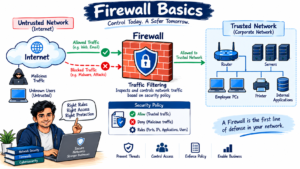
A network firewall primarily controls traffic using IP addresses, ports, and protocols. A Web Application Firewall (WAF) analyzes HTTP/HTTPS traffic and helps protect web applications from attacks such as SQL injection and cross-site scripting.
28. What is network segmentation?
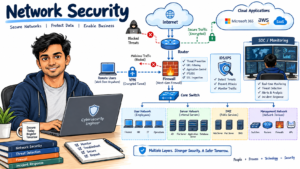
Network segmentation divides a network into separate security zones. For example, production servers, employee systems, and databases can be separated to restrict unauthorized lateral movement.
29. What is a rogue access point?
A rogue access point is an unauthorized wireless access point connected to an organization’s network. It can create an unauthorized entry point into the corporate environment.
SOC Analyst Interview Questions and Answers 2026
30. Why is outbound SMB traffic to the internet suspicious?
SMB commonly uses TCP port 445. Unexpected outbound SMB connections to external systems can indicate malicious activity, lateral movement, data transfer, or attempted exploitation. The SOC analyst should investigate the source endpoint, destination, process, and surrounding events.
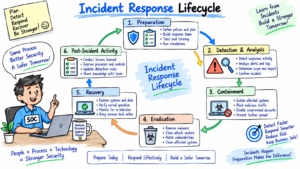
31. What are the phases of incident response?
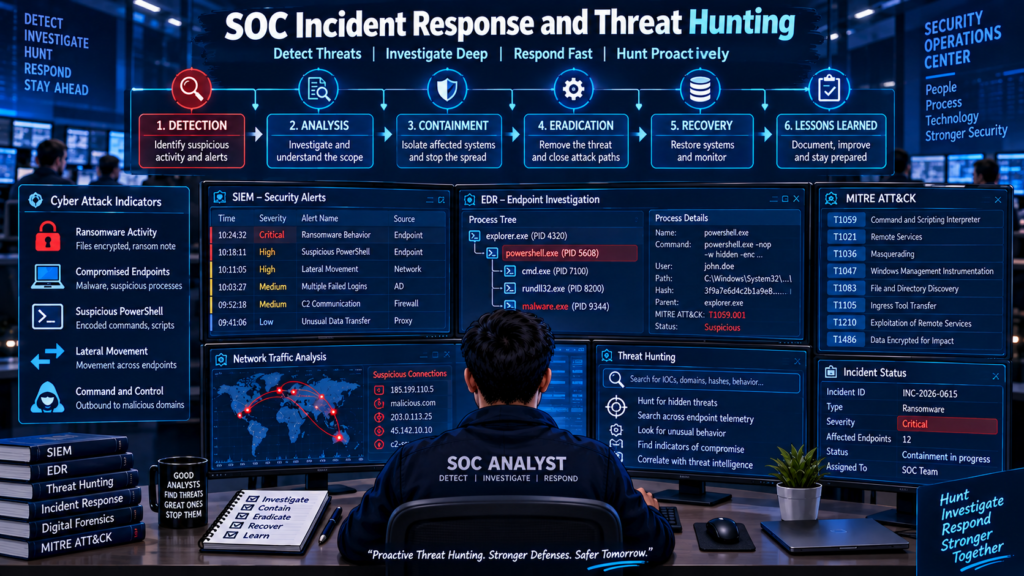
A commonly used incident response lifecycle includes:
- Preparation
- Detection and Analysis
- Containment, Eradication, and Recovery
- Post-Incident Activity
32. How would you respond to a ransomware alert?
First, isolate the affected endpoint and preserve relevant evidence. Then identify affected systems, determine the initial infection vector, investigate lateral movement, contain additional systems, eradicate the malware, recover from clean backups when appropriate, and document the incident.
33. What is lateral movement?
Lateral movement occurs when an attacker moves from an initially compromised system to other systems within an environment. Attackers may use stolen credentials, remote services, administrative shares, or other techniques.
SOC Analyst Interview Questions and Answers 2026
34. What is credential dumping?
Credential dumping is the process of obtaining authentication material such as password hashes or credentials from a compromised system. SOC analysts can investigate suspicious processes, authentication events, EDR telemetry, and access to credential-related processes.
35. What is Pass-the-Hash?
Pass-the-Hash is an attack technique where an attacker uses a captured NTLM password hash to authenticate to another system without knowing the user’s plaintext password.
36. What is Living off the Land?
Living off the Land (LotL) refers to attackers using legitimate tools already available on a system instead of introducing custom malware. Examples include PowerShell, WMI, and PsExec.
SOC Analyst Interview Questions and Answers 2026
37. What is Command and Control?
Command and Control (C2) is the communication mechanism attackers use to interact with compromised systems. C2 can allow attackers to send commands, maintain access, and transfer information.
38. How do you investigate suspicious PowerShell activity?
Review PowerShell logs, command-line arguments, parent processes, user context, network connections, and EDR telemetry. Suspicious indicators can include encoded commands, unusual downloads, Office applications spawning PowerShell, and attempts to bypass security controls.
39. What is threat hunting?
Threat hunting is a proactive security activity where analysts search the environment for signs of malicious activity that automated security controls may not have detected. Analysts can hunt using IOCs, TTPs, unusual authentication, network activity, and endpoint telemetry.
SOC Analyst Interview Questions and Answers 2026
40. What is the difference between detection and threat hunting?
Detection generally relies on predefined rules, signatures, or behavioral analytics to identify suspicious activity. Threat hunting is a proactive investigation where analysts search security telemetry for previously unidentified threats.
41. How is cloud logging different from traditional on-premises logging?
Traditional environments often focus on operating-system, network, and hardware logs. Cloud environments also require control-plane and API audit logs that record activities such as who accessed or changed cloud resources.
SOC Analyst Interview Questions and Answers 2026
42. What is impossible travel?
Impossible travel is an identity-security anomaly where the same account appears to authenticate from geographically distant locations within a time period that would make physical travel unrealistic. For example, a login from New York followed by another login from London within 30 minutes could trigger an alert.
43. What is a supply chain attack?
A supply chain attack occurs when attackers compromise a trusted vendor, software component, service, or update mechanism and use that relationship to reach downstream organizations. The SolarWinds compromise is a well-known example.
44. How do you monitor data exfiltration?
Monitor outbound traffic volume, unusual destinations, abnormal protocols, DNS activity, cloud storage transfers, large downloads, DLP alerts, and unusual user behavior. Compare the activity with normal user and system behavior.
SOC Analyst Interview Questions and Answers 2026
45. What is Threat Intelligence?
Threat intelligence is security information about threats, attackers, infrastructure, indicators, and TTPs. SOC teams use it to enrich alerts, investigate suspicious indicators, improve detection rules, and support threat hunting.
46. What is the difference between IOC and IOA?
An IOC (Indicator of Compromise) is evidence associated with potentially malicious activity, such as a malicious hash, IP address, or domain.
An IOA (Indicator of Attack) focuses on attacker behavior or activity patterns, such as credential dumping, process injection, or suspicious lateral movement.
47. What is the difference between EDR and XDR?
EDR primarily monitors and protects endpoints by collecting endpoint telemetry and detecting suspicious behavior. XDR combines security telemetry from multiple areas, such as endpoints, networks, cloud services, email, and identity, to correlate related activity.
48. What is UEBA?
User and Entity Behavior Analytics (UEBA) analyzes normal behavior patterns for users and entities such as devices or applications. It can identify anomalies such as unusual login locations, abnormal access patterns, or unexpected data usage.
SOC Analyst Interview Questions and Answers 2026
49. How would you investigate a suspected compromised user account?
Review authentication history, source IP addresses, login locations, MFA events, endpoint activity, email activity, privilege changes, and possible lateral movement. If required, revoke sessions, reset credentials, contain the account, and escalate the incident according to the organization’s response process.
50. How is the SOC evolving in 2026?
Modern SOC operations increasingly use automation, behavioral analytics, AI-assisted investigation, cloud security monitoring, identity telemetry, detection engineering, and automated response. These technologies can reduce repetitive alert-triage work and allow analysts to focus more on complex investigations, threat hunting, and detection development.
SOC Analyst Interview Questions and Answers 2026
Related Cybersecurity Articles
Powerful EDR vs XDR vs MDR Comparison: Which Wins in 2026?
Security Information and Event Management: Complete SIEM Guide 2026
Best SOC Analyst Roadmap 2026: Complete Guide to L1, L2, L3 Roles, Skills, and Tools
Essential Endpoint Security Guide 2026 for Every Organization
Network Segmentation Explained with Real-World Example
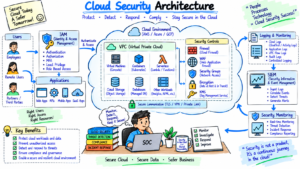
Cloud Security Basics 2026: Complete Beginner Guide
Identity and Access Management in 2026: A Practical Guide for Cloud Security Professionals
Zero Trust Security in 2026: Architecture, Real Examples, and Implementation Guide
How Ransomware Attacks Work in 2026 Explained
ARP Spoofing Attack Explained: 7 Ways to Stop ARP Cache Poisoning and MITM Attacks
DNS Tunneling: 10 Dangerous Ways Attackers Bypass Security Controls
Network Protocols and Ports: 10 Critical Security Facts
Useful Cybersecurity Resources
- MITRE ATT&CK
Use this for your MITRE ATT&CK question. MITRE describes ATT&CK as a knowledge base of adversary tactics and techniques used to support threat-informed defense.
MITRE ATT&CK - NIST Incident Response
Useful for your incident response questions. NIST’s current guidance is SP 800-61 Rev. 3, finalized in April 2025.
NIST Incident Response - NIST Cybersecurity Framework
Useful as a general cybersecurity reference for SOC and incident-response topics. NIST’s current incident-response guidance integrates with CSF 2.0.
NIST Cybersecurity Framework - CISA Incident Response Plan Basics
Useful for your incident response and ransomware-related sections. CISA’s guide covers preparation and actions during and after cybersecurity incidents.
CISA Incident Response Plan Basics
Disclaimer
The information provided in this SOC Analyst Interview Questions and Answers 2026 article is intended for educational and interview preparation purposes only. The questions and explanations are based on commonly used cybersecurity concepts, SOC practices, security monitoring, SIEM, incident response, threat hunting, network security, endpoint security, cloud security, and related technologies.
Cybersecurity tools, techniques, frameworks, and industry practices can change over time. Some organizations may use different procedures, technologies, terminology, or incident response processes. You should verify technical information with official documentation and your organization’s security policies before applying it in a production environment.
This article does not constitute professional cybersecurity, legal, compliance, or security consulting advice. TechNaga is not responsible for any loss, damage, security incident, or other consequence resulting from the use or misuse of the information provided in this article.
External resources are provided for educational and reference purposes. TechNaga does not claim ownership of third-party content and does not endorse any specific third-party product, service, or organization unless explicitly stated.
The SOC Analyst Interview Questions and Answers 2026 provided here are intended to help students, beginners, and cybersecurity professionals prepare for interviews and improve their understanding of SOC operations. Always follow your organization’s approved security procedures and obtain appropriate authorization before performing security testing or investigation activities.