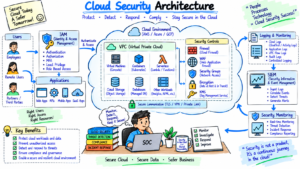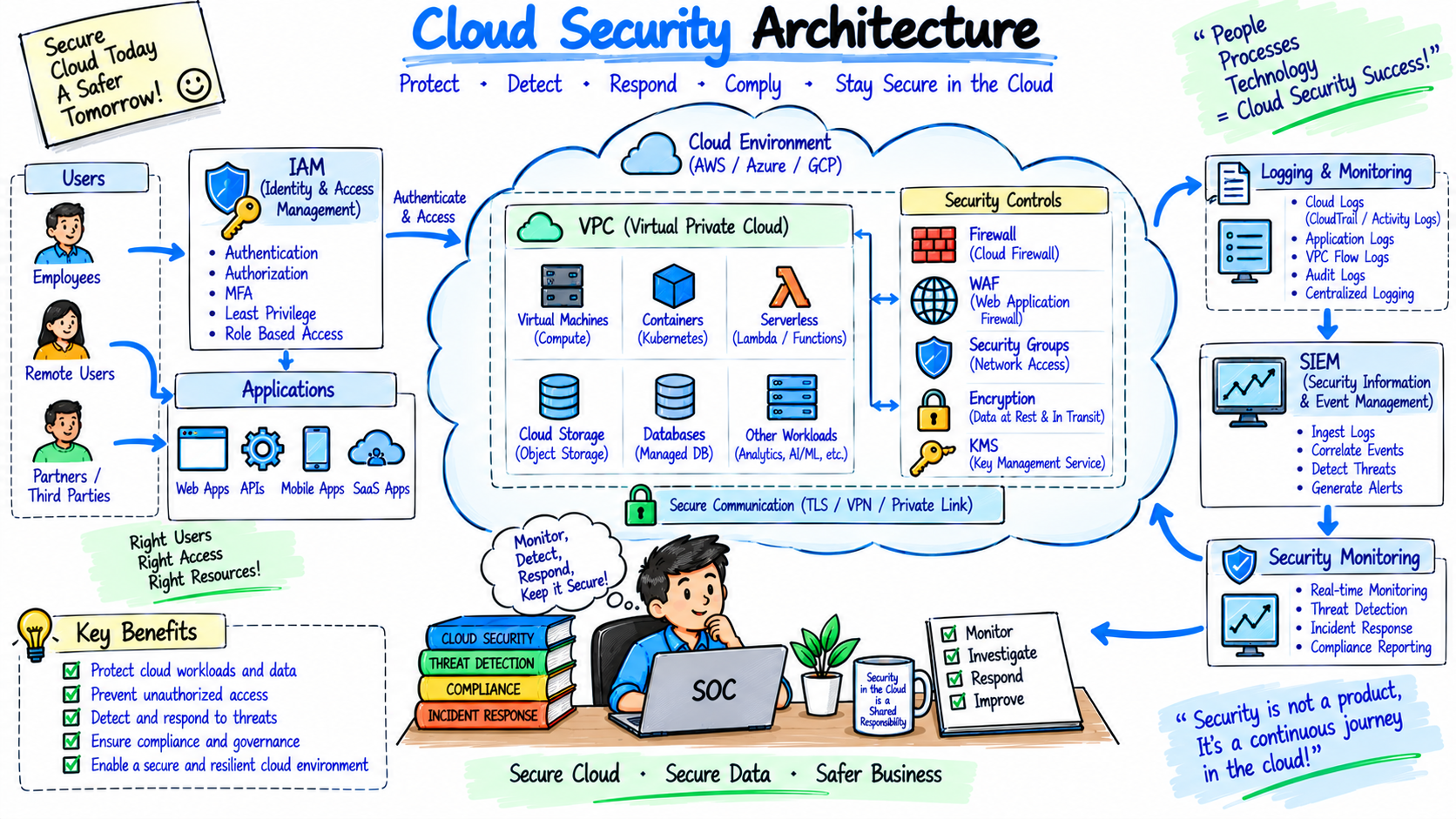
Cloud security is a critical part of modern cybersecurity because organizations increasingly run applications, workloads, identities, databases, containers, and infrastructure across cloud environments. Cloud security focuses on protecting these resources from unauthorized access, data exposure, misconfiguration, malware, account compromise, and other security threats.
If you are preparing for a Cloud Security Engineer, Cloud Security Analyst, SOC Analyst, Cybersecurity Analyst, Security Engineer, or Cloud Security Architect interview, you should understand cloud identity, access control, network security, data protection, logging, monitoring, workload security, containers, compliance, and incident response.
This guide covers 50 Cloud Security Interview Questions and Answers 2026, ranging from basic cloud security concepts to advanced IAM, network security, cloud monitoring, encryption, container security, DevSecOps, and real-world cloud security scenarios.
1. What is Cloud Security?
Cloud security is the collection of technologies, processes, policies, and controls used to protect cloud-based infrastructure, applications, data, identities, and workloads.
Cloud security commonly covers:
- Identity and Access Management
- Network security
- Data protection
- Encryption
- Security monitoring
- Vulnerability management
- Workload security
- Container security
- Compliance
- Incident response
The goal is to protect cloud resources while maintaining appropriate access for authorized users and applications.
2. What are the main cloud service models?
The three primary cloud service models are:
IaaS
Infrastructure as a Service provides infrastructure components such as:
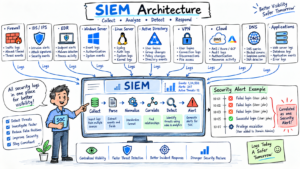
- Virtual machines
- Networks
- Storage
- Firewalls
Examples include Amazon EC2 and Azure Virtual Machines.
PaaS
Platform as a Service provides a managed platform for application development and deployment.
Examples include:
- Azure App Service
- AWS Elastic Beanstalk
- Google App Engine
SaaS
Software as a Service provides complete applications managed by the provider.
Examples include:
- Microsoft 365
- Salesforce
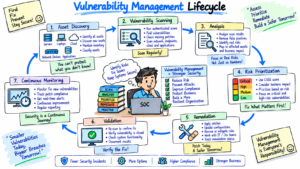
- Google Workspace
The customer’s security responsibilities differ between these models.
3. What are the main cloud deployment models?
Common cloud deployment models include:
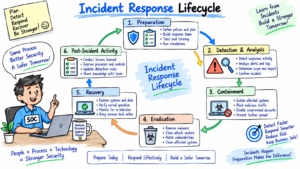
- Public cloud
- Private cloud
- Hybrid cloud
- Multi-cloud
Public Cloud
Infrastructure is provided by a cloud service provider and shared across customers using logical isolation.
Private Cloud
Cloud infrastructure is dedicated to a single organization.
Hybrid Cloud
Combines private infrastructure with public cloud resources.
Multi-Cloud
Uses services from multiple cloud providers.
Each model introduces different security, operational, and governance considerations.
4. What is the shared responsibility model?
The shared responsibility model defines which security responsibilities belong to the cloud provider and which belong to the customer.
Generally, the provider is responsible for security of the cloud, such as:
- Physical data centers
- Physical hardware
- Core infrastructure
Customers are responsible for security in the cloud, depending on the service being used.
Customer responsibilities may include:
- IAM
- Data
- Configurations
- Applications
- Operating systems
- Network controls
The exact responsibility varies between IaaS, PaaS, and SaaS.
5. Why is IAM important in cloud security?
IAM stands for Identity and Access Management.
IAM controls:
- Who can access resources
- What resources they can access
- What actions they can perform
- Under which conditions access is allowed
Important IAM principles include:
- Least privilege
- Strong authentication
- MFA
- Role-based access
- Regular access reviews
- Separation of duties
A compromised cloud identity can provide attackers with access to multiple resources, so IAM is a major part of cloud security.
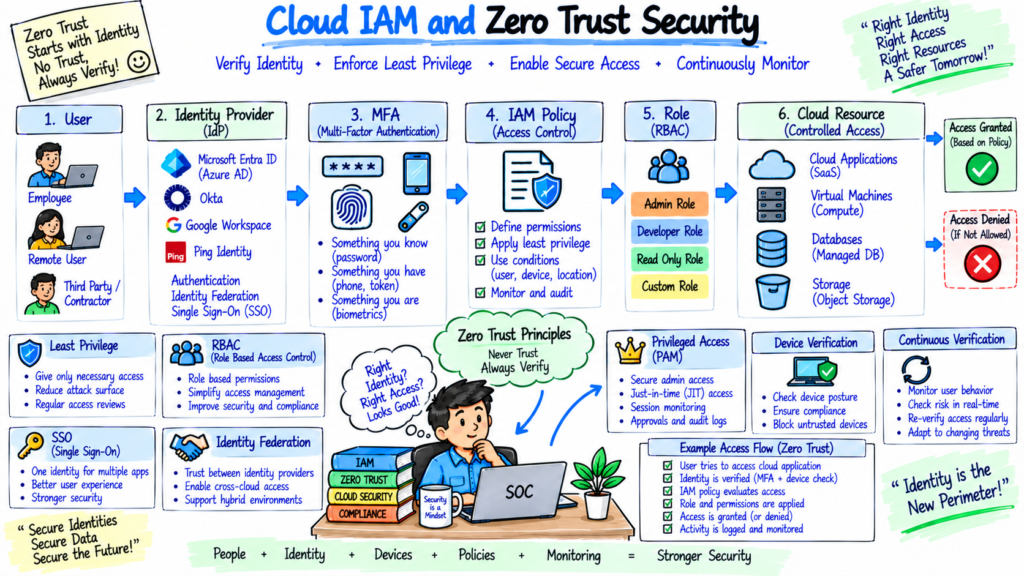
6. What is the principle of least privilege?
Least privilege means giving a user, application, or service only the permissions required to perform its intended task.
For example, an application that only needs to read objects from a storage bucket should not have permission to delete the bucket.
Least privilege helps reduce the impact of compromised accounts and applications.
7. What is MFA and why is it important in cloud security?
MFA stands for Multi-Factor Authentication.
It requires more than one authentication factor.
Examples include:
- Password + authenticator application
- Password + hardware security key
- Password + biometric authentication
MFA provides an additional security control when passwords are stolen or compromised.
Organizations should prioritize MFA for privileged and sensitive accounts.
8. What is a cloud security group?
A security group is a virtual network access control mechanism used by cloud platforms to control network traffic to or from resources.
For example, a security group attached to a cloud server might allow:
- HTTPS from the internet
- SSH only from an administrative network
Security groups should follow least-privilege principles and avoid unnecessary open access.
9. What is a Network ACL?
A Network ACL, or Network Access Control List, is a network-level control used to allow or deny traffic according to defined rules.
For example, an ACL may control:
- Source IP
- Destination IP
- Protocol
- Port
- Direction
The exact behavior and capabilities depend on the cloud provider.
10. What is the difference between a security group and a Network ACL?
A security group generally operates at the resource or virtual network interface level, while a Network ACL generally operates at the subnet or network boundary level.
A simplified comparison:
| Security Group | Network ACL |
|---|---|
| Resource-level control | Subnet-level control |
| Commonly stateful | Commonly stateless |
| Usually allows traffic rules | Can allow or deny traffic |
| Applied to supported resources | Applied to subnet traffic |
The exact implementation varies between cloud providers.
11. What is cloud network segmentation?
Cloud network segmentation divides cloud infrastructure into separate logical network zones.
For example:
Internet
   ↓
Load Balancer
   ↓
Web Subnet
   ↓
Application Subnet
   ↓
Database Subnet
This limits unnecessary communication between systems.
Segmentation can help reduce lateral movement if one workload is compromised.
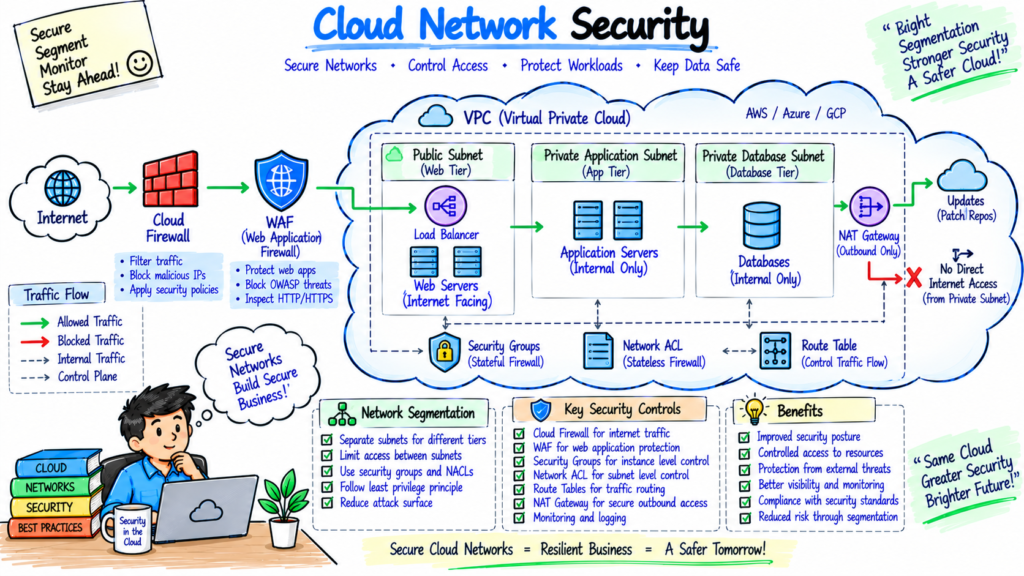
12. What is a VPC or virtual network?
A VPC, or Virtual Private Cloud, is a logically isolated network environment within a public cloud.
Depending on the provider, it can contain:
- Subnets
- Route tables
- Security groups
- Network ACLs
- Internet gateways
- NAT gateways
- Load balancers
Azure commonly uses the term Virtual Network, while AWS uses VPC.
13. What is a private subnet?
A private subnet is a subnet designed so that resources do not have direct inbound internet access.
For example, databases are commonly placed in private subnets.
A typical architecture might be:
Internet
   ↓
Public Load Balancer
   ↓
Private Application Servers
   ↓
Private Database
Private subnets reduce direct exposure to the internet.
14. What is a public subnet?
A public subnet is a subnet that has a route allowing traffic to an internet gateway or equivalent public connectivity mechanism.
Resources in a public subnet may be internet-accessible if their network and security controls allow it.
Public exposure should be limited to resources that actually require it.
15. What is cloud encryption?
Cloud encryption protects data by transforming readable information into ciphertext using cryptographic algorithms.
Cloud environments commonly use:
- Encryption at rest
- Encryption in transit
Examples include:
- Storage encryption
- Database encryption
- TLS
- Encrypted backups
Encryption helps reduce the risk of data exposure if protected data is accessed without authorization.
16. What is encryption at rest?
Encryption at rest protects stored data.
Examples include:
- Cloud storage
- Databases
- Disk volumes
- Backups
- Snapshots
Cloud providers often integrate encryption with key management services.
17. What is encryption in transit?
Encryption in transit protects data while it moves between systems.
TLS is commonly used for:
- HTTPS
- APIs
- Application communication
- Administrative connections
For example:
Client
  ↓ TLS
Cloud Application
  ↓ TLS
Database
This helps protect data from interception while it is transmitted.
18. What is a Cloud KMS?
KMS stands for Key Management Service.
A cloud KMS helps organizations create, store, control, rotate, and use cryptographic keys.
Examples include:
- AWS KMS
- Azure Key Vault
- Google Cloud KMS
Key management is important because encryption security depends heavily on how keys are protected and controlled.
19. What is secrets management?
Secrets management protects sensitive information such as:
- API keys
- Passwords
- Database credentials
- Tokens
- Private keys
- Application secrets
Examples of cloud secrets services include:
- AWS Secrets Manager
- Azure Key Vault
- Google Secret Manager
Secrets should not be hardcoded into source code or stored in public repositories.
20. What is cloud logging?
Cloud logging collects records of activities occurring within cloud environments.
Logs may include:
- Authentication events
- API calls
- Network activity
- Configuration changes
- Resource creation
- Administrative actions
- Application events
Cloud logs are important for security monitoring, investigation, compliance, and incident response.
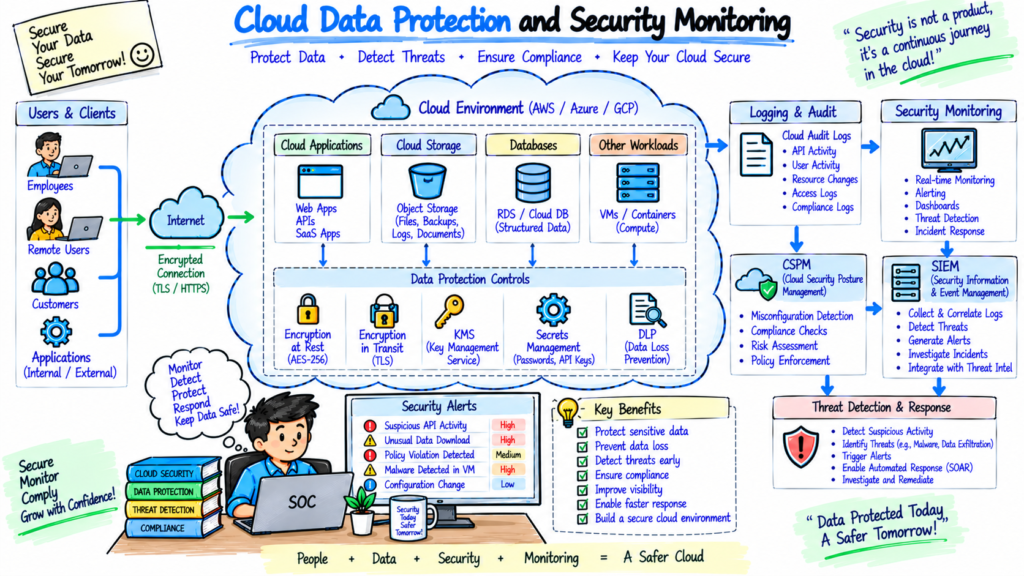
21. What is cloud security monitoring?
Cloud security monitoring continuously analyzes cloud activity for suspicious or unauthorized behavior.
Monitoring can identify:
- Unusual logins
- Privilege escalation
- Suspicious API calls
- Public resource exposure
- Unauthorized configuration changes
- Malware activity
- Data access anomalies
Cloud monitoring commonly integrates with SIEM and security analytics platforms.
22. What is CSPM?
CSPM stands for Cloud Security Posture Management.
CSPM tools identify cloud security configuration issues such as:
- Public storage
- Excessive permissions
- Open network ports
- Missing encryption
- Weak security configurations
- Compliance violations
CSPM helps organizations continuously assess their cloud security posture.
23. What is CWPP?
CWPP stands for Cloud Workload Protection Platform.
CWPP focuses on protecting cloud workloads such as:
- Virtual machines
- Containers
- Servers
- Applications
Capabilities may include:
- Malware protection
- Vulnerability management
- Runtime protection
- Workload monitoring
- Threat detection
24. What is CNAPP?
CNAPP stands for Cloud-Native Application Protection Platform.
CNAPP brings together multiple cloud security capabilities.
These may include:
- CSPM
- CWPP
- Cloud workload security
- Application security
- Infrastructure-as-code security
- Container security
- Identity security
The exact capabilities vary between vendors.
25. What is CIEM?
CIEM stands for Cloud Infrastructure Entitlement Management.
CIEM focuses on managing and analyzing permissions across cloud identities and resources.
It helps identify:
- Excessive permissions
- Unused permissions
- Privilege escalation paths
- Risky identities
- Overprivileged accounts
CIEM supports least-privilege access in cloud environments.
26. What is cloud misconfiguration?
A cloud misconfiguration occurs when a cloud resource is configured in an insecure or unintended way.
Examples include:
- Public storage buckets
- Open security groups
- Excessive IAM permissions
- Disabled logging
- Missing encryption
- Public databases
- Exposed management interfaces
Misconfiguration is one of the common causes of cloud security incidents.
27. How would you secure an AWS S3 bucket?
I would start by ensuring the bucket is not publicly accessible unless there is a documented business requirement.
I would review:
- Block Public Access
- Bucket policies
- IAM permissions
- Encryption
- Versioning
- Logging
- Data classification
- Access monitoring
- Lifecycle policies
I would also apply least privilege and regularly review access.
28. How would you secure a cloud storage account?
I would:
- Restrict public access.
- Apply least-privilege IAM permissions.
- Enable encryption.
- Protect encryption keys.
- Enable logging and monitoring.
- Configure appropriate network controls.
- Enable versioning where appropriate.
- Monitor unusual data access.
- Review permissions regularly.
- Use data classification and retention controls.
The exact configuration depends on the cloud provider.
29. What is cloud identity federation?
Identity federation allows users to authenticate using an external identity provider while accessing cloud resources.
Examples include:
- Microsoft Entra ID
- Okta
- Active Directory Federation Services
Federation can reduce the need for separate cloud passwords and centralize identity management.
30. What is SSO in cloud security?
SSO stands for Single Sign-On.
It allows users to authenticate once through an identity provider and access multiple applications or services.
SSO can improve:
- Centralized authentication
- Access management
- User lifecycle management
- Security policy enforcement
SSO should be combined with strong authentication and appropriate access controls.
31. What is Zero Trust in cloud security?
Zero Trust is a security approach based on the principle that access should not automatically be trusted based on network location.
Common principles include:
- Verify explicitly
- Use least privilege
- Assume breach
- Continuously evaluate access
In cloud environments, Zero Trust can involve identity-based access, device posture, application-level controls, and continuous monitoring.
32. What is cloud workload security?
Cloud workload security protects workloads running in cloud environments.
Workloads may include:
- Virtual machines
- Containers
- Serverless applications
- Kubernetes workloads
- Databases
Controls can include:
- Vulnerability management
- Endpoint protection
- Runtime monitoring
- Network segmentation
- IAM
- Logging
- Configuration management
33. What are the security risks of containers?
Container security risks include:
- Vulnerable images
- Malicious images
- Excessive privileges
- Exposed container services
- Secrets stored in images
- Weak registry security
- Container escape
- Insecure configurations
Container images should be scanned before deployment and monitored during runtime.
34. How would you secure Kubernetes?
I would focus on several areas:
- RBAC
- Network policies
- Pod security
- Image scanning
- Secrets management
- API server protection
- Admission controls
- Audit logging
- Node security
- Runtime monitoring
Kubernetes security requires controls across the cluster, workloads, identities, and underlying infrastructure.
35. What is DevSecOps?
DevSecOps integrates security into the software development and deployment lifecycle.
Security activities may include:
- Source code scanning
- Dependency scanning
- Secret detection
- Infrastructure-as-code scanning
- Container image scanning
- Dynamic application testing
- Security testing in CI/CD
The goal is to identify security issues earlier in development.
36. What is Infrastructure as Code security?
Infrastructure as Code, or IaC, allows infrastructure to be defined using code.
Examples include:
- Terraform
- CloudFormation
- ARM templates
IaC security scanning can identify issues such as:
- Public storage
- Open firewall rules
- Excessive IAM permissions
- Missing encryption
- Insecure configurations
Security checks can be integrated into CI/CD pipelines before infrastructure is deployed.
37. What is cloud vulnerability management?
Cloud vulnerability management identifies, prioritizes, remediates, and validates vulnerabilities affecting cloud assets.
It can include:
- Virtual machines
- Containers
- Kubernetes
- Cloud applications
- Operating systems
- Dependencies
- APIs
Cloud vulnerability management should consider both software vulnerabilities and cloud configuration risks.
38. How would you investigate a compromised cloud account?
I would first validate the suspicious activity.
Then I would review:
- Authentication logs
- Source IP
- Device information
- MFA events
- API calls
- IAM changes
- Resource creation
- Data access
- Network activity
I would determine:
- When the account was compromised.
- How the credentials were obtained.
- Which resources were accessed.
- What actions were performed.
- Whether persistence was created.
- Whether other accounts were affected.
Containment could include revoking sessions, rotating credentials, disabling access, or removing unauthorized permissions according to the organization’s procedures.
39. How would you investigate a public cloud storage exposure?
I would:
- Identify the exposed resource.
- Determine whether public access is intentional.
- Review the access policy.
- Identify the data stored there.
- Check access logs.
- Determine whether unauthorized users accessed the data.
- Restrict public access if required.
- Review related IAM permissions.
- Investigate possible data exposure.
- Document and remediate the configuration.
If sensitive information was exposed, the incident should be escalated according to organizational and regulatory procedures.
40. How would you detect privilege escalation in a cloud environment?
I would monitor:
- IAM policy changes
- Role assignments
- Privileged account creation
- Permission changes
- Service account modifications
- API activity
- Unusual administrative actions
For example:
User
 ↓
Role Modification
 ↓
New Privileges
 ↓
Sensitive Resource Access
 ↓
Suspicious API Activity
I would correlate identity logs, cloud audit logs, SIEM alerts, and resource activity.
41. What is cloud incident response?
Cloud incident response is the process of detecting, investigating, containing, eradicating, and recovering from security incidents involving cloud resources.
Evidence may include:
- Cloud audit logs
- IAM activity
- Network flow logs
- Application logs
- Storage access logs
- Endpoint telemetry
- Container logs
The response process should account for the cloud provider’s architecture and available security controls.
42. What is a cloud audit log?
A cloud audit log records administrative and API activity within a cloud environment.
Depending on the provider, it may record:
- Who performed an action
- What action was performed
- When it occurred
- Source IP
- Resource affected
- Authentication context
Audit logs are valuable during incident investigation and compliance reviews.
43. What is cloud data loss prevention?
Cloud DLP helps identify and protect sensitive information stored or transmitted through cloud services.
Sensitive data can include:
- Personally identifiable information
- Financial information
- Credentials
- Intellectual property
- Healthcare information
DLP controls can detect sensitive data and apply actions such as blocking, alerting, or restricting access.
44. What is a cloud firewall?
A cloud firewall controls network traffic between cloud resources or between cloud resources and external networks.
It may control:
- Source
- Destination
- Port
- Protocol
- Application
- Identity or context, depending on the platform
Cloud firewalls can be combined with security groups, network ACLs, WAFs, and other controls.
45. What is a WAF?
WAF stands for Web Application Firewall.
A WAF protects web applications from common application-layer attacks.
It can help detect or block:
- SQL injection
- Cross-site scripting
- Malicious HTTP requests
- Bot activity
- Application-layer attacks
A WAF does not replace secure application development.
46. What is the difference between a WAF and a cloud firewall?
A cloud firewall generally controls network traffic based on network-level attributes such as IP addresses, ports, and protocols.
A WAF focuses on HTTP/HTTPS application traffic and web application attacks.
For example:
Internet
   ↓
Cloud Firewall
   ↓
WAF
   ↓
Web Application
   ↓
Database
Both can provide different layers of protection.
47. What are common cloud security threats?
Common threats include:
- Account compromise
- Credential theft
- Misconfiguration
- Public data exposure
- Excessive privileges
- Malware
- Ransomware
- Insecure APIs
- Vulnerable workloads
- Container vulnerabilities
- Insider threats
- Supply-chain attacks
Security teams should continuously monitor cloud resources and identities for suspicious behavior.
48. How would you secure a cloud environment?
I would implement security controls across several areas:
Identity
- MFA
- Least privilege
- RBAC
- SSO
- Privileged access controls
Network
- Segmentation
- Private subnets
- Security groups
- Network ACLs
- Firewalls
- WAF
Data
- Encryption
- Key management
- DLP
- Backup protection
Workloads
- Vulnerability management
- EDR
- Container security
- Runtime monitoring
Monitoring
- Audit logging
- SIEM
- Security alerts
- Threat detection
Governance
- Policies
- Compliance controls
- Regular assessments
- Security reviews
49. What would you do if you discovered an overly permissive IAM policy?
I would first determine:
- Which identity has the policy
- Which resources can be accessed
- Which actions are permitted
- Whether the permissions are actually required
- Whether the identity is being used
- Whether the policy has already been exploited
Then I would work with the resource owner to reduce permissions according to least privilege.
I would validate the updated policy and monitor for unexpected access failures or suspicious activity.
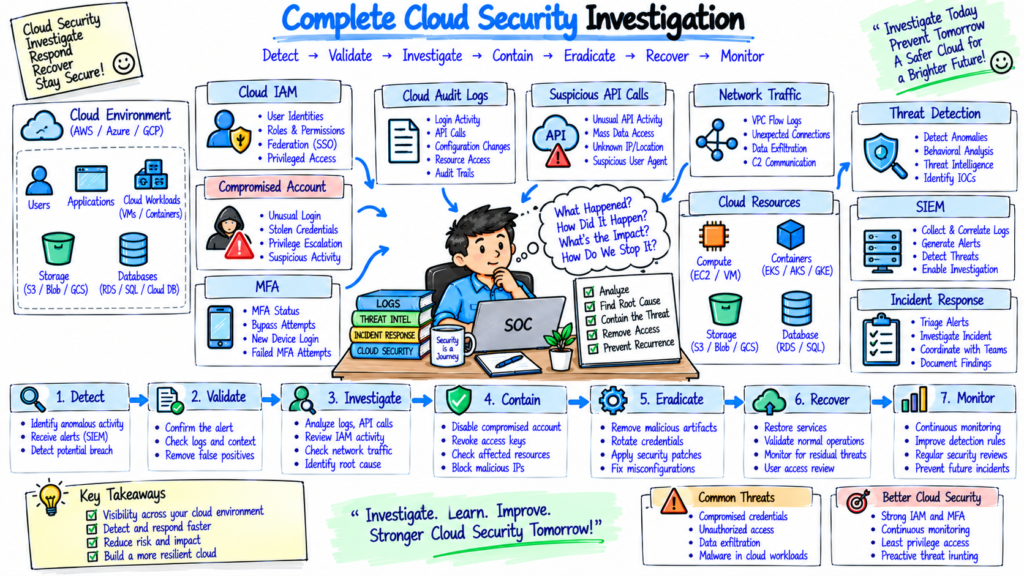
50. Explain a complete cloud security incident investigation.
Suppose an organization’s cloud monitoring system detects an unusual administrative login.
Step 1: Validate the Alert
Review:
- User
- Source IP
- Location
- Device
- Authentication method
- MFA status
Step 2: Review Identity Activity
Check:
- Login history
- Password changes
- MFA changes
- Role assignments
- Privilege changes
Step 3: Review Cloud Audit Logs
Identify:
- API calls
- Resource changes
- New resources
- Security configuration changes
- Data access
Step 4: Determine Scope
Search for:
- Other compromised accounts
- Additional source IPs
- Similar API activity
- Unauthorized resource access
Step 5: Contain
Depending on the organization’s procedures:
- Revoke active sessions
- Disable compromised credentials
- Remove unauthorized permissions
- Block malicious infrastructure
Step 6: Investigate
Determine:
- Initial access
- Attacker actions
- Affected resources
- Data accessed
- Persistence mechanisms
Step 7: Eradicate
Remove unauthorized accounts, permissions, resources, or persistence mechanisms.
Step 8: Recover
Restore affected resources and validate security controls.
Step 9: Monitor
Increase monitoring for related activity.
Step 10: Document
Record the timeline, evidence, root cause, response actions, and recommendations.
The complete process is:
Detect → Validate → Investigate → Contain → Eradicate → Recover → Monitor → Improve
Related Cloud Security and Cybersecurity Articles
- Cloud Security Basics 2026: Complete Beginner Guide
https://technaga.com/cloud-security-basics-2026/ - Identity and Access Management in 2026: A Practical Guide for Cloud Security Professionals
https://technaga.com/identity-and-access-management-cloud-security-2026/ - Multi-Factor Authentication (MFA): Critical Guide to Secure Your Systems (2026)
https://technaga.com/multi-factor-authentication-mfa-guide-2026/ - Critical API Security Risks in the Cloud and Best Practices for 2026
https://technaga.com/api-security-cloud-risks-best-practices-2026/ - Cloud Misconfiguration: 10 Critical Errors Leading to Data Breaches in 2026
https://technaga.com/cloud-misconfiguration-data-breaches-2026/ - Zero Trust Security in 2026: Architecture, Real Examples, and Implementation Guide
https://technaga.com/zero-trust-security-2026-guide/ - Security Information and Event Management: Complete SIEM Guide 2026
https://technaga.com/security-information-and-event-management-2026/ - Best SOC Analyst Roadmap 2026: Complete Guide to L1, L2, L3 Roles, Skills, and Tools
https://technaga.com/complete-soc-analyst-roadmap-2026/ - Endpoint Security 2026 Guide
https://technaga.com/endpoint-security-2026-guide/ - Network Segmentation Explained with Real-World Example
https://technaga.com/network-segmentation-guide-ransomware-prevention/
External Cloud Security Resources
For further reading, see these official frameworks and cloud provider documentation:
- NIST Cybersecurity Framework
https://www.nist.gov/cyberframework - NIST SP 800-207: Zero Trust Architecture
https://csrc.nist.gov/pubs/sp/800/207/final - CISA Cybersecurity Resources
https://www.cisa.gov/topics/cybersecurity-best-practices - OWASP
https://owasp.org/ - MITRE ATT&CK
https://attack.mitre.org/
Disclaimer
The information provided in this Cloud Security Interview Questions and Answers 2026 guide is intended for educational, informational, and interview preparation purposes only. The cloud security concepts, techniques, tools, security controls, and best practices discussed in this article are provided as general guidance and may vary depending on the cloud provider, organization, architecture, security requirements, and environment.
This Cloud Security Interview Questions and Answers 2026 article does not constitute professional cybersecurity, legal, compliance, or security consulting advice. Readers should verify technical information with official documentation and follow their organization’s security policies and procedures before implementing any security configuration or control.
The author and website are not responsible for any security issues, data loss, service disruption, configuration errors, or other consequences resulting from the use or misuse of the information presented in this article.
For production cloud environments, always test security configurations in an appropriate environment and consult qualified security professionals when necessary.