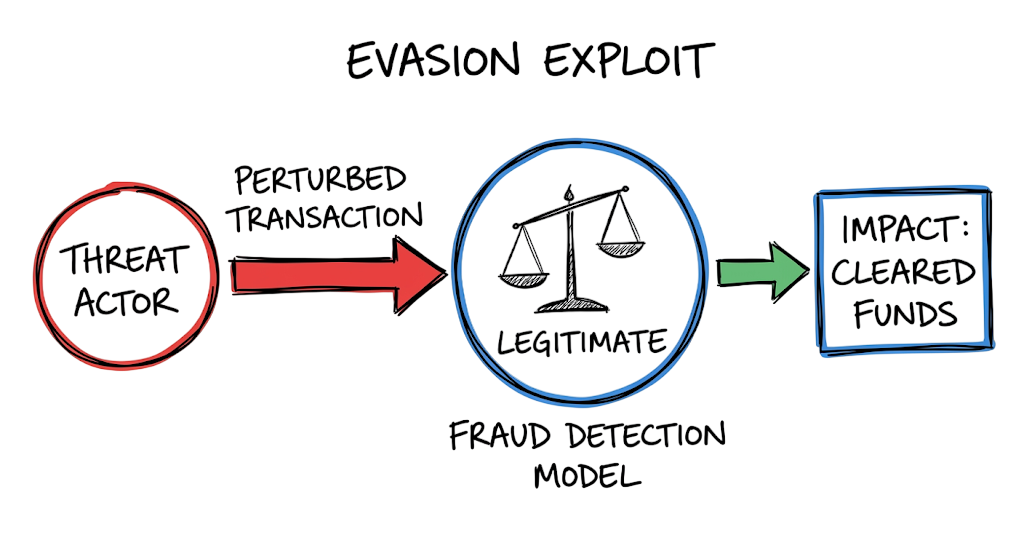
A mid-size private bank’s fraud detection model confidently cleared a structured series of transactions, even though the total volume matched a known money laundering pattern. The model had a 94% accuracy rate during compliance testing, yet it completely missed these carefully crafted inputs.
This was not caused by a software bug or a broken data pipeline. The attackers deliberately adjusted transaction values to remain just below the model’s detection threshold. These adversarial machine learning attacks exploited weaknesses in the AI model’s decision-making process, allowing malicious activity to pass unnoticed.
As organizations increasingly rely on artificial intelligence for fraud detection, malware analysis, and threat monitoring, adversarial machine learning attacks are becoming a growing cybersecurity concern. This guide explains how these attacks work, the risks they create, and the adversarial ML defense techniques you can use to protect production AI systems.
What Are Adversarial Machine Learning Attacks?
Adversarial machine learning attacks involve deliberately crafting inputs to force an artificial intelligence model to make incorrect decisions. Unlike traditional cybersecurity attacks that exploit software vulnerabilities, these attacks target the mathematical logic that machine learning models use to classify data.
For organizations dealing with machine learning model security threats, the concept is straightforward. An attacker provides valid-looking data that has been carefully modified to push the model’s confidence toward the wrong outcome. The changes are often so small that they remain invisible to human reviewers.
A human may see a normal payment request, image, or file, while the AI system interprets the subtle numerical changes differently and classifies the malicious input as safe. This is why adversarial machine learning attacks are particularly dangerous. The model operates exactly as designed, but attackers exploit weaknesses in its decision-making process to bypass detection and security controls.
How Adversarial Machine Learning Attacks Work
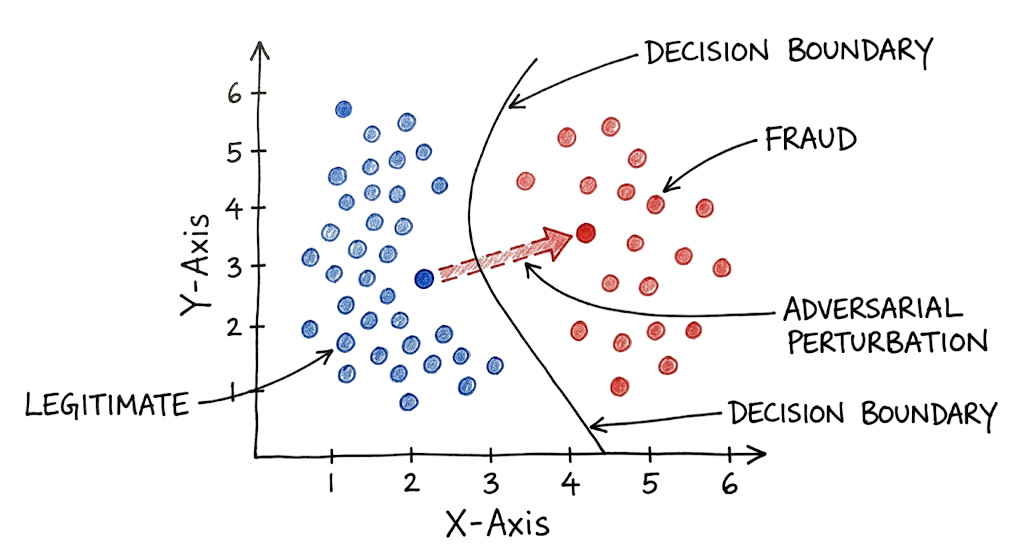
Every machine learning classification model learns a decision boundary that separates categories such as legitimate and malicious, safe and unsafe, or spam and non-spam. This mathematical boundary is created from the training data and helps the model determine how new inputs should be classified.
In adversarial machine learning attacks, attackers attempt to identify and exploit this decision boundary. Once they understand how the model reacts to different inputs, they can calculate the smallest possible change needed to force a misclassification.
For example, a network packet may have a single header field modified by one byte. To a security analyst, the packet may still appear suspicious. However, the AI model interprets the altered feature values differently and may classify the malicious packet as legitimate.
Most machine learning models rely on gradient-based optimization to make predictions. Because the model lacks human reasoning and context, a carefully crafted perturbation can push the input across the decision boundary and cause a high-confidence error. This weakness is one of the primary reasons adversarial machine learning attacks remain a significant challenge for AI security.
Model Evasion Attacks Explained: Attack Chain and Technical Flow
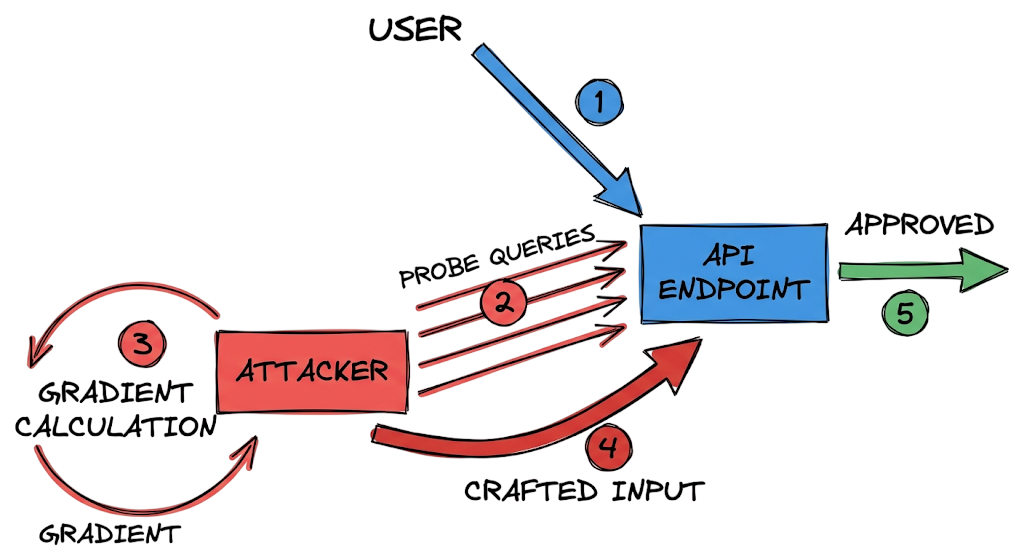
The attack typically begins when an attacker sends repeated queries to a deployed machine learning API and carefully observes the responses. By analyzing how the model scores different inputs, such as transaction amounts, network packets, or user behaviors, they gradually build an understanding of the model’s decision boundary.
Once enough information is collected, the attacker can estimate how small changes in the input affect the model’s predictions. This process helps them identify the most effective way to manipulate an input while keeping it seemingly legitimate.
In adversarial machine learning attacks, the attacker then introduces a tiny perturbation. This could involve slightly modifying a transaction amount, adjusting packet attributes, or adding nearly invisible noise to an image. These changes are often too small for humans to notice but can significantly influence the model’s decision.
The AI system processes the crafted input and may classify it as legitimate with high confidence. Because the prediction appears normal, no alerts are triggered and the malicious activity goes unnoticed. This is one of the most common examples of model evasion attacks, where attackers map the decision boundary and carefully bypass detection mechanisms without exploiting any software vulnerability.
Key Components Behind Adversarial Machine Learning Attacks
- Decision Boundary — The mathematical threshold separating classes, which attackers map and ultimately cross to evade detection.
- Loss Function Gradient — The directional vector indicating how input changes affect model error, used to calculate necessary perturbations.
- Perturbation Magnitude — The size of the alteration applied to the input, kept deliberately small to evade human detection and existing filters.
- Surrogate Model — A local replica trained by the attacker using your API outputs, allowing them to test exploits offline without generating noise.
- Adversarial examples in deep learning — The actual crafted inputs containing the mathematical noise required to force the misclassification.
Real-World Example of an Adversarial Machine Learning Attack
Plaintext
{
“timestamp”: “2026-06-09T08:14:22Z”,
“event”: “transaction_evaluation”,
“model_id”: “fraud_classifier_v4”,
“input_features”: {“amount”: 4997.50, “velocity”: 4, “merchant_category”: “5411”},
“confidence_score”: 0.51,
“classification”: “LEGITIMATE”,
“action”: “APPROVED”
}
This log shows a transaction positioned very close to the model’s decision boundary, receiving a 51% confidence score for a legitimate classification. Under normal conditions, similar transactions for this user would typically receive confidence scores closer to 95% legitimate or 90% fraudulent.
In this example, the attacker carefully adjusted the transaction amount to 4997.50 and modified the velocity metric to influence the model’s decision. These small changes were sufficient to alter the feature values used by the classifier, allowing the transaction to bypass fraud detection controls.
Such behavior is commonly observed in adversarial machine learning attacks, where attackers make subtle modifications to inputs to manipulate AI predictions. The goal is not to trigger errors or system failures but to achieve a high-confidence misclassification that appears legitimate.
Security teams should pay close attention to unusual clusters of borderline confidence scores across specific users, accounts, or merchant categories. These patterns may indicate active probing or model evasion attacks designed to map the classifier’s decision boundary.
When this behavior is detected, analysts should review the raw feature data, compare the events against historical baselines, and validate the samples using offline testing environments. Early identification of boundary-mapping activity can help prevent attackers from exploiting weaknesses in machine learning security controls.
Practical Implementation and Testing Methods
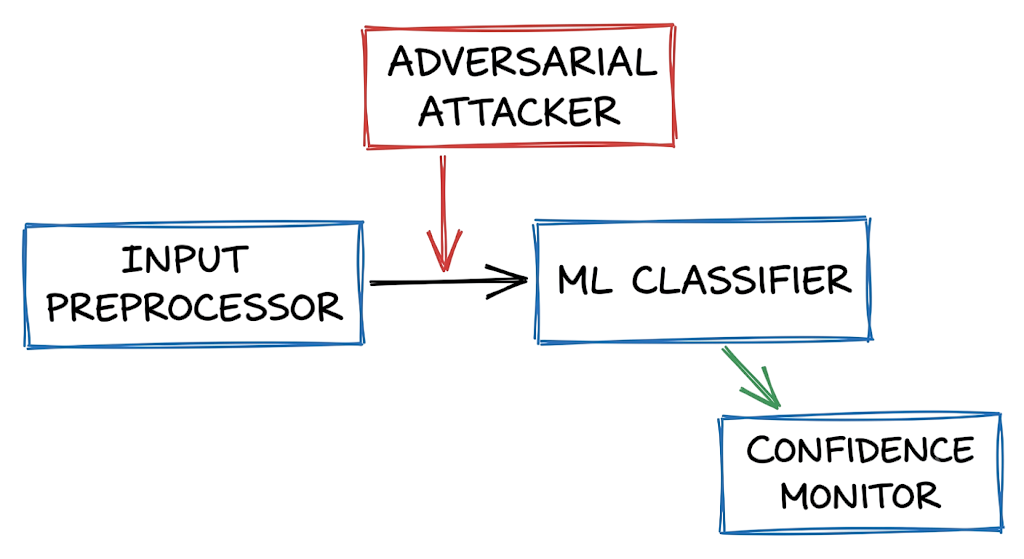
- Implement input preprocessing by rounding numerical values and normalizing text encoding to destroy the high-precision noise attackers rely on.
- Set up confidence score monitoring to trigger alerts whenever the model outputs an unusually high volume of borderline predictions.
- Restrict API access to your inference endpoints by enforcing strict rate limits to prevent attackers from mapping your model through brute-force querying.
- Integrate adversarial ML defense techniques directly into your CI/CD pipeline by running tools like the Adversarial Robustness Toolbox against every new model version.
- Apply adversarial training to high-stakes classifiers by explicitly feeding them known attack patterns so they learn to recognize the perturbations.
- Deploy an ensemble of models with diverse architectures so an input designed to fool one gradient path fails against the others.
- Audit model artifact access to protect weights and training data exactly as you would protect production database credentials.
Advantages and Limitations of Adversarial ML Defense Techniques
Adversarial training is one of the most effective adversarial ML defense techniques because it teaches a model to recognize and correctly classify manipulated inputs. By exposing the model to known attack patterns during training, organizations can improve resistance to many common adversarial machine learning attacks.
However, adversarial training has limitations. It requires significant computational resources and often improves resilience only against the specific attack methods included in the training process. For example, a model protected against a Fast Gradient Sign Method (FGSM) attack may still remain vulnerable to a Carlini-Wagner (C&W) attack.
Input preprocessing is another commonly used defense strategy. Techniques such as feature normalization, data sanitization, and value rounding can block simple automated attacks. Unfortunately, skilled attackers can often adapt their adversarial examples to account for these preprocessing steps and bypass the protection.
Many organizations also deploy ensemble models that combine predictions from multiple machine learning algorithms. This approach increases the complexity and cost of a successful attack because adversaries must fool several models simultaneously rather than a single classifier.
Despite these benefits, no defense provides complete protection. Given sufficient time, resources, and API access, determined attackers may still discover perturbations capable of bypassing multiple models. For this reason, effective protection against adversarial machine learning attacks requires a layered security strategy that combines adversarial training, input validation, model monitoring, rate limiting, and continuous security testing.
Common Mistakes When Defending Against Adversarial Machine Learning Attacks
Many organizations evaluate machine learning models using accuracy scores generated from clean test datasets. While a model may achieve 98% accuracy, this metric alone does not indicate whether it can withstand adversarial machine learning attacks or other real-world threats.
A common mistake is assuming that high accuracy automatically equals strong security. In reality, a model may perform exceptionally well under normal conditions while remaining vulnerable to maliciously crafted inputs designed to trigger incorrect predictions.
Teams often view adversarial manipulation as a research topic rather than an operational cybersecurity risk. As a result, they deploy machine learning APIs without implementing rate limiting, query monitoring, or other security controls that could detect suspicious activity.
Once a public-facing endpoint becomes available, attackers can begin sending automated queries to map the model’s decision boundary. Over time, this information helps them develop model evasion attacks capable of bypassing fraud detection, malware analysis, and other AI-driven security systems.
Another critical mistake is failing to protect model artifacts such as weights, training datasets, and architecture details. If attackers gain access to these assets through compromised developer accounts or exposed repositories, they can launch highly effective white-box adversarial machine learning attacks using complete knowledge of the model’s internal structure.
To reduce risk, organizations should treat machine learning models as critical assets, apply strong access controls, secure model repositories, monitor inference activity, and regularly test for adversarial machine learning attacks before deployment and throughout the model lifecycle.
Best Practices to Prevent Adversarial Machine Learning Attacks
You must treat adversarial machine learning attacks as a critical operational risk and enforce security gates before deployment. When I was working on a red team engagement for a fintech client running an ML-based AML screening system, we shifted numerical feature values by amounts well within normal variance ranges to push the false negative rate from 6% to 61%. To prevent this, you should continuously monitor your confidence score distributions in production for unnatural clustering near the decision boundary. Version-control your training data aggressively so you can trace the exact origin of a suspected poisoning event. For teams running public inference APIs, you must implement query fingerprinting to identify the statistical signatures of an attacker mapping your network.
Troubleshooting Model Evasion Attacks in Enterprise Environments
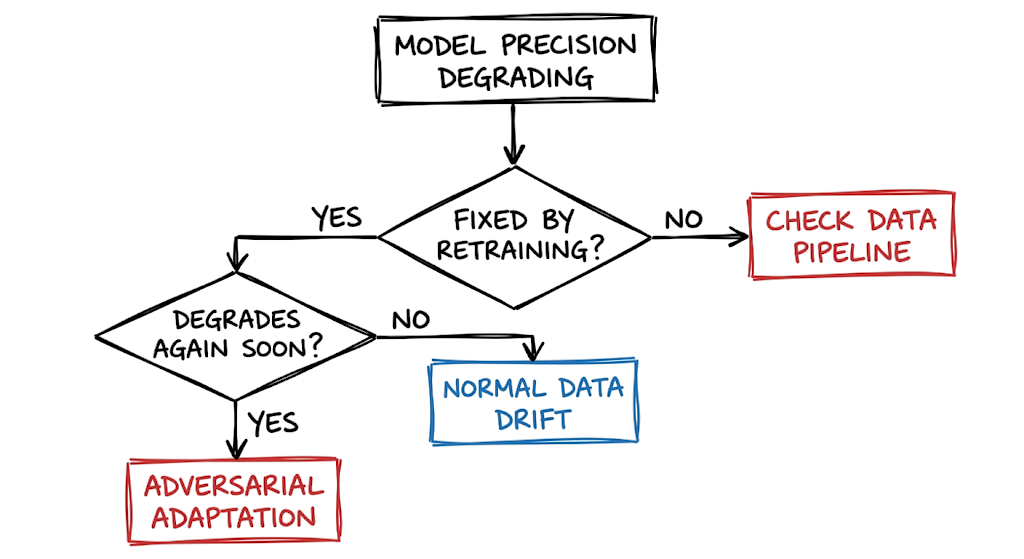
Symptom: A network intrusion detection model performs well at deployment but shows a steadily degrading precision over three months, with the false negative rate climbing significantly.
Wrong assumption most engineers make: They assume the traffic distribution changed naturally due to data drift, and they schedule more frequent retraining cycles to compensate.
Actual root cause: The attacker is actively adapting to the retrained model. Every time you retrain, the attacker probes the new decision boundary and adjusts their payloads to evade it. In real environments, it doesn’t work this cleanly. The retraining process gives the adversary a clear signal on how to update their attack.
Fix: You must implement randomized model variants to prevent the attacker from building a stable map of the boundary, and introduce strict query anomaly detection to catch the probing phase before they find the evasion path.
Interview Questions on Adversarial Machine Learning Attacks
Q: What is the difference between a white-box and a black-box adversarial attack?
A: In a white-box attack, the adversary possesses the model’s architecture and weights, allowing them to calculate precise mathematical perturbations. In a black-box attack, the adversary only interacts with the inputs and outputs, usually training a surrogate model to craft their exploit. Black-box attacks reflect realistic production threats.
Q: How does a noisy input differ from an adversarial example?
A: A noisy input contains random data corruption that degrades performance unpredictably. An adversarial example contains a calculated perturbation designed to force a specific, high-confidence misclassification.
Q: What are AI model poisoning attacks and how do they function?
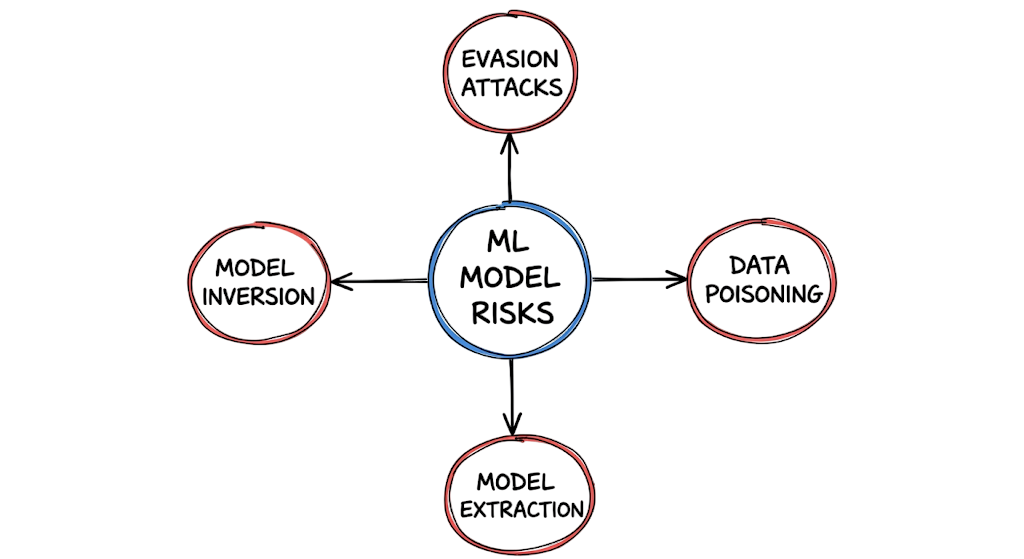
A: These attacks occur during the training phase when an adversary corrupts the underlying dataset. By injecting manipulated data, the attacker embeds permanent vulnerabilities or backdoors directly into the model’s decision boundary.
Q: Why do adversarial examples transfer between different models?
A: Models trained on similar datasets to solve the same problem often learn comparable mathematical representations. A perturbation that crosses the decision boundary of one model has a high probability of crossing the boundary of a distinct but related model.
Q: How do you secure an ML-based WAF during the design phase?
A: You must mandate query rate limiting and strict logging of confidence scores to detect boundary mapping. You also require integrity testing against known evasion frameworks before the WAF is permitted to process live traffic.
Future Trends in Adversarial Machine Learning Attacks (2026 and Beyond)
Automated attack pipelines are integrating directly into standard red team workflows, transforming adversarial manipulation from a specialized skill into commodity software. Frameworks like Counterfit will soon allow any pentester to launch sophisticated attacks against your APIs. Regulators are also recognizing this shift. Under the RBI’s AI in banking guidelines and the Saudi SAMA CSF, financial institutions will explicitly need to prove adversarial resistance during compliance audits. Finally, the focus is rapidly shifting toward large language models, where prompt injection and retrieval corruption pose direct operational risks to enterprise deployments.
Frequently Asked Questions About Adversarial Machine Learning Attacks
Q: What makes adversarial ML different from traditional hacking?
A: Traditional hacking exploits software bugs, memory leaks, or misconfigurations to compromise a system. Adversarial ML exploits the intended mathematical behavior of the algorithm itself. The software works perfectly, but the logic is manipulated.
Q: Can simple models like logistic regression be attacked?
A: Yes. While deep neural networks are the most widely studied, any model that relies on a mathematical decision boundary is susceptible. The complexity of the attack simply scales with the complexity of the model architecture.
Q: Does encrypting the model prevent these attacks?
A: Encryption protects the model weights at rest from theft, stopping direct white-box attacks. However, it does nothing to prevent black-box attacks where the adversary queries your live API to map the boundary.
Q: How do I know if my model is currently under attack?
A: You look for anomalies in your inference logs, specifically an unnatural clustering of borderline confidence scores. A high volume of requests subtly shifting single parameters is the primary signature of boundary mapping.
Q: Is retraining the model enough to stop an active evasion campaign?
A: No. Retraining without changing the architecture or defense strategy simply shifts the decision boundary slightly. The attacker will probe the new boundary and adjust their inputs to bypass it again.
Conclusion: Protecting Against Adversarial Machine Learning Attacks
The weaknesses targeted by adversarial machine learning attacks are rooted in the mathematical foundations of how machine learning models learn and make decisions. Because these vulnerabilities exist within the model itself, organizations cannot rely on a simple software update or security patch to eliminate the risk.
Security teams must treat model integrity and resilience as critical operational security metrics. A machine learning model should be evaluated not only for accuracy and performance but also for its ability to withstand adversarial inputs, model evasion attacks, and other AI-focused threats.
Regular security assessments are essential for identifying weaknesses before attackers can exploit them. Organizations should use adversarial ML defense techniques and automated testing frameworks to evaluate fraud detection systems, intrusion detection models, and other high-value AI applications.
By continuously testing and monitoring machine learning systems, security teams can uncover hidden blind spots, strengthen defenses, and reduce the likelihood of successful adversarial machine learning attacks in production environments.
External Links
- MITRE ATLAS (Adversarial Threat Landscape for AI Systems)
- OWASP Top 10 for Large Language Model Applications
- NIST AI Risk Management Framework
- IBM Adversarial Machine Learning Guide
- Microsoft Counterfit AI Security Tool
Internal Links
- What Is Cybersecurity and Why It Is Important Today
https://technaga.com/what-is-cybersecurity-and-why-it-is-important-today/ - Critical API Security Risks in the Cloud and Best Practices for 2026
https://technaga.com/api-security-cloud-risks-best-practices-2026/ - Security Information and Event Management: Complete SIEM Guide 2026
https://technaga.com/security-information-and-event-management-2026/ - Essential Endpoint Security Guide 2026 for Every Organization
https://technaga.com/endpoint-security-2026-guide/ - Zero Trust Security in 2026: Architecture, Real Examples, and Implementation Guide
https://technaga.com/zero-trust-security-2026-guide/