A finance employee in Hong Kong joined what appeared to be a routine video conference with the company’s CFO and several trusted colleagues. During the meeting, the CFO requested an urgent payment to a new vendor. Believing the request was legitimate, the employee transferred nearly $25 million.
A few hours later, investigators uncovered a shocking truth. The entire meeting was fake. The faces, voices, and conversations had been generated using advanced deepfake technology used in financial fraud. The attackers successfully impersonated senior executives and manipulated the employee into authorizing the transaction.
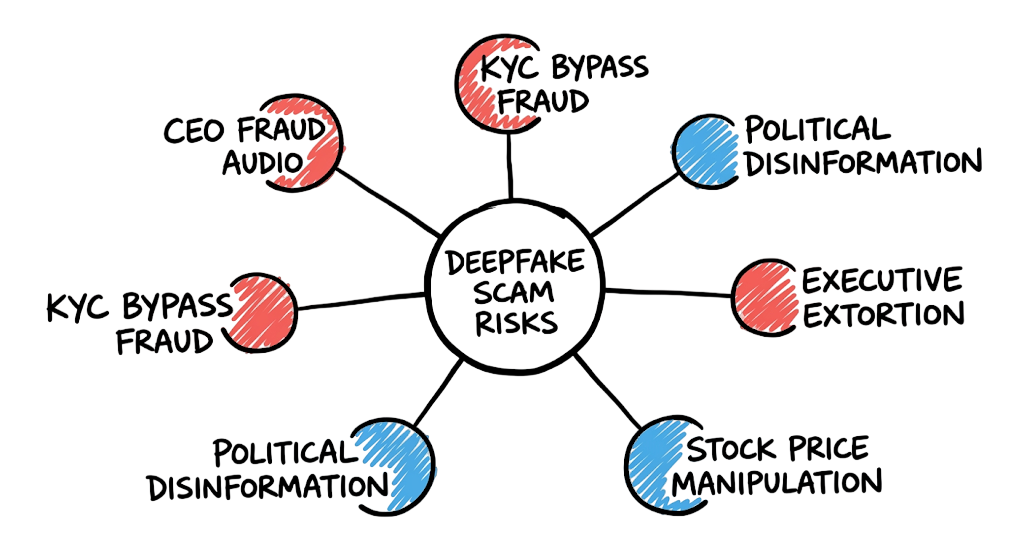
This incident demonstrates how dangerous modern deepfake voice cloning scams have become. Criminals can now create realistic synthetic voices and videos that are difficult to distinguish from genuine communications.
In this guide, you will learn how deepfake voice cloning scams work, the technology behind these attacks, real-world examples, common tactics used in CEO fraud using deepfake audio, and practical steps to protect yourself from AI voice cloning scams.
What Is Deepfake Fraud and Why Is It Increasing?
A deepfake scam uses artificial intelligence to replicate a person’s voice, face, or both. Attackers collect audio and video samples from social media, interviews, podcasts, or public recordings. These samples are then fed into AI models that learn the target’s speech patterns, tone, pitch, and facial expressions.
Once trained, the system generates synthetic audio or video that closely resembles the real individual. In many cases, the output is realistic enough to deceive employees, customers, and even security teams.
Modern deepfake technology used in financial fraud no longer requires expensive equipment or advanced technical expertise. With a standard laptop and widely available software, criminals can create convincing voice clones in a short amount of time.
As a result, deepfake voice cloning scams have become a growing cybersecurity threat. The barrier to entry is now extremely low, making identity theft, CEO fraud using deepfake audio, and social engineering attacks easier than ever.
How Deepfake Voice Cloning Scams Work Step by Step
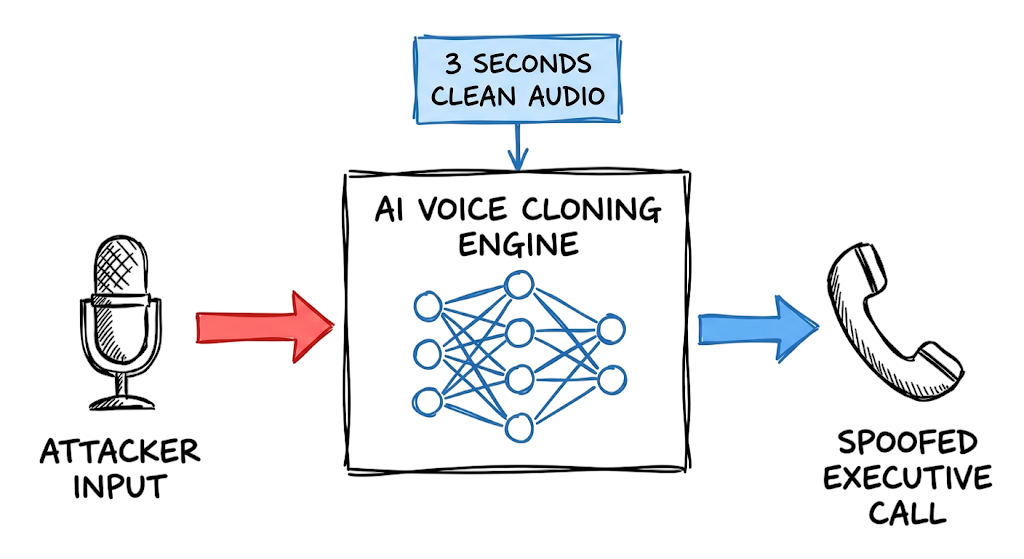
Attackers often begin by collecting audio samples from YouTube videos, LinkedIn presentations, podcasts, webinars, and corporate earnings calls. Surprisingly, modern AI systems may require only a few seconds of clean audio to generate a basic voice clone.
The collected audio is processed by a neural text-to-speech engine. The AI analyzes phonetic patterns, speech rhythm, tone, pitch, pronunciation, and even breathing characteristics. This information is used to build a digital voice model of the target individual.
Unlike early voice cloning tools, today’s systems do not rely on pre-recorded messages. Instead, attackers can connect the voice cloning platform directly to a live text input interface.
During a phone call, the attacker types responses in real time. The AI instantly converts the text into synthetic speech that sounds like the victim. This process occurs within milliseconds, allowing the conversation to flow naturally.
This capability is a key reason why deepfake voice cloning scams are becoming more effective. In many cases, victims believe they are speaking directly with a trusted executive, family member, or colleague.
The same technique is commonly used in CEO fraud using deepfake audio. An attacker can answer questions, issue payment instructions, and create a sense of urgency while using the cloned voice of a company executive. As a result, organizations may fall victim to deepfake technology used in financial fraud without realizing the conversation is entirely AI-generated.
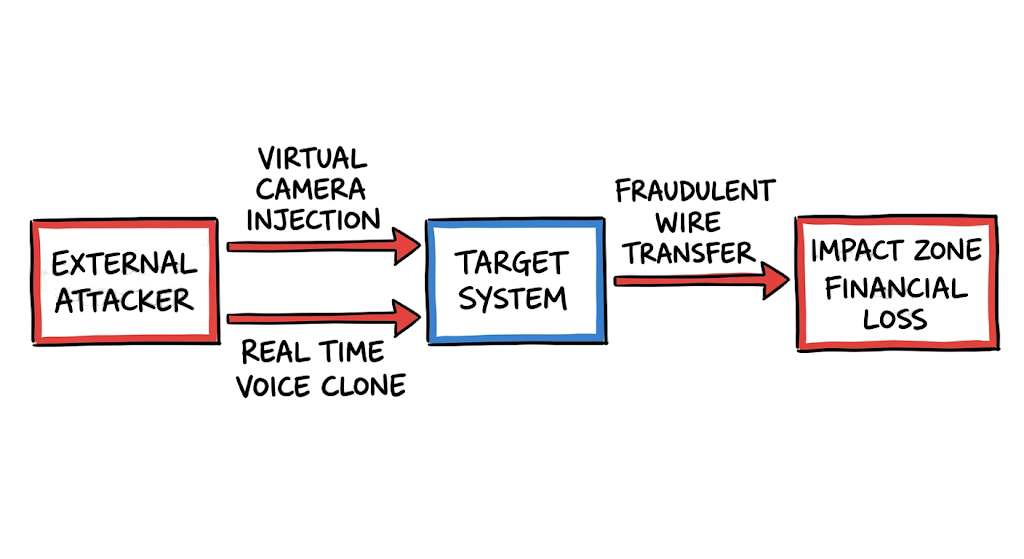
Deepfake Voice Cloning Scam Technical Flow and Architecture
To understand how advanced deepfake attacks operate, it helps to examine the technical flow behind AI-generated impersonation campaigns. Modern attackers often combine voice cloning with real time face swapping scams to create highly convincing identities.
The attack typically begins with reconnaissance. Cybercriminals collect high-quality images and videos of a target executive from company websites, social media platforms, public presentations, and corporate directories.
Next, the attacker trains an AI model to replicate the target’s facial appearance. The system learns facial features, expressions, head movements, and landmark positions, allowing it to generate realistic visual impersonations.
During the attack, virtual camera software is used to intercept the attacker’s webcam feed. The software replaces the attacker’s face with the AI-generated version before transmitting the video to platforms such as Zoom, Microsoft Teams, or Google Meet.
For the audio component, the attacker speaks into a microphone while a voice conversion engine processes the audio stream in real time. The system modifies tone, pitch, accent, and speech characteristics to match the target executive’s voice.
The modified video and audio streams are then delivered simultaneously through the conferencing platform. This creates a realistic appearance that can deceive employees, business partners, and even experienced professionals.
These combined techniques power some of the most sophisticated deepfake video scams targeting businesses today. By merging face swapping technology with AI voice synthesis, attackers can impersonate executives, conduct fraudulent meetings, and support CEO fraud using deepfake audio.
In many cases, the entire processing pipeline runs on the attacker’s local machine. Local processing reduces latency and helps maintain smooth conversations, making deepfake voice cloning scams and video impersonation attacks more difficult to detect during live interactions.
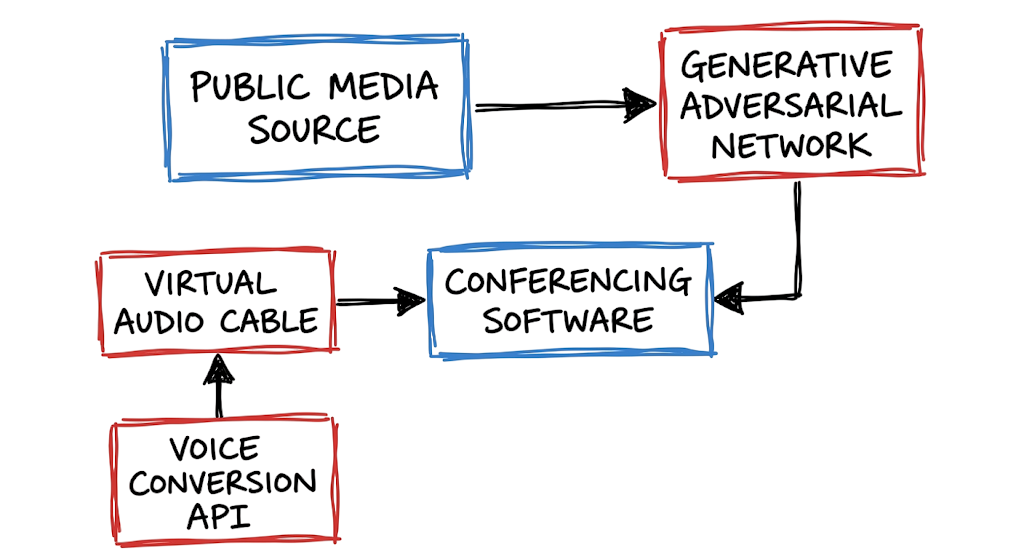
Key Components Behind Deepfake Voice Cloning Technology
- Neural Text to Speech Engine: Converts typed text into natural sounding audio using a pre trained voice model.
- Generative Adversarial Network: A machine learning framework that pits two neural networks against each other to produce highly realistic synthetic faces.
- Virtual Audio Cable: Software that routes synthetic audio output directly into the microphone input of a communication application.
- Face Landmark Tracker: An algorithm that maps key points on a human face to synchronize synthetic facial expressions with real movements.
- Liveness Detection API: A defensive tool that analyzes video feeds for unnatural pulse rates or pixel distortions to catch synthetic media.
Real World Examples of Deepfake Voice Cloning Scams
When I was working on a client environment in Dubai for a major telecom company, the incident response team caught a strange sequence. We found a business email compromise deepfake audio hybrid attack. The attacker compromised an email account and sent a wire instruction. Immediately after sending the email they left a voicemail to confirm the request. Here is the exact log from the corporate VoIP server:
Plaintext
[2025-06-12 09:14:22] INCOMING_CALL
Source: +971-50-XXXXXXX (Spoofed via SIP Provider)
Destination: Ext 4041 (Finance Dept)
Duration: 00:00:18
Audio_Codec: G.711 PCMA
SIP_User_Agent: Asterisk PBX 16.2.1
Voice_Analysis_Flag: ANOMALY_DETECTED (Spectral discontinuity at 4.2s)
Status: ROUTED_TO_VOICEMAIL
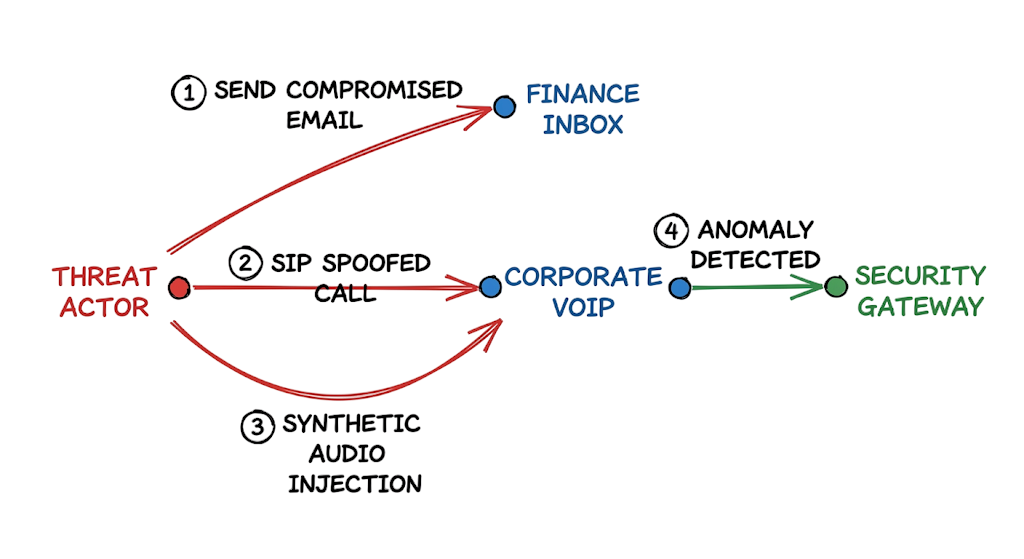
The VoIP security gateway flagged a spectral anomaly. The audio frequencies lacked the natural breath sounds a human produces. This log shows that the attacker used a SIP trunk to spoof the caller ID while injecting a synthetic audio file. You must implement SIP trunk validation and acoustic anomaly detection to catch these attempts early.
Practical Implementation of AI Voice Cloning Technology
If you want to know how to protect yourself from AI voice cloning scams and implement proper voice cloning phishing attacks prevention, you must enforce strict procedural controls.
- Configure aggressive call back protocols. If an executive asks for a money transfer over the phone you must hang up immediately. You then dial the exact number listed in the internal corporate directory.
- Deploy out of band verification channels. Mandate that any wire transfer above a specific threshold requires a secondary approval via a separate medium like a secure corporate messaging app.
- Implement strict identity verification for new vendors. Attackers often use synthetic voices to change payment details for known suppliers. You must require a video call with multiple stakeholders before altering any banking routing numbers.
- Sanitize public audio footprints. Restrict the amount of high quality audio your executives publish online. If a marketing video does not require the CEO to speak you should use a professional voiceover artist instead.
- Integrate biometric authentication tools. Use software that analyzes voice prints against known baselines to detect the micro frequency anomalies present in all synthetic audio generation.
- Run synthetic media tabletop exercises. You must simulate an attack on your finance team by hiring a penetration testing firm to clone the voice of your CFO and attempt to authorize a fake payment.
Advantages of Deepfake Voice Cloning Technology
Modern deepfake face swap detection tools can help organizations identify suspicious video content and detect low-quality impersonation attempts. Many detection platforms analyze facial movements, blinking frequency, lip synchronization, lighting conditions, and digital artifacts that may indicate manipulated media.
These solutions are particularly effective against amateur attackers who use basic face-swapping software or poorly trained AI models. In many cases, detection engines can identify unnatural facial expressions, inconsistent shadows, or mismatched head movements.
However, organizations should understand the limitations of relying solely on automated detection. In real-world environments, identifying sophisticated deepfakes is far more challenging than laboratory demonstrations suggest.
Video conferencing platforms such as Zoom, Microsoft Teams, and Google Meet compress audio and video streams to reduce bandwidth consumption. This compression process can remove many of the subtle visual artifacts that deepfake face swap detection tools depend on for analysis.
As AI technology continues to improve, attackers can generate increasingly realistic synthetic media. High-performance GPUs and advanced generative models can produce content that appears natural to both humans and some existing detection systems.
For this reason, organizations should not depend exclusively on deepfake detection software. A layered security strategy is far more effective than a single technical control.
Best practices include multi-factor authentication, out-of-band verification, dual approval processes for financial transactions, employee awareness training, and strict identity verification procedures. These controls help reduce the risk of deepfake voice cloning scams, real time face swapping scams, and CEO fraud using deepfake audio.
The most effective defense combines technology with human verification. Even when detection tools fail to identify manipulated content, strong operational procedures can prevent attackers from achieving their objectives.
Common Mistakes That Make Organizations Vulnerable to Deepfake Fraud
This is where most people get confused. Engineers assume that a visual inspection will reveal aOne of the biggest misconceptions about deepfake video scams targeting businesses is that fake videos are easy to identify. Many engineers and employees believe they can detect a deepfake simply by looking for blurry edges, distorted faces, or obvious visual defects.
In reality, modern deepfake technology has improved significantly. High-quality AI models can generate realistic facial movements and expressions that appear natural during a standard video conference.
Most business meetings take place at 720p or compressed video resolutions. Under these conditions, many visual artifacts become difficult or impossible to notice. As a result, visual inspection alone is no longer a reliable defense against real time face swapping scams.
Another common mistake is trusting caller identification. Attackers can spoof phone numbers and communication channels to make calls appear legitimate. This technique is frequently used alongside deepfake voice cloning scams to increase credibility and deceive victims.
Organizations also make the mistake of treating synthetic media attacks as purely technical problems. They invest heavily in detection software while overlooking the human factors that often determine whether an attack succeeds.
Technology can help identify suspicious activity, but human verification remains essential. If an employee feels uncomfortable questioning an executive’s request, even the most advanced security tools may fail to prevent fraud.
This is why effective protection against CEO fraud using deepfake audio requires both technical controls and strong operational procedures. Multi-factor authentication, callback verification, dual approval processes, and employee awareness training remain critical defenses against modern AI-powered impersonation attacks.
Best Practices: How to Protect Yourself from AI Voice Cloning Scams
Learning how to protect yourself from AI voice cloning scams requires more than installing advanced cybersecurity software. Organizations should adopt a Zero Trust approach to human communication, especially when handling financial transactions, executive approvals, confidential information, or sensitive customer data. Understanding how deepfake voice cloning scams work helps security teams implement controls that stop these attacks before they succeed.
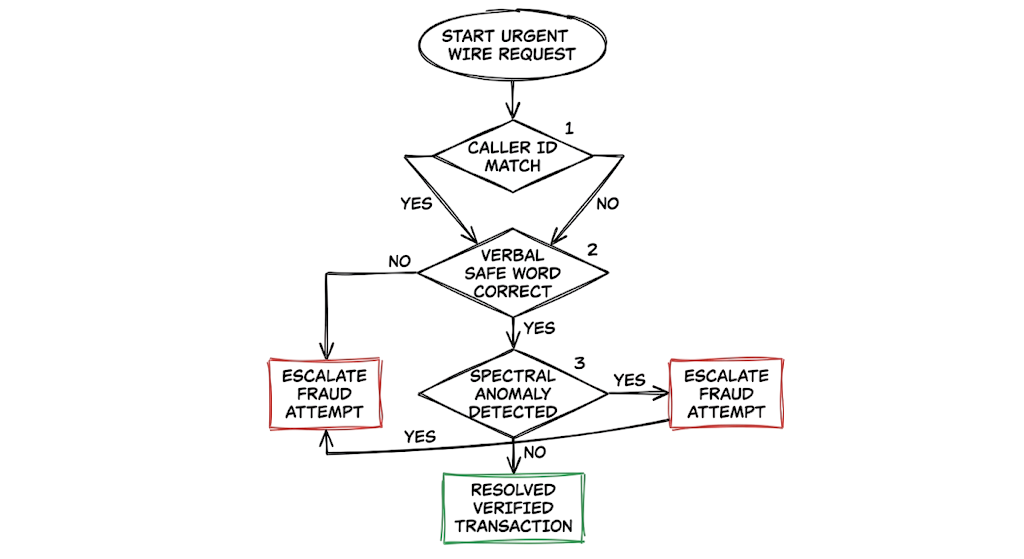
One of the most effective defenses against CEO fraud using deepfake audio is implementing a verbal verification process for senior leadership. Executives can use pre-established authentication phrases, unique verification codes, or secure callback procedures during high-risk communications. Employees should always verify these requests through a trusted communication channel before approving urgent wire transfers, changing payment details, or sharing sensitive information.
Organizations should also strengthen their defenses against deepfake technology used in financial fraud by continuously monitoring public websites, social media platforms, threat intelligence feeds, and underground forums for signs that executive voices, images, videos, or AI models are being abused. Early detection can prevent attackers from using synthetic media in targeted fraud campaigns.
Security teams must update their incident response plans to address how deepfake voice cloning scams work, executive impersonation attempts, CEO fraud using deepfake audio, and other AI-generated fraud scenarios. Clear procedures should define how employees report suspicious communications, preserve evidence, investigate incidents, and escalate confirmed attacks.
Employees should know how to protect yourself from AI voice cloning scams by recognizing warning signs such as unexpected payment requests, urgent executive instructions, or voice calls requesting confidential information. Rapid reporting and verification can significantly reduce the impact of AI-powered social engineering attacks, including real time face swapping scams and synthetic media extortion attempts.
Regular cybersecurity awareness training is equally important. Finance teams, executives, HR personnel, customer support staff, and IT administrators should understand how deepfake voice cloning scams work, recognize real time face swapping scams, and identify deepfake technology used in financial fraud before attackers can exploit human trust.
Organizations should also align security controls with industry regulations, cybersecurity frameworks, and data protection laws. Combining technical safeguards, employee awareness, multi-factor verification, and continuous monitoring creates a stronger defense against CEO fraud using deepfake audio, real time face swapping scams, and other threats driven by deepfake technology used in financial fraud.
By understanding how deepfake voice cloning scams work and implementing these best practices, organizations and individuals can significantly improve how to protect yourself from AI voice cloning scams, reduce the risk of executive impersonation, and defend against the growing use of deepfake technology used in financial fraud.
Deepfake Voice Cloning Scam Detection and Troubleshooting Scenario
Troubleshooting Scenario: Deepfake KYC Fraud Detection
Symptom
An automated onboarding platform flags a new customer registration as suspicious during the Know Your Customer (KYC) verification process. The system reports a biometric mismatch while performing live video identity verification.
Common Mistake
A security analyst assumes the alert was triggered by poor lighting conditions, network instability, or a low-quality webcam. To accelerate customer onboarding and meet operational targets, the analyst manually overrides the warning and approves the application.
Root Cause
The alert is actually associated with an active deepfake KYC fraud detection event. An attacker is attempting to bypass identity verification controls using AI-generated video, face-swapping technology, or synthetic identity techniques.
Investigation Process
The analyst should immediately pause the onboarding workflow and begin a detailed review of the verification session. This includes examining the raw video stream, authentication logs, device information, and connection metadata.
Special attention should be given to the video source. Many AI face swap identity theft attempts rely on virtual camera software that injects manipulated video into the verification platform. Security teams should investigate whether the session originated from a known virtual camera driver or media injection tool.
Actual Fix
If virtual camera activity or synthetic media indicators are detected, the registration should be treated as a confirmed fraud attempt and blocked immediately.
To reduce future risk, organizations should implement controls that prevent virtual camera drivers from interacting with the onboarding platform. Additional verification checks should be applied to high-risk registrations.
A stronger long-term defense is to require identity verification through a native mobile application. Mobile environments provide greater control over camera access and make video injection attacks significantly more difficult than browser-based onboarding processes.
Prevention Best Practices
Organizations should combine deepfake KYC fraud detection capabilities with device fingerprinting, liveness detection, behavioral analytics, mobile attestation, and manual fraud review procedures. This layered approach helps identify synthetic identities before fraudulent accounts are created.
Organizations should implement strong authentication controls such as Multi-Factor Authentication (MFA) to reduce the risk of deepfake impersonation attacks.
Link: https://technaga.com/multi-factor-authentication-mfa-guide-2026/
INTERVIEW QUESTIONS
Q: What is the primary difference between a replay attack and a voice cloning attack?
A: A replay attack uses a static previously recorded audio file. A voice cloning attack generates entirely new sentences in real time using a neural network trained on the victim.
Q: Why do attackers combine business email compromise with synthetic audio?
A: Employees are highly trained to spot suspicious emails. Attackers use a synthetic phone call immediately after sending the email to bypass employee skepticism and force immediate action.
Q: How do you verify the authenticity of a caller without relying on caller ID?
A: You hang up and execute a manual call back using the verified number from your internal directory. You also use pre arranged secure pass phrases.
Q: Which frequencies typically reveal synthetic audio?
A: Synthetic audio models often struggle with high frequency breath sounds and natural vocal cord friction. Spectral analysis tools flag these missing organic frequencies.
Q: How does video compression aid an attacker during a live video scam?
A: Compression algorithms group and smooth pixels to reduce bandwidth. This smoothing process hides the digital artifacts and unnatural blending lines that would otherwise expose the face swap.
FUTURE TRENDS (2026 AND BEYOND)
We will see a massive rise in fully autonomous social engineering agents. Attackers will deploy language models connected to voice cloning interfaces that can hold interactive phone conversations with thousands of targets simultaneously. Regulatory bodies are already noticing this shift. Frameworks like Saudi SAMA will likely mandate cryptographically signed video streams for all remote banking sessions. We will also see a sharp increase in localized synthetic media extortion scams where attackers fabricate compromising videos of regional business leaders and demand cryptocurrency to delete the files.
FAQ
Q: How to detect deepfake voice calls without specialized software?
A: Listen for an unnatural cadence, a lack of breathing sounds, or a perfectly quiet background. You should also ask a highly specific question that only the real person would know to break the attacker script.
Q: Are attacks using synthetic voices common against small businesses?
A: Yes. Attackers target businesses of all sizes because the tools are now incredibly cheap and accessible. Small businesses often lack the procedural controls to stop unauthorized wire transfers.
Q: What is the most effective deepfake technology used in financial fraud?
A: Attackers primarily use real time voice conversion models paired with caller ID spoofing. This combination effectively bypasses human verification processes at the helpdesk or accounts payable level.
Q: Can antivirus software block these attacks?
A: No. These attacks manipulate human trust rather than exploiting software vulnerabilities on an endpoint. You need procedural controls and biometric analysis to stop them.
Q: What should you do if you realize you transferred money to a scammer?
A: You must immediately contact your bank to freeze the transfer. Then notify your internal security team and preserve all call logs and emails for law enforcement.
CONCLUSION
The rapid growth of artificial intelligence is making deepfake voice cloning scams, face-swapping attacks, and synthetic media fraud more accessible than ever. Organizations can no longer rely on traditional trust models where a familiar voice, video call, or caller ID is treated as proof of identity.
As attackers continue to improve their techniques, businesses must rethink how they verify identity and approve high-risk transactions. Every critical request should be validated through multiple layers of authentication rather than a single communication channel.
Understanding how deepfake voice cloning scams work is the first step toward building effective defenses. Security teams should implement callback verification procedures, dual-approval workflows, employee awareness training, and zero trust communication practices.
Financial transactions, account changes, and sensitive requests should never be authorized solely through a phone call, video meeting, or voice message. Even the most convincing executive voice can now be artificially generated.
The most resilient organizations combine technology, process controls, and human verification to defend against CEO fraud using deepfake audio, deepfake video scams targeting businesses, and other AI-powered impersonation attacks.
Start by reviewing your wire transfer approval process today. If a single phone call can authorize the movement of company funds, your organization remains vulnerable to modern deepfake fraud. Strong verification procedures implemented now can prevent significant financial and reputational damage in the future.
For readers who want additional background information on the history, development, and applications of deepfake technology, the Wikipedia Deepfake article provides a useful overview.
To strengthen your understanding of identity verification, fraud prevention, and modern cybersecurity defenses, explore these guides:
- Multi-Factor Authentication (MFA): Critical Guide to Secure Your Systems (2026)
https://technaga.com/multi-factor-authentication-mfa-guide-2026/ - Zero Trust Security in 2026: Architecture, Real Examples, and Implementation Guide
https://technaga.com/zero-trust-security-2026-guide/ - Identity and Access Management in 2026: A Practical Guide for Cloud Security Professionals
https://technaga.com/identity-and-access-management-cloud-security-2026/ - 15 Common Online Scams in India: Complete Guide 2026
https://technaga.com/tech-naga-com-online-scams-india-2026-guide/ - Top 10 Cybersecurity Best Practices for 2026
https://technaga.com/top-10-cybersecurity-best-practices-2026/
External References
For additional information on deepfake technology, artificial intelligence, and cybersecurity frameworks, refer to:
- NIST Artificial Intelligence Resources
https://www.nist.gov/artificial-intelligence - CISA Artificial Intelligence Resources
https://www.cisa.gov/artificial-intelligence - MITRE ATT&CK Framework
https://attack.mitre.org - Microsoft Security Blog
https://www.microsoft.com/security/blog/ - Deepfake Technology Overview (Wikipedia)
https://en.wikipedia.org/wiki/Deepfake