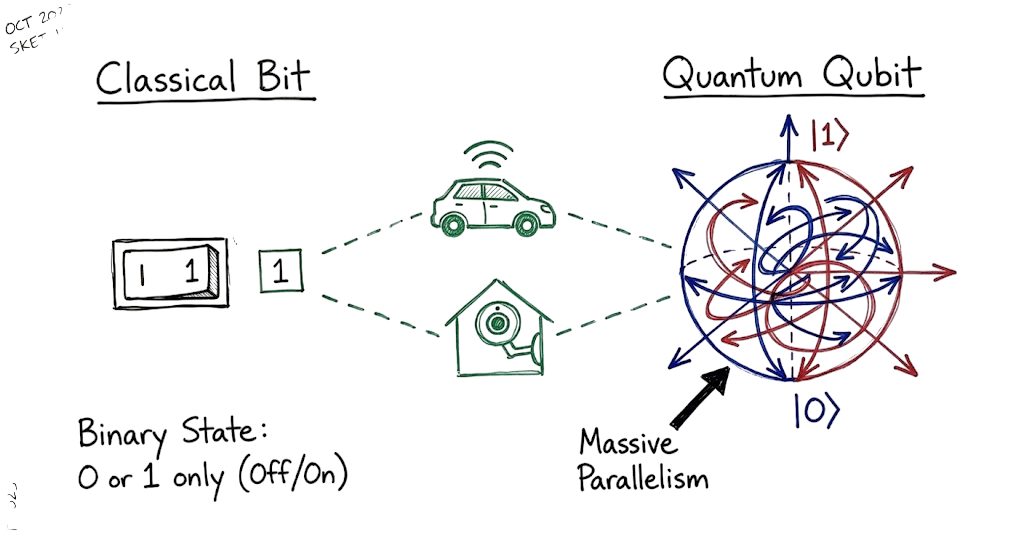
Quantum computing is a new computing technology that processes information differently from traditional computers such as laptops and smartphones. Instead of relying only on binary bits (0s and 1s), quantum computers use qubits, allowing them to solve certain complex problems much faster than classical computers.
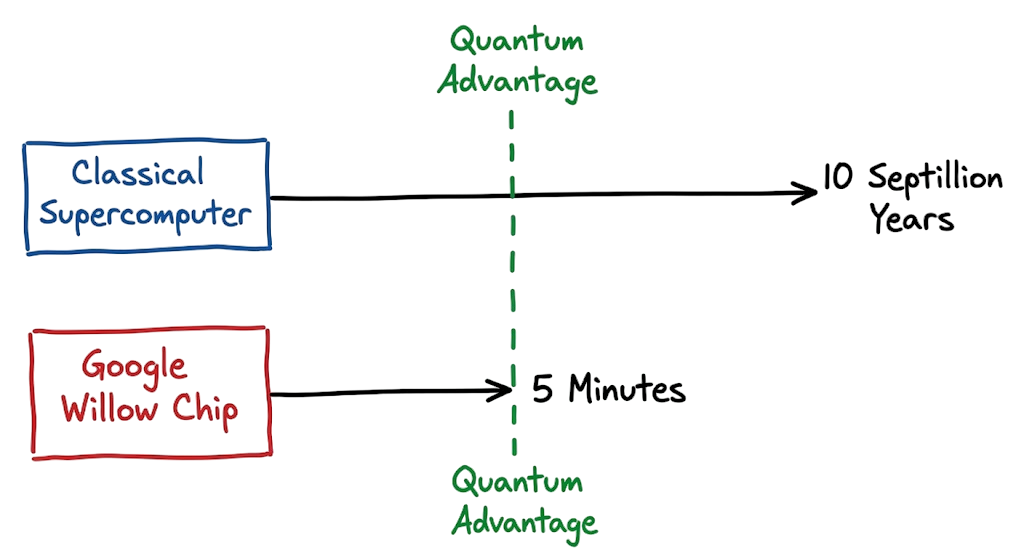
In late 2024, Google introduced its Willow quantum chip, which completed a specialized benchmark task in less than five minutes. According to Google, a comparable classical supercomputer would require approximately 10 septillion years to perform the same benchmark. This milestone demonstrates the potential of quantum computing to solve problems that are currently impractical for conventional computers.
Understanding quantum computing is becoming increasingly important because it has the potential to transform many industries, including cybersecurity, cryptography, healthcare, finance, and scientific research. As quantum technology advances, organizations will need to prepare for new security challenges, especially in the Internet of Things (IoT), where billions of connected devices rely on current encryption methods to protect sensitive data.

Traditional computers use bits to process and store information. A bit can have only one of two values: 0 or 1. Every application, website, image, and file on your computer is ultimately represented using these binary values. While this approach is highly effective for everyday computing, some complex scientific and mathematical problems require an enormous amount of processing power.
Quantum computing uses a different unit of information called a qubit (quantum bit). Unlike a classical bit, a qubit can exist in multiple states because of the principles of quantum mechanics. This unique capability allows quantum computers to process certain calculations much more efficiently than traditional computers.
Understanding how qubits work is becoming increasingly important because quantum computing has the potential to break some of today’s encryption methods. As organizations adopt Internet of Things (IoT) devices and cloud technologies, preparing for the impact of quantum computing will play a key role in protecting sensitive data and strengthening future cybersecurity.
The Core Principles of Qubits
A qubit can exist in multiple states at the same time, a property known as superposition. Unlike a classical bit, which can only be 0 or 1, a qubit has a probability of being both 0 and 1 simultaneously until it is measured. Once measured, the qubit collapses into a single state, either 0 or 1.
Another fundamental concept in quantum computing is entanglement. This occurs when two or more qubits become linked, causing their quantum states to be correlated. A change in the state of one entangled qubit is reflected in the other, even when they are separated by large distances. This unique property enables quantum computers to perform highly complex calculations much more efficiently than classical computers.
The combination of superposition and entanglement gives quantum computers their exceptional computational power. While a traditional computer evaluates one possible solution at a time, a quantum computer can process many possibilities simultaneously. This capability makes quantum computing especially useful for solving complex mathematical and scientific problems that would take classical computers years or even centuries to complete.
These advances are particularly important for cybersecurity because many modern encryption algorithms rely on mathematical problems that are difficult for classical computers to solve. As quantum computers continue to evolve, they may eventually be able to break some of today’s widely used encryption methods. For this reason, researchers and organizations are developing post-quantum cryptography to protect sensitive data, cloud services, and Internet of Things (IoT) devices from future quantum-powered attacks.

The Hardware Behind Quantum Computing

Building a quantum computer is one of the biggest engineering challenges in modern technology. Qubits are extremely sensitive to changes in their environment. Even small amounts of heat, vibration, or electromagnetic interference can disrupt their quantum state. This loss of quantum information is known as decoherence, and it is one of the primary obstacles to building reliable quantum computers.
To minimize decoherence, quantum processors operate inside specialized dilution refrigerators that cool the hardware to temperatures close to absolute zero (around -273°C or 0 Kelvin). These systems are even colder than outer space, creating the stable environment required for qubits to perform complex quantum calculations.
Researchers have developed several technologies for building qubits, each with its own strengths and limitations. IBM and Google primarily use superconducting qubits, which offer high processing speeds but require sophisticated error correction because they are more susceptible to noise. Other companies, such as IonQ, use trapped-ion qubits, where individual ions are suspended and controlled using lasers. These qubits generally provide greater stability and accuracy but perform operations more slowly than superconducting systems.
Quantum computing is also expanding globally. In April 2026, India launched the Amaravati Quantum Valley, a major initiative to accelerate quantum research, innovation, and workforce development. The facility includes Amaravati 1S, a superconducting quantum test bed hosted by SRM University-AP, featuring components manufactured in India. This initiative demonstrates how quantum computing is moving beyond research laboratories into practical development, helping countries prepare for the future of quantum technology and cybersecurity.
Real-World Scenario: Protecting Digital Assets
The rapid advancement of quantum computing has raised important concerns about the security of today’s cryptographic systems. Many widely used encryption methods, including Elliptic Curve Cryptography (ECC), protect sensitive information such as cryptocurrency wallets, secure websites, and digital signatures. These algorithms are considered secure against classical computers but could become vulnerable as large-scale quantum computers mature.
In recent years, researchers have used quantum algorithms and simulations to study how future quantum computers might affect the security of Bitcoin and other blockchain technologies. Their findings suggest that sufficiently powerful, fault-tolerant quantum computers could eventually break the cryptographic algorithms that protect digital wallets and encrypted communications much faster than classical computers. Although today’s quantum hardware is not yet capable of performing such attacks at scale, the research highlights the need to prepare for the future.
To address this challenge, governments, technology companies, and cybersecurity experts are actively developing post-quantum cryptography (PQC). These new cryptographic algorithms are designed to resist attacks from both classical and quantum computers, helping organizations protect sensitive data, financial systems, cloud services, and Internet of Things (IoT) devices in the coming quantum era.
Security Risks in the Age of Quantum Computing
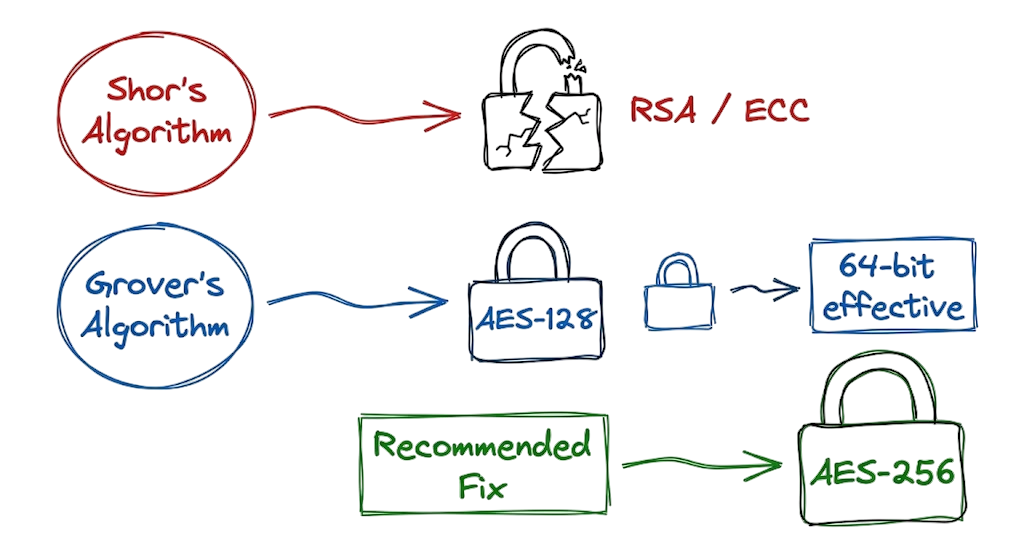
Two quantum algorithms are particularly important because of their potential impact on modern cryptography and cybersecurity: Shor’s algorithm and Grover’s algorithm.
Shor’s algorithm poses the greatest threat to public-key cryptography. It can efficiently solve mathematical problems such as integer factorization and the discrete logarithm problem, which form the foundation of widely used encryption algorithms like RSA, Elliptic Curve Cryptography (ECC), and Diffie-Hellman. While these problems are extremely difficult for classical computers, a sufficiently powerful, fault-tolerant quantum computer running Shor’s algorithm could solve them much faster, making current public-key encryption vulnerable.
Grover’s algorithm affects symmetric encryption in a different way. Instead of completely breaking encryption, it speeds up brute-force key searches by providing a quadratic improvement over classical search methods. As a result, algorithms such as AES remain secure but require longer encryption keys to maintain the same level of protection against future quantum attacks. For example, AES-256 is widely considered more resistant to quantum attacks than AES-128.
These quantum algorithms are the primary reason governments, security researchers, and technology companies are investing in post-quantum cryptography (PQC). New quantum-resistant encryption standards are being developed to protect sensitive data, financial systems, cloud services, and Internet of Things (IoT) devices from future quantum-enabled threats.
One of the most significant long-term risks posed by quantum computing is the “Harvest Now, Decrypt Later” (HNDL) attack. In this scenario, attackers intercept and store encrypted data today, even though they cannot currently decrypt it. Their goal is to preserve the stolen information until sufficiently powerful quantum computers become available to break existing encryption algorithms.
This threat is especially relevant for Internet of Things (IoT) devices, healthcare systems, financial institutions, and government organizations that transmit sensitive data expected to remain confidential for many years. If this information is protected using encryption algorithms that are vulnerable to future quantum attacks, it could eventually be exposed.
For example, an attacker who compromises an IoT gateway may capture large volumes of encrypted network traffic and transfer the data to an external server for long-term storage. Although the encrypted files remain unreadable with today’s computing technology, they could become accessible in the future if quantum computers are capable of breaking the underlying cryptographic algorithms.
To reduce this risk, organizations should begin planning their migration to post-quantum cryptography (PQC), identify systems that rely on vulnerable encryption methods, and prioritize quantum-resistant security solutions for long-lived sensitive data. Preparing early helps protect critical information against both current and future cyber threats.
Moving Toward NIST Standards and Solutions
To address the security challenges posed by quantum computing, researchers have developed Post-Quantum Cryptography (PQC). The goal of PQC is to create cryptographic algorithms that remain secure against attacks from both classical computers and future quantum computers. Leading this global effort is the National Institute of Standards and Technology (NIST), which has selected several quantum-resistant algorithms as part of its post-quantum cryptography standardization program.
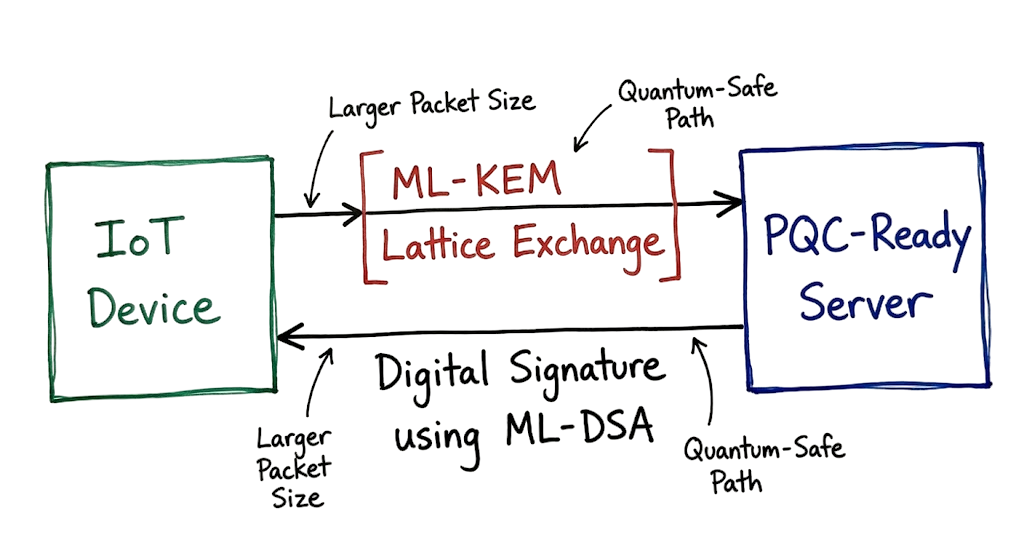
Among the selected standards are ML-KEM (Module-Lattice-Based Key Encapsulation Mechanism) for secure key exchange and ML-DSA (Module-Lattice-Based Digital Signature Algorithm) for digital signatures. These algorithms rely on lattice-based cryptography, a mathematical approach that is currently believed to be resistant to both classical and quantum attacks. Unlike traditional algorithms such as RSA and Elliptic Curve Cryptography (ECC), lattice-based cryptography is specifically designed to withstand future quantum threats.
Migrating to post-quantum cryptography will require updates to software, hardware, and security protocols. This transition can be particularly challenging for Internet of Things (IoT) devices because many endpoints have limited processing power, memory, and battery capacity. Organizations should begin assessing their infrastructure now to ensure future compatibility with quantum-resistant security standards.
Another important concept is cryptographic agility, which refers to the ability to replace or upgrade cryptographic algorithms without redesigning an entire system. By implementing cryptographic agility, organizations can quickly adopt stronger encryption standards as new threats emerge or security recommendations evolve. Conducting regular cryptographic assessments, identifying systems that rely on vulnerable algorithms, and planning a phased migration to PQC are essential steps for protecting sensitive data in the quantum era.
Steps to Prepare Your IoT Network
- Identify all devices using RSA or ECC encryption.
- Assess which data needs protection for more than five years.
- Test your network for the larger key sizes used in PQC.
- Update your firmware to support NIST-approved algorithms.
- Monitor your vendors for their quantum-safe roadmaps.
The Future of Quantum Advantage
We are currently in the era of quantum advantage. This means quantum machines can beat supercomputers at specific tasks. Microsoft has reached major milestones in building logical qubits. These qubits are better because they have error correction. This allows them to run longer and more complex programs.
As hardware improves, we will see new uses for this tech. It will help us design better batteries for electric cars. It will help us find new medicines faster. For your IoT projects, it could optimize traffic flow in smart cities. The benefits are large, but the security risks are just as big.
You do not need a degree in physics to get ready. You just need to stay informed about the standards. Follow the progress of the National Quantum Mission. Watch how regions like Amaravati are building their infrastructure. Being an early learner gives you an edge in the job market. It also keeps your network safe.
Quantum City – Amaravati
India’s first “Quantum City” – Amaravati – has come into existence with the inauguration of the Amaravati Quantum Valley on World Quantum Day (April 14, 2026). This quantum valley is part of India’s National Quantum Mission and strives to make Andhra Pradesh a center for deep tech innovation and quantum hardware fabrication.
Amaravati Quantum Valley Inauguration
Chief Minister of Andhra Pradesh, N. Chandrababu Naidu inaugurated Amaravati Quantum Valley on World Quantum Day by launching two quantum computers in an open-access testbed mode to help validate hardware and software developments.
Technical Infrastructure
The primary technical components of Amaravati’s quantum ecosystem include two “testbeds”:
- Amaravati 1S (SRM University-AP): A superconducting quantum reference facility developed by the start-up Qubit Force. It works in near zero temperatures (-273 degrees Celsius) and can execute precise quantum operations with higher fidelity.
- Amaravati 1Q (Medha Towers, Gannavaram): An indigenous quantum computer set up by the start-up CubiTech. It provides an accessible facility for executing quantum algorithms and testing quantum circuitry.
- Made in India: It is a proud achievement to see that more than 85 percent of all components of these quantum machines including cryogenics, dilution refrigerators, ultra-low noise power supply units, cryogenic wiring, control electronics etc., have been indigenously developed with contributions from TIFR, IISc, and DRDO.
Research & Academic Institutions
India’s premier educational institutions are playing an essential role as the brains of the Quantum Valley:
- SRM University-AP: Hosting 1S test-bed, it has set up the SRM Qkrishi Quantum Information and Computation Center. Besides offering special BTech courses, the university has also initiated research modules in the field of quantum cryptography and quantum algorithms.
- VIT-AP University: With a quantum AI Department, the institution conducts various training courses on quantum foundation, Qiskit programming, and mixed quantum-classical models.
- Practical Applications: Scientists and researchers working at these testbeds have already started applying quantum techniques to solve various regional problems. For example, they are finding optimal locations to position ambulances for the State’s health department or simulating molecules to develop drugs.
Industry Partnerships & Project Scaling
The State Government has made various MoU signings with global & Indian tech giants:
- IBM & TCS Collaboration: There are plans to establish IBM’s 156-qubit quantum computer “Heron Processor”. It will be the most advanced quantum computer in India
- Quantum Valley Funding: The goal of the project is to secure $1 billion investments by 2029 and create an entrepreneurship culture based on QaaS (Quantum as a Service).
- Future Scale-Up Plans: Currently capable of handling quantum devices up to 111 qubits, the plan is to increase it up to one million qubits within a decade.
Summary of Amaravati’s Quantum Ecosystem
| Feature | Details |
| Primary Hubs | SRM University-AP & Medha Towers |
| Indigenous Startups | Qubit Force, Qubitech, QUTE Electronics |
| Key Partners | IBM, TCS, L&T, IISc, TIFR, DRDO |
| Unique Feature | Open-Access Test Beds (anyone in India can request to run algorithms) |
| Target Investment | $1 Billion USD |
Conclusion
Understanding quantum computing is the first step in a long journey. This technology uses qubits and superposition to solve hard problems. It offers a massive speedup that leads to a quantum advantage over today’s machines. But it also creates a major risk for your current security stack. You must start planning for a quantum-safe future today.
Review your encryption and look at NIST standards. Make sure your IoT devices can handle the transition to PQC. By taking these steps, you protect your data from future attackers. Stay curious and keep learning about this shifting world of technology. Quantum computing is no longer science fiction. It is a tool you will use to build the next generation of secure systems.
- What Is Cybersecurity and Why It Is Important Today
https://technaga.com/what-is-cybersecurity-and-why-it-is-important-today/ - Complete Network Security Basics Guide for Beginners 2026
https://technaga.com/what-is-networks-and-network-security-basics-2026/ - What Is Firewall in Cybersecurity? Types, Examples and How It Works
https://technaga.com/what-is-firewall-in-cybersecurity-types-examples-and-how-it-works/
External References
- NIST Post-Quantum Cryptography Project
https://csrc.nist.gov/projects/post-quantum-cryptography - NIST FIPS 203 (ML-KEM Standard)
https://csrc.nist.gov/pubs/fips/203/final - NIST FIPS 204 (ML-DSA Standard)
https://csrc.nist.gov/pubs/fips/204/final - IBM Quantum Learning
https://www.ibm.com/quantum - Google Quantum AI
https://quantumai.google/ - Microsoft Azure Quantum
https://azure.microsoft.com/products/quantum - Cloudflare Blog: Post-Quantum Cryptography
https://blog.cloudflare.com/tag/post-quantum-cryptography/ - CISA: Post-Quantum Cryptography Resources
https://www.cisa.gov/resources-tools/resources/post-quantum-cryptography - NIST Computer Security Resource Center
https://csrc.nist.gov/ - National Security Agency (NSA) Cybersecurity Information
https://www.nsa.gov/Cybersecurity/
Note: This content is written based on my personal research and practical understanding. Before applying any concepts or configurations in real-world scenarios, make sure to verify the details from official documentation or trusted sources.


1 thought on “What Is Quantum Computing in Simple Terms? Powerful Beginner’s Guide (2026)”